All species › Passerines › New World sparrows › Bay-crowned Brushfinch
Bay-crowned Brushfinch | Atlapetes seebohmi
Roodkruinstruikgors | Atlapetes de Seebohm | Tico-tico-de-coroa-baia
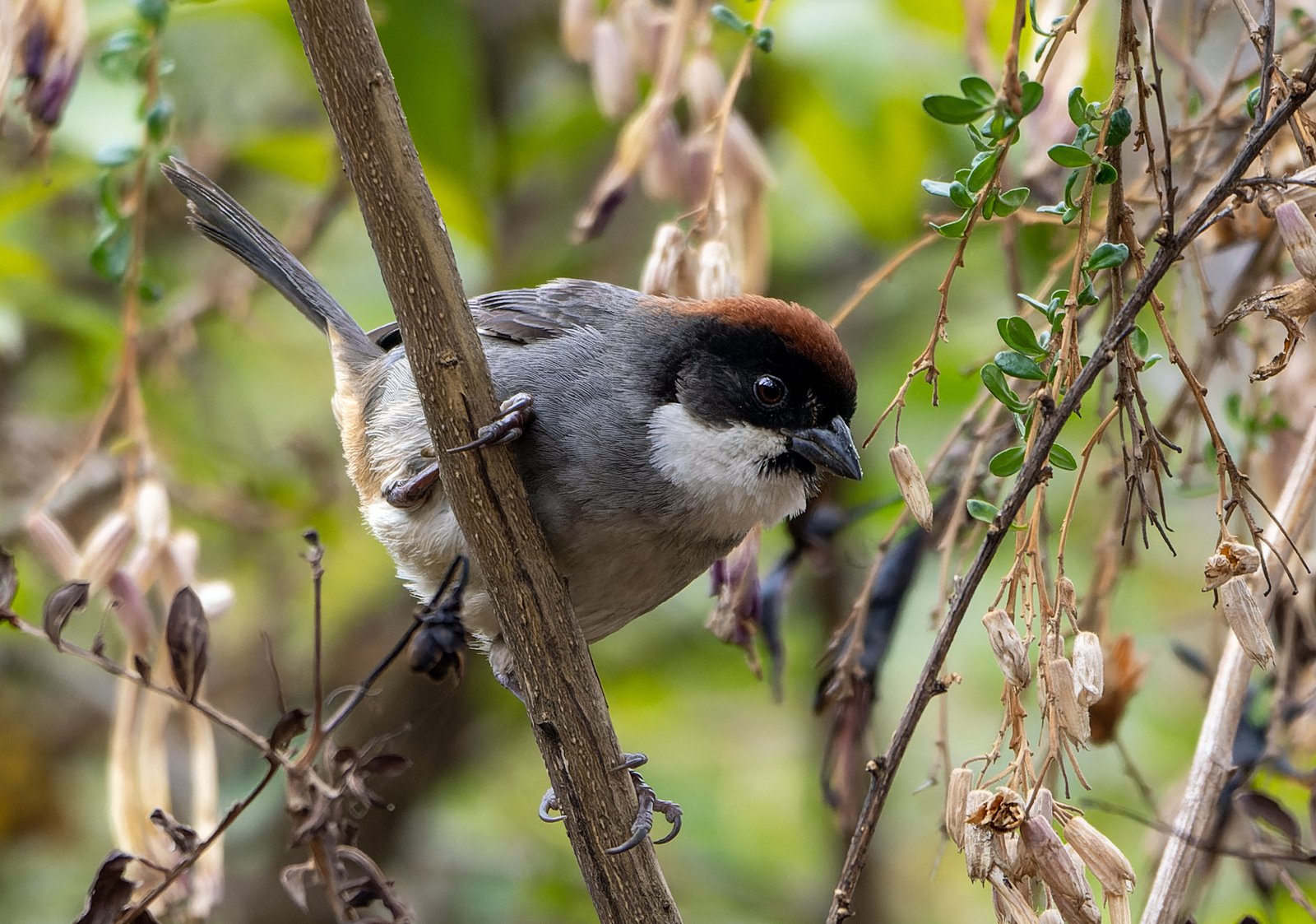
The Bay-crowned Brushfinch is a grey brushfinch with a deep rufous crown from the scrub of the Pacific slope in southern Ecuador and north-western Peru. It belongs to the group of brushfinches of the Tumbesian region and lives in pairs low in shrubbery and at forest edges.
Voice
The song is a fast series of chew notes ending in a short trill or buzz. The main call is a high tseep; in alarm a repeated, sharp peet or put.
Recording: Paul Coopmans — CC BY-NC-SA 4.0 · xeno-canto
Identification
16–17 cm. In the southern nominate form the forehead is black and the crown and nape deep rufous; the northern form simonsi has a rufous forehead and a white spot above the lores. The face is black, with a broad white lower cheek. The upperparts are olive-grey, darker grey in simonsi. The throat is white, with a pale grey breast band below; the rest of the underparts are whitish to pale grey. The sexes are alike. Juveniles are browner above and buff below, with faint streaks.
Confusion species
White-winged Brushfinch Atlapetes leucopterus has a white wing patch and whiter underparts without a grey breast band. White-headed Brushfinch Atlapetes albiceps has much white on the head and face. Yellow-breasted Brushfinch Atlapetes latinuchus has yellow underparts.
Habitat
Montane scrub and the undergrowth and edges of montane woodland, in Ecuador roughly between 1300 and 2300 m, in Peru between 1150 and 2800 m. It forages in pairs low in the vegetation and on the ground for insects and seeds.
Where the bird is most at home, classified by the vegetation units of the Andes and the west coast.


Range and movements
In Ecuador in the south, mainly in Loja (form simonsi). In Peru on the Pacific slope of the Andes from the Ecuadorian border south to Ancash. Absent from Colombia, Bolivia and the Galápagos. Does not occur outside the guide area.
- Resident
- dark = core range, pale = thinly spread
How and when to look
Search shrubby ravines and forest edges on the western slope of northern Peru and in Loja; pairs give their fast song in the early morning. The grey breast band below the white throat separates it from White-winged Brushfinch in the same area.
Conservation status
Least Concern. The range is restricted, but the population is considered stable and no direct threats are known.
Scientific name
Atlapetes seebohmi | (Taczanowski, 1883)
Taczanowski described the species in 1883 as Carenochrous seebohmi; because it was later moved to another genus, the author and year stand in brackets. The genus Atlapetes was introduced in 1831 by Wagler. The genus name comes from Greek: the mythical titan Atlas and petēs, 'flyer'. The species name honours Henry Seebohm (1832–1895), English steel manufacturer and amateur ornithologist. The specimen the first description was based on came from Cajacay, Áncash, Peru.