All species › Passerines › New World sparrows › Rusty-bellied Brushfinch
Rusty-bellied Brushfinch | Atlapetes nationi
Roestbuikstruikgors | Atlapetes ventrirrufo | Tico-tico-de-barriga-ferrugínea
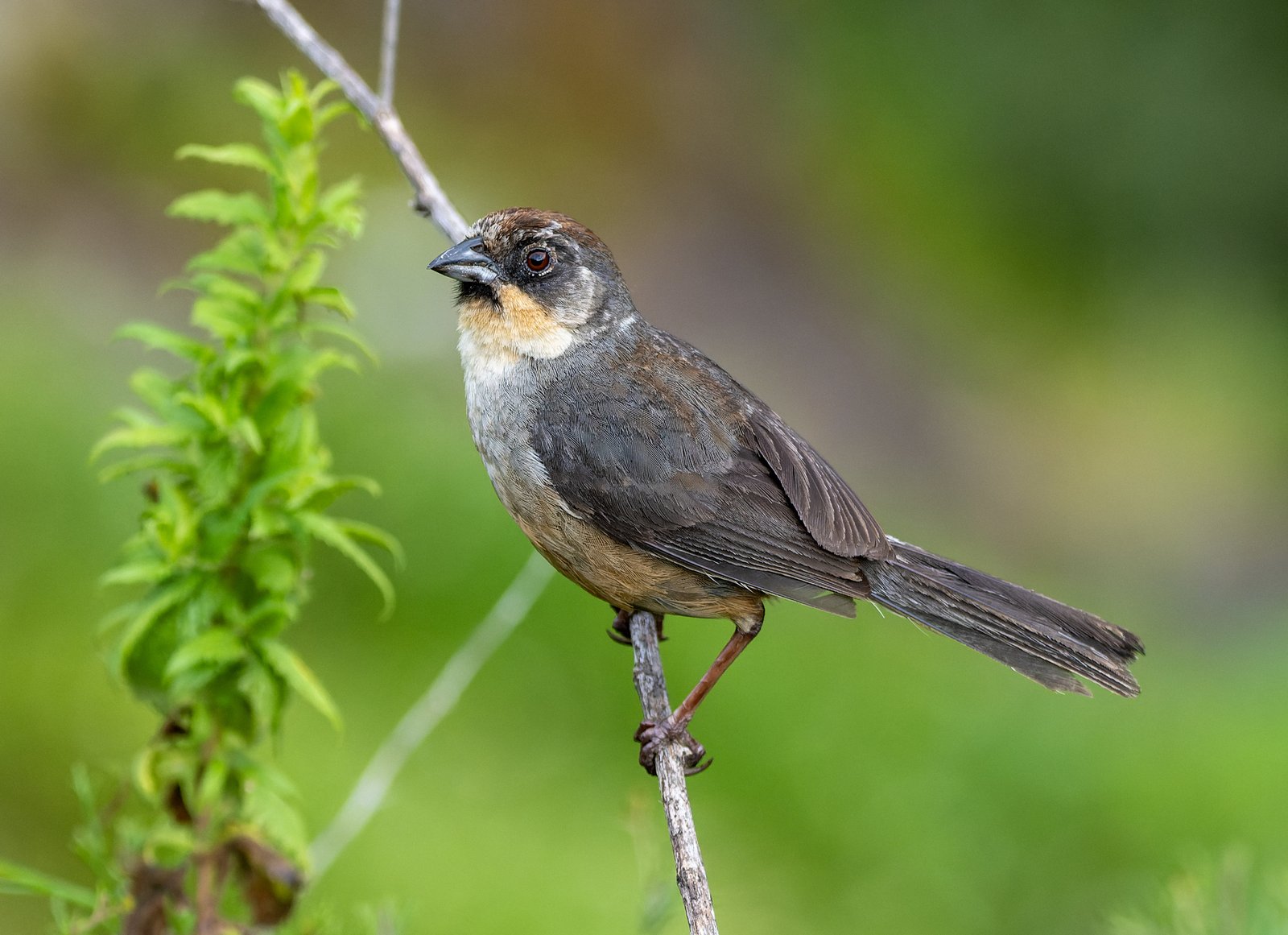
The Rusty-bellied Brushfinch is a large grey brushfinch with a cinnamon belly from the dry scrub of the western slope of the Andes in central and southern Peru. It occurs only in Peru. Pairs and family groups feed on or just above the ground.
Voice
The song is poorly described. Calls are a hard, rich tchi and a high ti; excited pairs duet with a rapid, simple chatter.
Recording: Herman van Oosten — CC BY-NC-SA 3.0 · xeno-canto
Identification
17–19 cm, large and heavy for a brushfinch. The nominate form has a black forehead, a dark olive crown and a black face with a broad white lower cheek. The upperparts are lead-grey, the throat is white, the breast band grey and the rest of the underparts cinnamon to ochre. The southern form brunneiceps is paler, with olive-grey upperparts, an indistinct breast band and a tawny to dark buff throat and underparts, sometimes with white speckles on the crown and face. The sexes are alike. Juveniles are browner above and have buff-streaked underparts.
Confusion species
Apurimac Brushfinch Atlapetes forbesi lives further east and has a rufous head and grey underparts without cinnamon. Black-spectacled Brushfinch Atlapetes melanopsis in the Mantaro Valley has an orange-rufous head with a large black patch around the eye. Rufous-collared Sparrow Zonotrichia capensis is smaller, with a streaked back and a rufous collar. Peruvian Sierra Finch Phrygilus punensis has a grey hood and olive-yellow underparts and lives more in open terrain.
Habitat
Dry montane scrub, shrubby ravines, hedgerows along fields and small patches of woodland on the western slope of the Andes, between about 2100 and 4000 m. It forages on or just above the ground in the vegetation for insects and seeds, usually in pairs or small family groups.
Where the bird is most at home, classified by the vegetation units of the Andes and the west coast.


Range and movements
Only in Peru, on the western slope of the Andes. The nominate form in Lima department; brunneiceps from southern Lima south to Arequipa. Absent from Colombia, Ecuador, Bolivia and the Galápagos. Does not occur outside the guide area.
- Resident
- dark = core range, pale = thinly spread
How and when to look
Search the shrubby valleys above Lima, such as the Santa Eulalia valley, in the early morning; pairs give themselves away by their hard calls and often forage under bushes along the road.
Conservation status
Least Concern. The population is thought to be declining, but no direct threats are known. Fairly common in central Peru, scarcer further south.
Scientific name
Atlapetes nationi | (Sclater, 1881)
Sclater described the species in 1881 as Buarremon nationi; because it was later moved to another genus, the author and year stand in brackets. The genus Atlapetes was introduced in 1831 by Wagler. The genus name comes from Greek: the mythical titan Atlas and petēs, 'flyer'. The species name honours William Nation, who provided the type specimen; he collected birds in Peru. The specimen the first description was based on came from western Andes above Lima, Peru.