All species › Swifts › Swifts › Lesser Swallow-tailed Swift
Lesser Swallow-tailed Swift | Panyptila cayennensis
Cayennegierzwaluw | Vencejo tijereta menor | Andorinhão-estofador
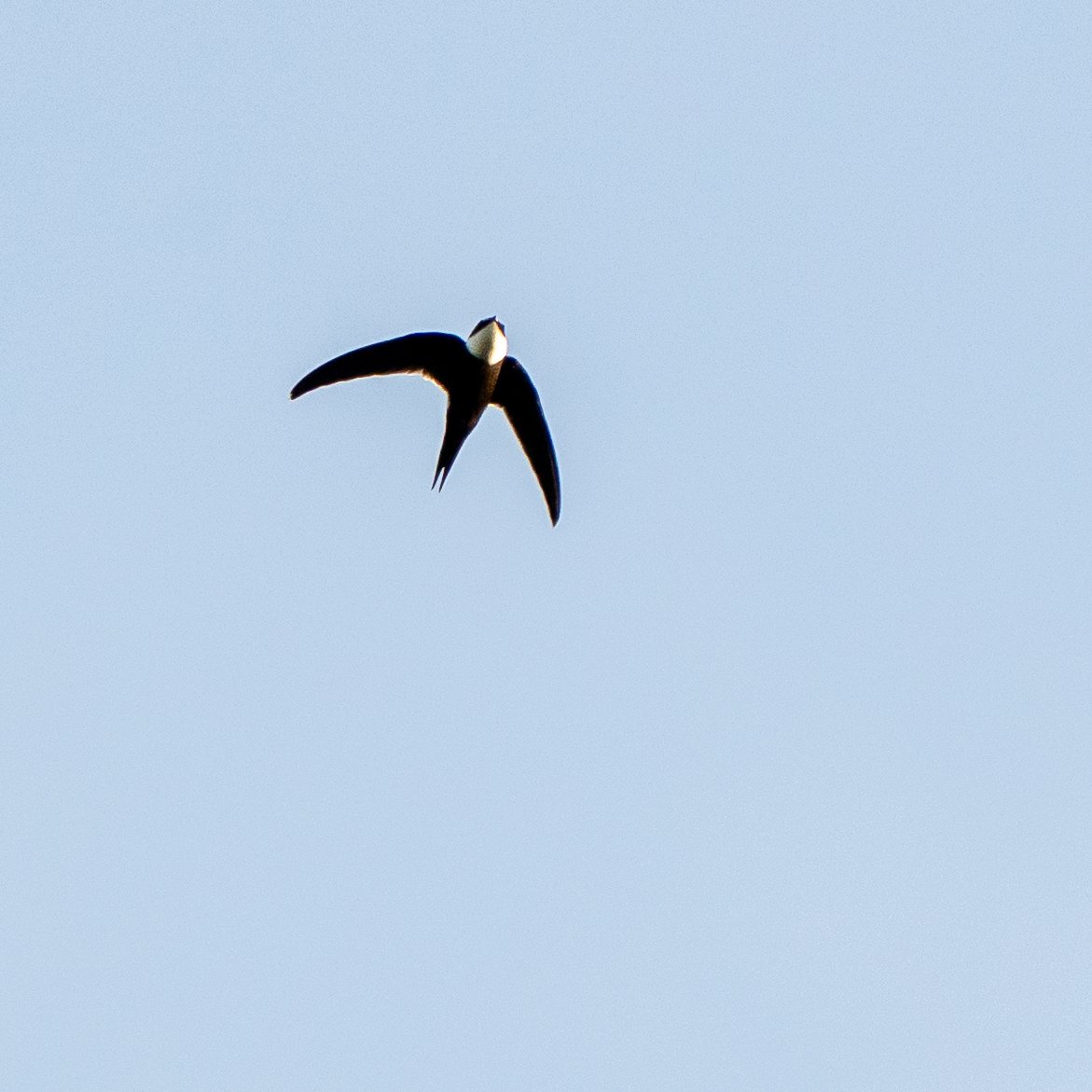
The Lesser Swallow-tailed Swift is a slender, black-and-white swift with a long, usually closed tail that projects behind the bird as a thin point. Its nest is a long, hanging tube of plant down and saliva, glued to a tree trunk, rock face or building, with the entrance at the bottom. It usually flies alone or in pairs, often high above the forest.
Voice
Usually silent. At the nest and in flight sometimes a high, thin, buzzy call.
Recording: Geoffrey Monchaux — CC BY-NC-SA 4.0 · xeno-canto
Identification
13 cm, with narrow, slightly curved wings and a long, deeply forked tail that opens when turning. The plumage is black, with a white throat and upper breast that continue as a narrow white collar across the nape, a white patch on the rear flanks and a narrow white edge to the inner secondaries. The sexes are alike.
Confusion species
Fork-tailed Palm Swift Tachornis squamata is smaller and browner, with a greyish-white throat and belly and no collar. White-tipped Swift Aeronautes montivagus has a white throat and white flank patches, but no collar and a shorter, less forked tail, and lives higher in the mountains. White-collared Swift Streptoprocne zonaris is much larger, with a short tail.
Habitat
Humid lowland forest, forest edges, clearings, riverbanks and villages, also the foothills up to about 1000 m, locally higher. It hunts flying insects in the air, often high above the canopy. The tubular nest, often several tens of centimetres long, hangs from a tree trunk, an overhanging rock or a building.
Where the bird is most at home, classified by the vegetation units of the Andes and the west coast.


Range and movements
In Colombia in the Pacific, northern and Amazonian lowlands and the Magdalena valley. In Ecuador in the western and eastern lowlands and foothills. In Peru in the eastern lowlands and foothills. In Bolivia in the northern lowlands. Absent from the high Andes, the dry coastal regions and the Galápagos. Outside the guide area from southern Mexico through Central America to Venezuela, the Guianas and Brazil.
- Resident
- dark = core range, pale = thinly spread
How and when to look
Look for the birds high above forest edges and rivers, often singly or in pairs; the long, pointed tail and the white collar are then the main features. A nest tube under a bridge or eave sometimes indicates a regular site.
Conservation status
Least Concern. The species is widespread and also uses buildings and bridges as nest sites.
Scientific name
Panyptila cayennensis | (Gmelin, 1789)
Gmelin described the species in 1789 as Hirundo cayennensis; because it was later moved to another genus, the author and year stand in brackets. The genus Panyptila was introduced in 1847 by Cabanis. The genus name combines Greek panu, 'very', with ptilon, 'wing'. The species name refers to Cayenne in French Guiana, not necessarily the type locality. The specimen the first description was based on came from Cayenne, French Guiana.