All species › Passerines › Wrens › Mountain Wren
Mountain Wren | Troglodytes solstitialis
Bergwinterkoning | Cucarachero montañés | Corruíra-montanhesa
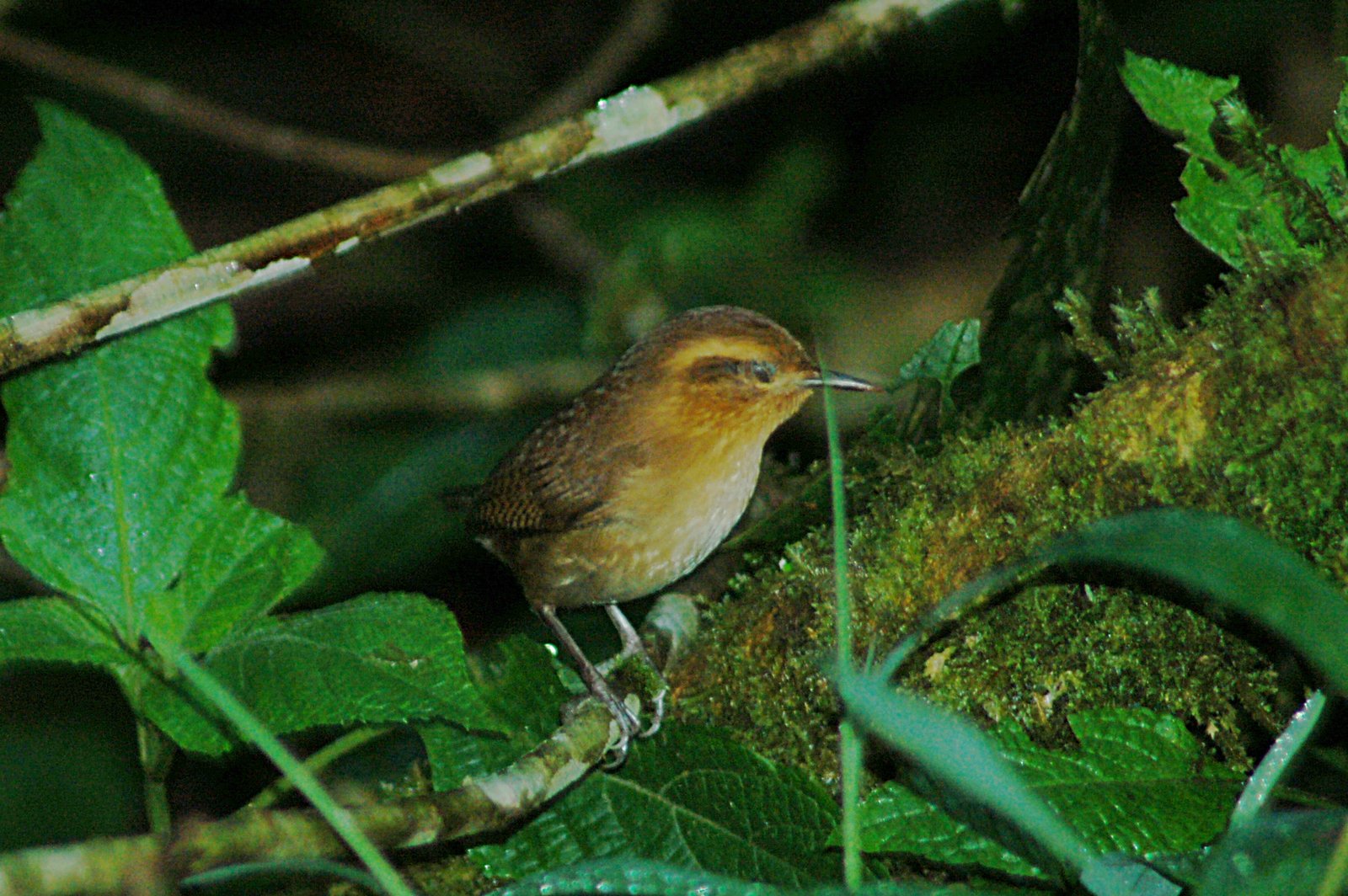
The Mountain Wren is a small, rufous-brown wren of the cloud forest and upper montane forest of the Andes. It forages among moss and epiphytes on branches, often higher in the trees than other wrens, and regularly joins mixed flocks. Southern birds, in Peru and Bolivia, have a much whiter belly than northern ones.
Voice
The song is a short, high, slightly trilling series of thin notes and trills, somewhat stuttering; the call is a dry chit or a short rattle.
Recording: Germán Darío Gallego Chica — CC BY-NC-SA 4.0 · xeno-canto
Identification
10–11 cm, with a short, thin bill and a short tail. The upperparts are warm rufous-brown, with dark barring on the wings and tail. A distinct buff supercilium contrasts with a dark eye-stripe. The throat and breast are buff to ochre, the belly paler, almost white in southern birds; the flanks are brown and the undertail coverts barred. The sexes are alike.
Confusion species
Southern House Wren Troglodytes musculus is larger and longer-tailed, with a vaguer supercilium, and lives in open country and around buildings. Santa Marta Wren Troglodytes monticola is greyer, with white underparts, and lives only high in the Sierra Nevada de Santa Marta. Grey-breasted Wood Wren Henicorhina leucophrys has a grey breast, a streaked cheek and a very short tail, and lives low in the undergrowth.
Habitat
Humid montane forest, cloud forest and their edges, also old secondary forest, mostly between 1800 and 3500 m. It creeps along mossy branches and trunks, from the middle levels up into the canopy, seeking insects and spiders among moss and epiphytes; often in mixed flocks. The nest is a domed structure in moss, a crevice or a cavity.
Where the bird is most at home, classified by the vegetation units of the Andes and the west coast.


Range and movements
In Colombia in all three Andean ranges and the Serranía de Perijá. In Ecuador on both slopes of the Andes. In Peru along the whole length of the eastern slope of the Andes and in the north also on the western slope. In Bolivia in the Yungas and the montane forest of the eastern slope. Absent from the Galápagos. Outside the guide area in Venezuela and north-western Argentina.
- Resident
- dark = core range, pale = thinly spread
How and when to look
In mixed flocks in cloud forest, look for a small, rufous-brown bird creeping along mossy branches; the thin, high song often comes from the canopy.
Conservation status
Least Concern. Common in suitable montane forest, but declining locally through deforestation.
Scientific name
Troglodytes solstitialis | Sclater, 1859
Sclater described the species in 1859 and placed it straight away in the genus where it still stands. The genus Troglodytes was introduced in 1809 by Vieillot. The genus name comes from Greek trōglodutēs, 'cave-dweller', after the wrens' habit of creeping into and nesting in cavities. The species name comes from Latin solstitialis, 'of summer' (from solstitium and sol, 'sun'); why Sclater chose this name is unclear. The specimen the first description was based on came from Riobamba, Chimborazo, Ecuador.