All species › Passerines › New World sparrows › White-headed Brushfinch
White-headed Brushfinch | Atlapetes albiceps
Witkopstruikgors | Atlapetes cabeciblanco | Tico-tico-de-cabeça-branca
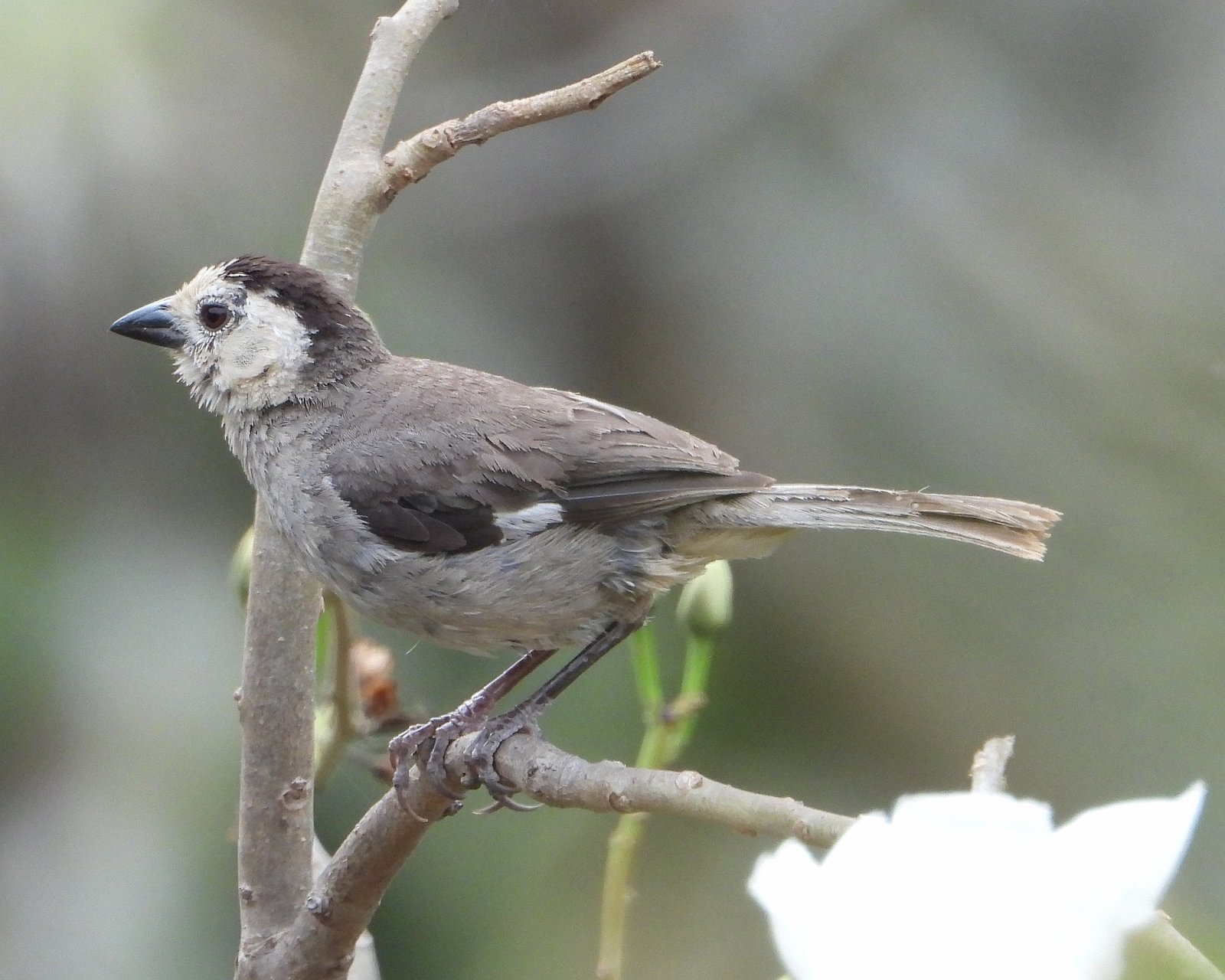
The White-headed Brushfinch is a grey brushfinch of the dry forests of the Tumbesian region in south-western Ecuador and north-western Peru. With its white face and black hindcrown it differs from most brushfinches, which live in humid montane forest. It lives in pairs close to the ground in dry thickets.
Voice
The song is a series of squeaky, whistled notes. Excited pairs give a liquid, descending chatter with high, shrill notes. Calls are a high rising and falling note, a high ti and tseeip.
Recording: Paul Coopmans — CC BY-NC-SA 4.0 · xeno-canto
Identification
16–17 cm, with a sturdy black bill and a fairly long tail. The forehead, face and throat are white; the hindcrown and nape are black. A thin black line separates the ear coverts from the throat. The upperparts are slate grey, the wings and tail slightly blacker; the white bases of the primaries form a white patch on the closed wing. The breast and flanks are grey, the belly and undertail coverts white. The sexes are alike. Juveniles are browner, with a less sharp head pattern.
Confusion species
Pale-headed Brushfinch Atlapetes pallidiceps has a pale, greyish-brown head without a black hindcrown and lives only in a small area in the dry Yunguilla valley in southern Ecuador, higher than White-headed Brushfinch. White-winged Brushfinch Atlapetes leucopterus also has a white wing patch, but a darker head with a rufous or blackish crown, and usually lives higher, in more humid scrub.
Habitat
Dry deciduous forest, dry scrub and riparian woodland along streams, roughly between 200 and 1400 m. It searches on and just above the ground, in leaf litter and low shrubs, for insects, other invertebrates and seeds. The nest is a cup in a shrub or low tree.
Where the bird is most at home, classified by the vegetation units of the Andes and the west coast.


Range and movements
In Ecuador only in the south-west, mainly in southern Loja province. In Peru on the Pacific slope in the north-west, south to Lambayeque and south-western Cajamarca. Absent from Colombia, Bolivia and the Galápagos. Does not occur outside the guide area.
- Resident
- dark = core range, pale = thinly spread
How and when to look
Search dry forest in south-western Loja, for example around Zapotillo, or the dry forests of Piura and Lambayeque in Peru. Pairs move low through the thickets; listen for their squeaky song in the early morning.
Conservation status
Least Concern. The range is small, and the population is probably declining through logging and grazing of the dry forest in the Tumbesian region.
Scientific name
Atlapetes albiceps | (Taczanowski, 1884)
Taczanowski described the species in 1884 as Buarremon albiceps; because it was later moved to another genus, the author and year stand in brackets. The genus Atlapetes was introduced in 1831 by Wagler. The genus name comes from Greek: the mythical titan Atlas and petēs, 'flyer'. The species name comes from Latin albus, 'white', and -ceps (from caput), 'head', for the white head. The specimen the first description was based on came from Paucal, Cajamarca, Peru.