All species › Passerines › New World sparrows › White-rimmed Brushfinch
White-rimmed Brushfinch | Atlapetes leucopis
Brilstruikgors | Atlapetes embridado | Tico-tico-de-anel-branco
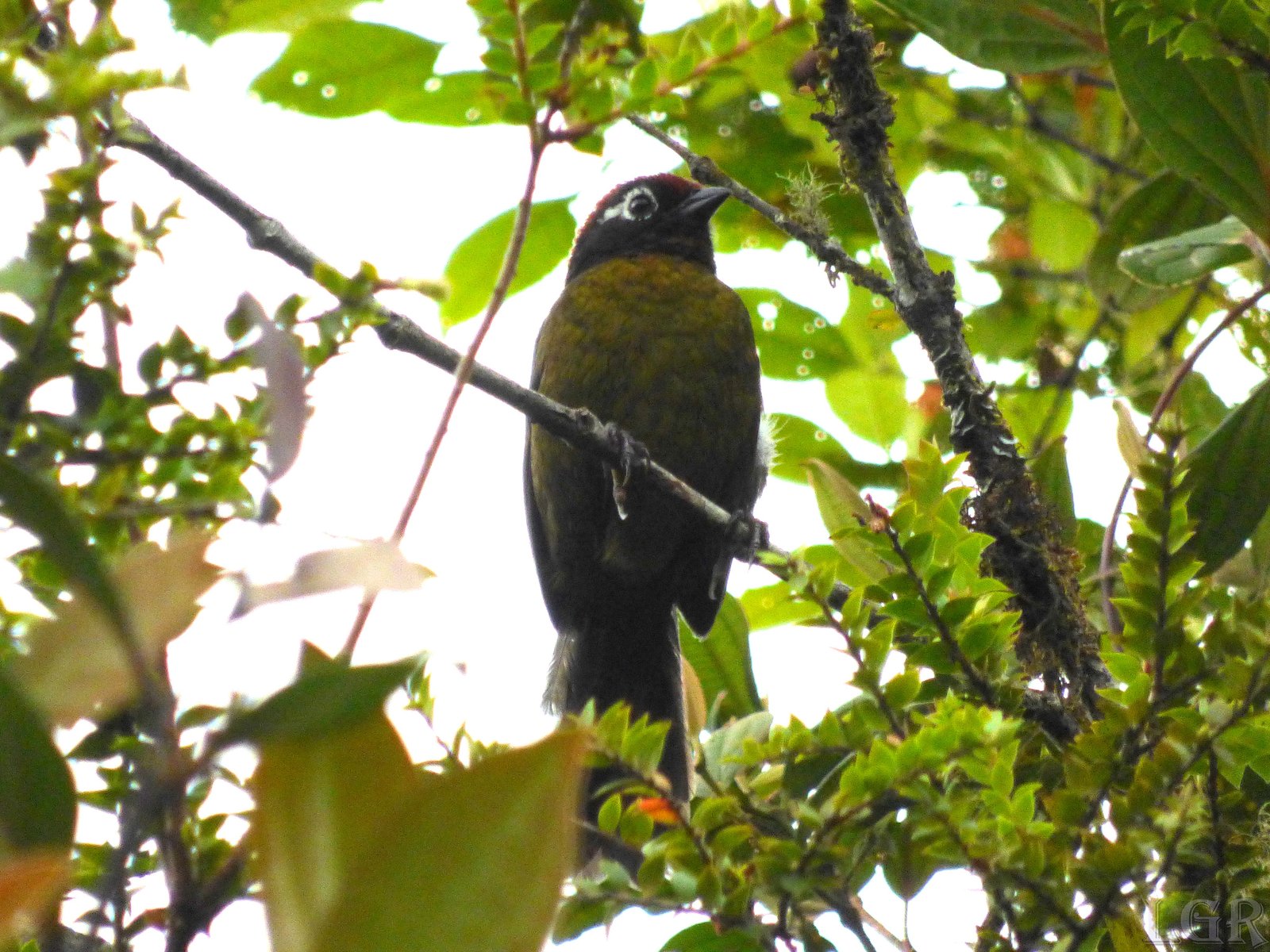
The White-rimmed Brushfinch is a large, dark brushfinch of high cloud forest in Ecuador and southern Colombia. Its name refers to the white eye-ring, which together with a short white stripe behind the eye forms spectacles. It lives hidden in dense undergrowth and bamboo and is very local and scarce over most of its range.
Voice
High, thin calls, roughly tseet, and a song of a few high, piercing whistles, often in duet.
Recording: Brayan Coral Jaramillo — CC BY-NC-SA 4.0 · xeno-canto
Identification
18–19 cm, large and sturdy, with a heavy, black bill. The crown and nape are chestnut; the face is black, with a white eye-ring and a short white stripe behind the eye. The upperparts are dark olive-green; the throat and underparts are dark olive-grey, slightly paler on the belly. The sexes are alike; juveniles are browner, with less distinct spectacles.
Confusion species
Chestnut-capped Brushfinch Arremon brunneinucha also has a chestnut crown, but has a white throat and a black breast band and no white eye-ring. Slaty Brushfinch Atlapetes schistaceus has a rufous crown, grey underparts and a white moustache and throat. Grey-browed Brushfinch Arremon assimilis has a black head with grey stripes and a white throat.
Habitat
Dense undergrowth of humid, mossy cloud forest and upper montane forest, often with Chusquea bamboo, and adjacent forest edges, roughly between 2200 and 3200 m. It searches on and just above the ground among leaves and moss for insects and seeds, usually in pairs. Little is known about the nest.
Where the bird is most at home, classified by the vegetation units of the Andes and the west coast.


Range and movements
In Colombia very locally in the south, in the Central Andes of Huila and Cauca and in Nariño. In Ecuador very locally in the Andes, mainly on the eastern slope. Not known with certainty from Peru; absent from Bolivia and the Galápagos. Does not occur outside the guide area.
- Resident
- dark = core range, pale = thinly spread
How and when to look
Search dense bamboo and undergrowth of high cloud forest on the eastern slope of the Ecuadorian Andes, early in the morning. The birds rarely come into the open; listen for their high whistles and watch for movement low in the bamboo.
Conservation status
Least Concern according to the current assessment, but the species is very local throughout its range. Clearance of high cloud forest is a threat.
Scientific name
Atlapetes leucopis | (Sclater & Salvin, 1878)
Sclater & Salvin described the species in 1878 as Buarremon leucopis; because it was later moved to another genus, the author and year stand in brackets. The genus Atlapetes was introduced in 1831 by Wagler. The genus name comes from Greek: the mythical titan Atlas and petēs, 'flyer'. The species name comes from Greek leukos, 'white', and ōps, 'eye', for the white eye-ring. The specimen the first description was based on came from Yanayacu (?), Ecuador.