All species › Hummingbirds and swifts › Swifts › American Black Swift
American Black Swift | Cypseloides niger
Zwarte gierzwaluw | Vencejo negro
The American Black Swift is a large, all-dark swift that in the Caribbean breeds on cliffs in the mountains and along the coast, often near waterfalls. The Caribbean birds belong to the nominate form Cypseloides niger niger. They are present mainly in the breeding season; where they spend the winter is not well known. North American breeders winter in western Brazil.

Voice
Usually silent. At the nest and in flocks a soft, sharp chipping or twittering, plik-plik-plik.
Recording: Richard E. Webster — CC BY-NC-SA 4.0 · shortened to the first 60 s, mono · xeno-canto
Identification
15–18 cm, large and entirely blackish, with long, fairly broad, sickle-shaped wings and a rather long tail, slightly forked in the male and square or slightly notched in the female. In good light a fine whitish frosting on the forehead may be seen. The underparts are hardly paler than the upperparts. Juveniles have white fringes to the underpart feathers. Flight is often gliding and less fluttering than in the smaller swifts.
Confusion species
White-collared Swift Streptoprocne zonaris is much larger and has a white neck band. Lesser Antillean Swift Chaetura martinica and Short-tailed Swift Chaetura brachyura are much smaller, with a pale rump and a short, spiny tail; Antillean Palm Swift Tachornis phoenicobia is small, with a white rump and belly. Chimney Swift Chaetura pelagica, a passage migrant, is smaller, with a paler throat and a short, stubby tail. Caribbean Martin Progne dominicensis has broader wings, a forked tail and a white belly, except the dark male Cuban Martin Progne cryptoleuca, which has broader, shorter wings.
Habitat
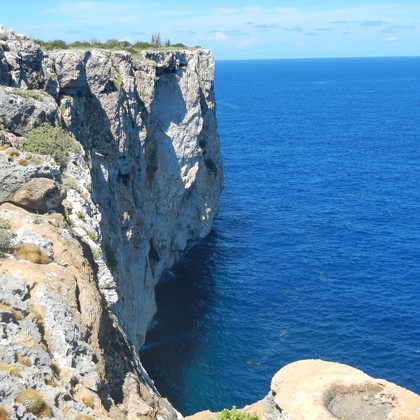
Feeds high over montane forest, cloud forest and valleys, but also over lowlands and the coast, especially in cloudy weather. It eats flying insects. It breeds on mountain cliffs, in gorges, beside or behind waterfalls and on sea cliffs; the nest is a cup of moss and plant material with mud on a damp, shaded ledge. The clutch is a single egg.
Where the bird is most at home, classified by the vegetation types of the Caribbean.




Range and movements
Breeds locally on Jamaica, Hispaniola (Haiti and the Dominican Republic), Puerto Rico and the mountainous islands of the Lesser Antilles, notably Guadeloupe, Dominica, Martinique, St Lucia and St Vincent. Rare and local on Cuba. Rare or vagrant on Trinidad and the other islands. Outside the region other forms from south-east Alaska to Costa Rica.
- Resident
- Summer visitor (c. Oct–Mar)
- Winter visitor (c. Apr–Sep)
- dark = core range, pale = thinly spread
How and when to look
On Puerto Rico in the mountains of El Yunque and Maricao, on Dominica and the other volcanic islands of the Lesser Antilles over the forested ridges, especially between April and August. Flocks often feed low ahead of rain and are then best identified by size, uniform black plumage and longer tail.
Conservation status
Vulnerable (VU). The global listing reflects mainly the decline of the North American breeding population. Caribbean birds are little studied; in Puerto Rico the species is regarded locally as vulnerable, and disturbance and habitat degradation around breeding sites are the main threats.
Scientific name
Cypseloides niger | (Gmelin, 1789)
Gmelin described the species in 1789 as Hirundo nigra; because it was later moved to another genus, the author and year stand in brackets. The genus Cypseloides was introduced in 1848 by Streubel. Cypseloides combines Cypselus, an old genus name for swifts (Greek kupselos), with Greek -oidēs 'resembling': 'swift-like'. niger is Latin for 'black', after the uniformly blackish plumage. The specimen the first description was based on came from Hispaniola.