All species › Flamingos › Flamingos › American Flamingo
American Flamingo | Phoenicopterus ruber
Rode flamingo | Flamenco del Caribe
The American Flamingo is the flamingo of the Caribbean, more deeply coloured than the other flamingos: pink to orange-red over head, neck and body. It breeds in colonies on a handful of remote salt flats, including Great Inagua in the Bahamas, Cuba and Bonaire, and wanders along the coasts from there. It is the national bird of the Bahamas.

Voice
Goose-like: a nasal, honking ka-ha, mainly in flight; feeding flocks give a low, continuous gabbling that swells into a loud din at a colony.
Recording: FREDERIC Lionel — CC BY-NC-SA 4.0 · shortened to the first 60 s, mono · xeno-canto
Identification
120–145 cm, with a very long neck and very long legs. Adults are pink to coral-red, brightest on head, neck and breast; the wing coverts are deep red and the flight feathers black, visible only in flight or with the wings spread. The bill is bent in the middle, with a pale base, a pink to orange central part and a black tip; the legs are pink. Juveniles are grey-brown with a pink wash, a grey bill with a black tip and grey legs, and only colour up after several years. It flies with neck and legs outstretched, in long lines or loose Vs.
Confusion species
With its shape it cannot be confused with anything in the region. Roseate Spoonbill Platalea ajaja is much smaller, with a shorter neck, a white neck in adults and a flat spoon-shaped bill. Scarlet Ibis Eudocimus ruber is scarlet, much smaller and has a long, curved bill. Escapes from collections may belong to other species: Greater Flamingo Phoenicopterus roseus is paler and whiter pink, and Chilean Flamingo P. chilensis has grey legs with red joints and a bill that is more than half black.
Habitat
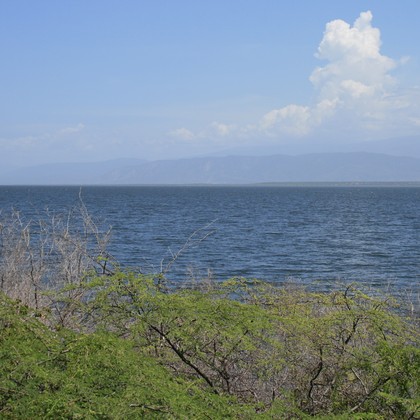
Shallow salt pans, saline and brackish coastal lagoons, tidal flats and shallow bays; locally also saline inland lakes, such as Lake Enriquillo on Hispaniola. It feeds walking with the head upside down in the water, filtering small crustaceans, molluscs, insect larvae and algae from water and mud with the bill. It breeds in dense colonies on bare mudbanks, where each pair builds a flattened cone of mud holding a single egg.
Where the bird is most at home, classified by the vegetation types of the Caribbean.


Range and movements
In the region most numerous in Cuba, with large breeding colonies along the north coast, among them the Río Máximo delta, and in the Bahamas, where the colony is on Great Inagua. On Bonaire it breeds in the Pekelmeer; on Curaçao and Aruba birds occur regularly. In the Turks and Caicos Islands it occurs regularly and may breed. On Hispaniola mainly around Lake Enriquillo and in coastal saline lagoons; whether it breeds there regularly is not clearly established. On Anegada in the British Virgin Islands the species was reintroduced in the 1990s and breeds there again. In Puerto Rico, Jamaica, the Cayman Islands, Trinidad and the Lesser Antilles an irregular visitor or vagrant. Beyond the region in Yucatán, along the coasts of Colombia and Venezuela, in the Galápagos and in smaller numbers in Florida.
- Resident
- dark = core range, pale = thinly spread
How and when to look
On Bonaire American Flamingos can be seen year-round in the salt pans in the south and at the Gotomeer; the breeding colony in the Pekelmeer is closed to visitors. In Cuba along the lagoons of the northern cays and in the saline lagoons of the Zapata Peninsula. In feeding flocks the difference between pink adults and grey-brown young birds can be seen.
Conservation status
Not threatened; the world population is increasing. In the twentieth century the species declined sharply in the region through hunting, egg collecting and disturbance of the colonies; on Great Inagua it had all but disappeared by about 1950, and after protection the colony recovered. Coastal development, salt extraction, sea-level rise, pollution and collisions with power lines are the current threats.
Scientific name
Phoenicopterus ruber | Linnaeus, 1758
Linnaeus described the species in 1758 and placed it straight away in the genus where it still stands. He introduced the genus Phoenicopterus in that same work. Phoenicopterus is Greek, from phoinix 'crimson' and pteron 'feather', thus 'red-feathered'. ruber is Latin for 'red', after this species' deep rose-red plumage. The specimen the first description was based on came from the West Indies.