All species › Passerines › Antthrushes › Black-faced Antthrush
Black-faced Antthrush | Formicarius analis
Zwartkeelmierlijster | Hormiguero cholino cara negra
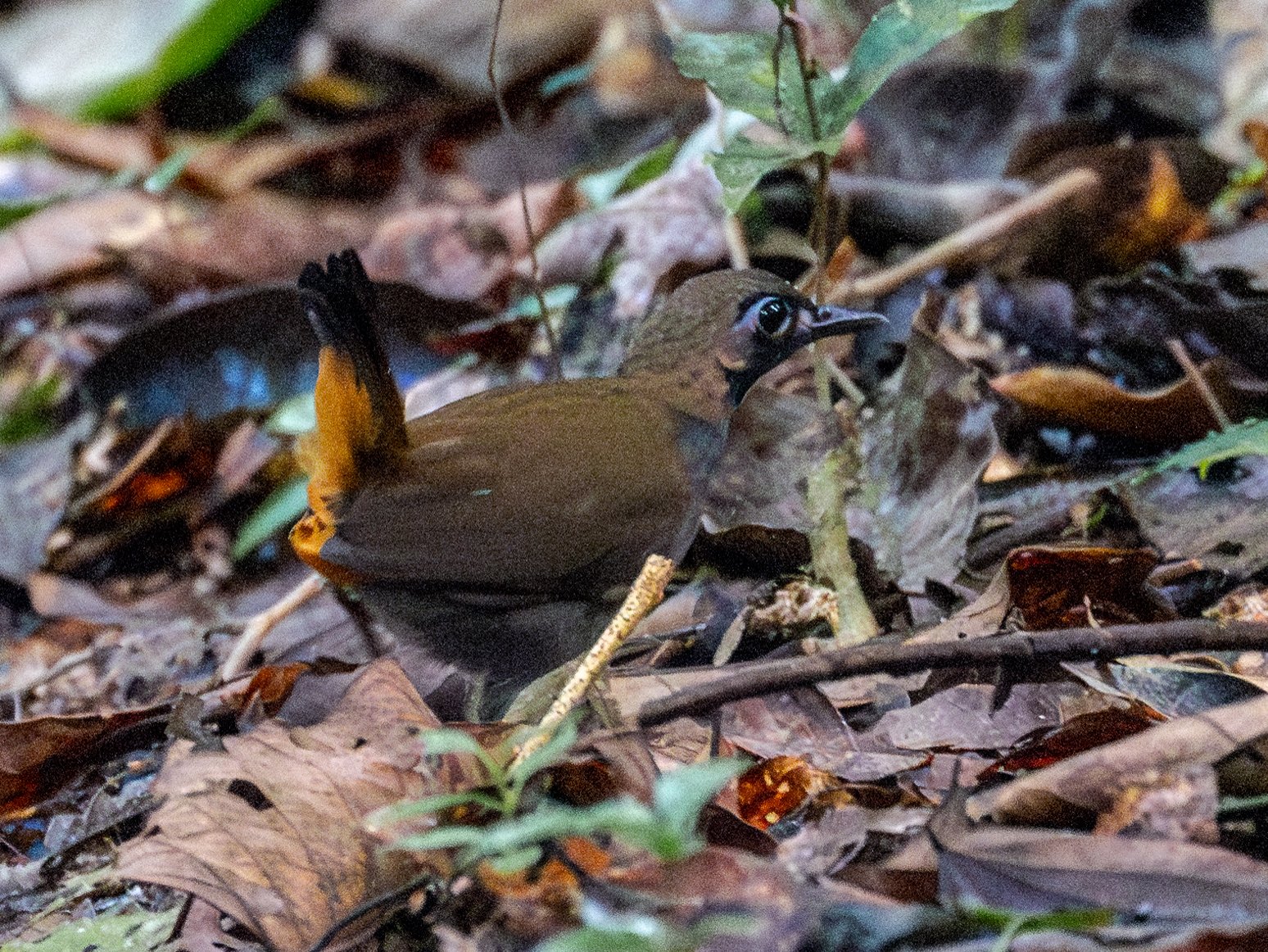
The Black-faced Antthrush is an antthrush, a forest-floor bird of the family Formicariidae, which in the Caribbean occurs only on Trinidad. It walks with measured steps over the leaf litter, its short tail cocked and bobbing, looking more like a small rail than a songbird. It is heard far more often than seen.
Voice
A clear, flat introductory whistle followed by a fast, slightly falling series of shorter whistles, something like tyooo, tu-tu-tu-tu-tu-tu. Birds often respond to an imitation of the song by coming closer. When alarmed a sharp chip.
Recording: Juan Freile — CC BY-NC-SA 4.0 · shortened to the first 60 s, mono · xeno-canto
Identification
17–19 cm, plump and rounded, with a short, constantly cocked tail, long legs and a straight black bill. Crown and upperparts are dark rufous-brown, the sides of the neck chestnut. Face, chin and throat are black, with a small white spot in front of the eye and a bare bluish eye-ring. Breast and belly are dark grey, paler towards the rear, and the undertail coverts are rufous. In flight an ochre band shows at the base of the flight feathers. The legs are dark. The sexes are alike.
Confusion species
Grey-throated Leaftosser Sclerurus albigularis also lives on the floor of the same forest, but has a pale grey throat, chestnut breast, rufous rump and a long thin bill, and does not walk with a cocked tail. White-bellied Antbird Myrmeciza longipes is rufous above with a white belly and pale legs, and forages mainly in dense undergrowth. Cocoa Thrush Turdus fumigatus is uniformly rufous-brown without a black throat, and hops rather than walks.
Habitat
Humid evergreen lowland and hill forest, including older secondary forest, with a deep litter layer and open undergrowth, from sea level to the higher parts of the Northern Range. It walks over the forest floor in search of insects, spiders and other small invertebrates, picked from among fallen leaves; it sometimes follows army ants. The nest is a cup of dead leaves in a cavity in a trunk or stump, usually low down.
Where the bird is most at home, classified by the vegetation types of the Caribbean.



Range and movements
In the Caribbean only on Trinidad, in the forests of the Northern Range and the larger forest tracts of the centre and south of the island; absent from Tobago. Outside the region from south-eastern Mexico through Central America to Colombia, Venezuela, the Guianas and Amazonia, south to Bolivia and Brazil.
- Resident
- dark = core range, pale = thinly spread
How and when to look
Early in the morning along quiet forest trails in the Northern Range, for example in the Arima Valley. The best approach is to stand still as soon as the whistled series is heard: the bird often walks into view across a trail or an open patch of forest floor, tail bobbing.
Conservation status
Not threatened. The species has a very large range, but depends on closed forest and disappears where forest is fragmented or heavily logged.
Scientific name
Formicarius analis | (d'Orbigny, ACVMD & de Lafresnaye, 1837)
D'Orbigny, ACVMD & de Lafresnaye described the species in 1837 as Myothera analis; because it was later moved to another genus, the author and year stand in brackets. The genus Formicarius was introduced in 1783 by Boddaert. Formicarius is Latin, from formica 'ant' with the suffix -arius: 'ant-bird'. analis is Latin for 'of the vent', after the rufous undertail coverts. The specimen the first description was based on came from Yuracarés and Chiquitos, Bolivia.