All species › Passerines › Ovenbirds and woodcreepers › Grey-throated Leaftosser
Grey-throated Leaftosser | Sclerurus albigularis
Grijskeelbladkrabber | Tirahojas gorgigrís
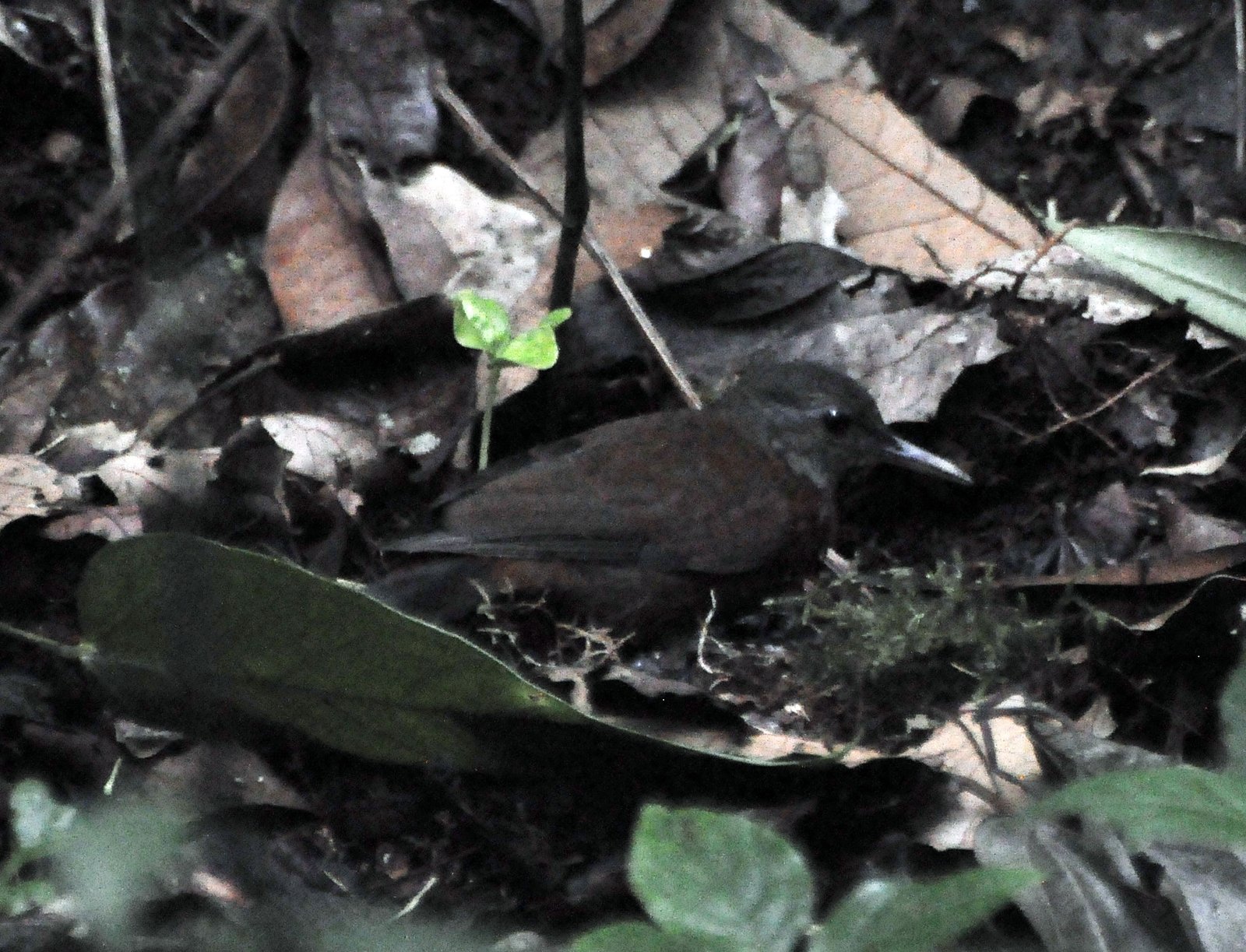
The Grey-throated Leaftosser is a dark, shy ovenbird of the forest floor. It owes its name to its feeding method: with quick sideways flicks of the bill it tosses fallen leaves aside to expose the prey beneath. In the Caribbean it lives only on Trinidad and Tobago, where it is local and secretive.
Voice
A series of four to six squeaky, plaintive, rising notes in groups of three. In alarm or when flushed a sharp cheek or chik-chik, often the first sign of the bird.
Recording: Brayan Coral Jaramillo — CC BY-NC-SA 4.0 · converted to mono · xeno-canto
Identification
16–18 cm, compact, with a short blackish tail and a long, straight, thin bill with a black upper and pale lower mandible. Crown and back are warm chestnut-brown; the rump is brighter rufous and contrasts with the dark tail. The face is greyish-brown and finely scaled. The throat is greyish-white with a dark lower border; the breast is deep rufous and the belly dark brown. The sexes are alike.
Confusion species
Black-faced Antthrush Formicarius analis shares the forest floor on Trinidad, but has a black throat, grey breast and a short, constantly cocked tail. Northern Waterthrush Parkesia noveboracensis, a winter visitor, is streaked below and has a pale supercilium; it bobs its tail and stays close to water. Cocoa Thrush Turdus fumigatus is larger and uniformly rufous-brown, lacking the pale throat and contrasting rump.
Habitat
Humid evergreen forest in hills and lower mountains, with open undergrowth and plenty of leaf litter, often in ravines and along streams. It forages alone or in pairs on the ground, turning leaves in search of insects, spiders and other invertebrates. It nests in a self-dug burrow in a steep earth bank, with a cup of leaves in a chamber at the end; on Trinidad nesting has been recorded from October to May.
Where the bird is most at home, classified by the vegetation types of the Caribbean.



Range and movements
In the Caribbean only on Trinidad and Tobago. On Trinidad uncommon in the forest of the Northern Range and a few other wooded hills. On Tobago rare and confined to the Main Ridge forest; it went unrecorded there for a long period and was reported as rediscovered in 1998. Outside the region in Costa Rica and Panama, in the mountains of Colombia and Venezuela and along the eastern slope of the Andes to Bolivia and south-western Amazonia.
- Resident
- dark = core range, pale = thinly spread
How and when to look
On Trinidad along shady forest trails in the Northern Range, where the sharp alarm call of a flushed bird is often the first clue. The rustle of tossed leaves on an otherwise silent forest floor gives away a feeding bird; patient waiting in one spot then usually produces a sighting.
Conservation status
Not threatened. Widely distributed over a large range. The species depends on undisturbed humid forest with a rich litter layer; on Tobago the population is small.
Scientific name
Sclerurus albigularis | Sclater & Salvin, 1869
Sclater & Salvin described the species in 1869 and placed it straight away in the genus where it still stands. The genus Sclerurus was introduced in 1827 by Swainson. Sclerurus is Greek, from sklēros 'stiff, hard' and oura 'tail', after the stiff tail feathers. albigularis is Latin, from albus 'white' and gula 'throat', after the pale throat. The specimen the first description was based on came from Venezuela (Cumbre de Valencia).