All species › Birds of prey › Hawks, eagles and kites › Black Hawk-Eagle
Black Hawk-Eagle | Spizaetus tyrannus
Zwarte kuifarend | Águila tirana
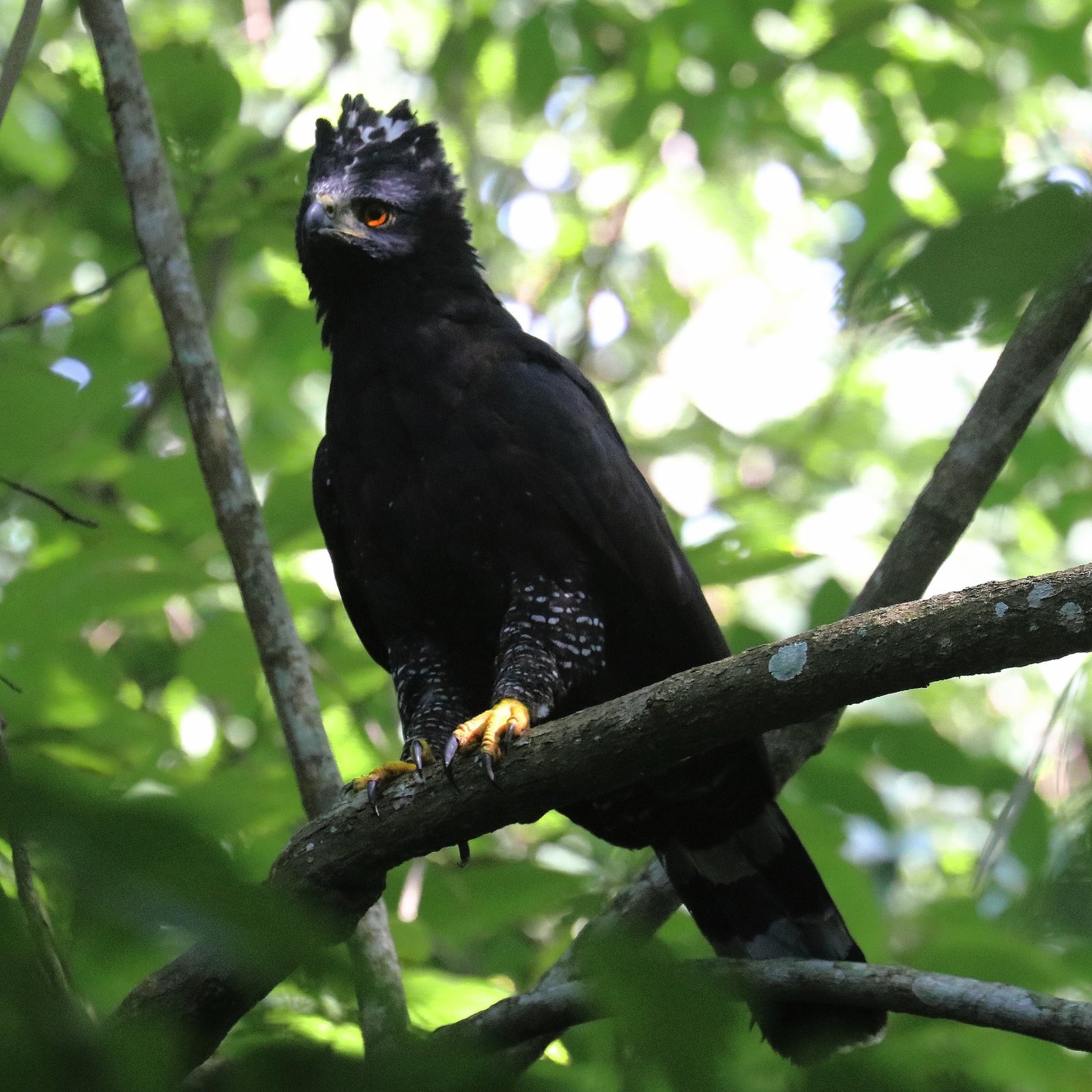
The Black Hawk-Eagle is a slender forest eagle with a long tail and broad wings pinched in at the base. It spends long periods hidden in the canopy and is mostly seen when soaring and calling high above the forest. In the region it occurs only on Trinidad.
Voice
A loud, whistled wheet-wheet-wheeeer or wheet-wheeow, often in flight over the forest and especially in the morning; also shorter, repeated whistles from a perch.
Recording: JAYRSON ARAUJO DE OLIVEIRA — CC BY-NC-SA 4.0 · converted to mono · xeno-canto
Identification
58–70 cm. Adults are mainly black, with a short crest whose feathers are white at the base, fine white speckling on the belly and black-and-white barred thighs and undertail coverts. The long black tail has three or four broad grey bands. In flight the broad, paddle-shaped wings stand out, with black coverts and chequered black-and-white flight feathers. The legs are feathered to the toes and the iris is yellow to orange. Juveniles are dark brown above, with a whitish supercilium and throat, buff, dark-streaked underparts and a paler, barred tail.
Confusion species
Ornate Hawk-Eagle Spizaetus ornatus has a rufous head and neck, a white throat and black-and-white barred underparts; young Ornate Hawk-Eagles are much whiter than young Black. Common Black Hawk Buteogallus anthracinus and Great Black Hawk Buteogallus urubitinga have bare yellow legs, a shorter tail with one or two white bands and no barred flight feathers. Dark juvenile Grey-headed Kites Leptodon cayanensis resemble young Black Hawk-Eagles but are smaller and have unfeathered legs.
Habitat
Humid and semi-evergreen forest in hills and mountains, also older secondary forest, forest edges and clearings. It hunts from the canopy for medium-sized mammals such as squirrels, opossums and bats, for birds such as guans and toucans, and for lizards and snakes. The nest is a large stick platform high in a tree.
Where the bird is most at home, classified by the vegetation types of the Caribbean.



Range and movements
In the region only on Trinidad, mainly in the Northern Range and the larger forests of the centre and south of the island. Outside the region from Mexico through Central America to north-eastern Argentina and southern Brazil.
- Resident
- dark = core range, pale = thinly spread
How and when to look
Best from viewpoints over forest in the Northern Range in mid-morning, as thermals develop. The call is usually noticed before the bird itself; a soaring bird is recognised by the long tail and barred wings pinched in at the base.
Conservation status
Not threatened. The species depends on larger tracts of forest and declines where forest disappears; on Trinidad occasional persecution adds to this.
Scientific name
Spizaetus tyrannus | (Wied-Neuwied, 1820)
Wied-Neuwied described the species in 1820 as Falco tyrannus; because it was later moved to another genus, the author and year stand in brackets. The genus Spizaetus was introduced in 1816 by Vieillot. Spizaetus is Greek, from spizias 'hawk' and aetos 'eagle': 'hawk-eagle'. tyrannus is Latin for 'tyrant, ruler', after this powerful raptor. The specimen the first description was based on came from Rio Belmonte, Bahia, Brazil.