All species › Birds of prey › Hawks, eagles and kites › Ornate Hawk-Eagle
Ornate Hawk-Eagle | Spizaetus ornatus
Bonte kuifarend | Águila elegante
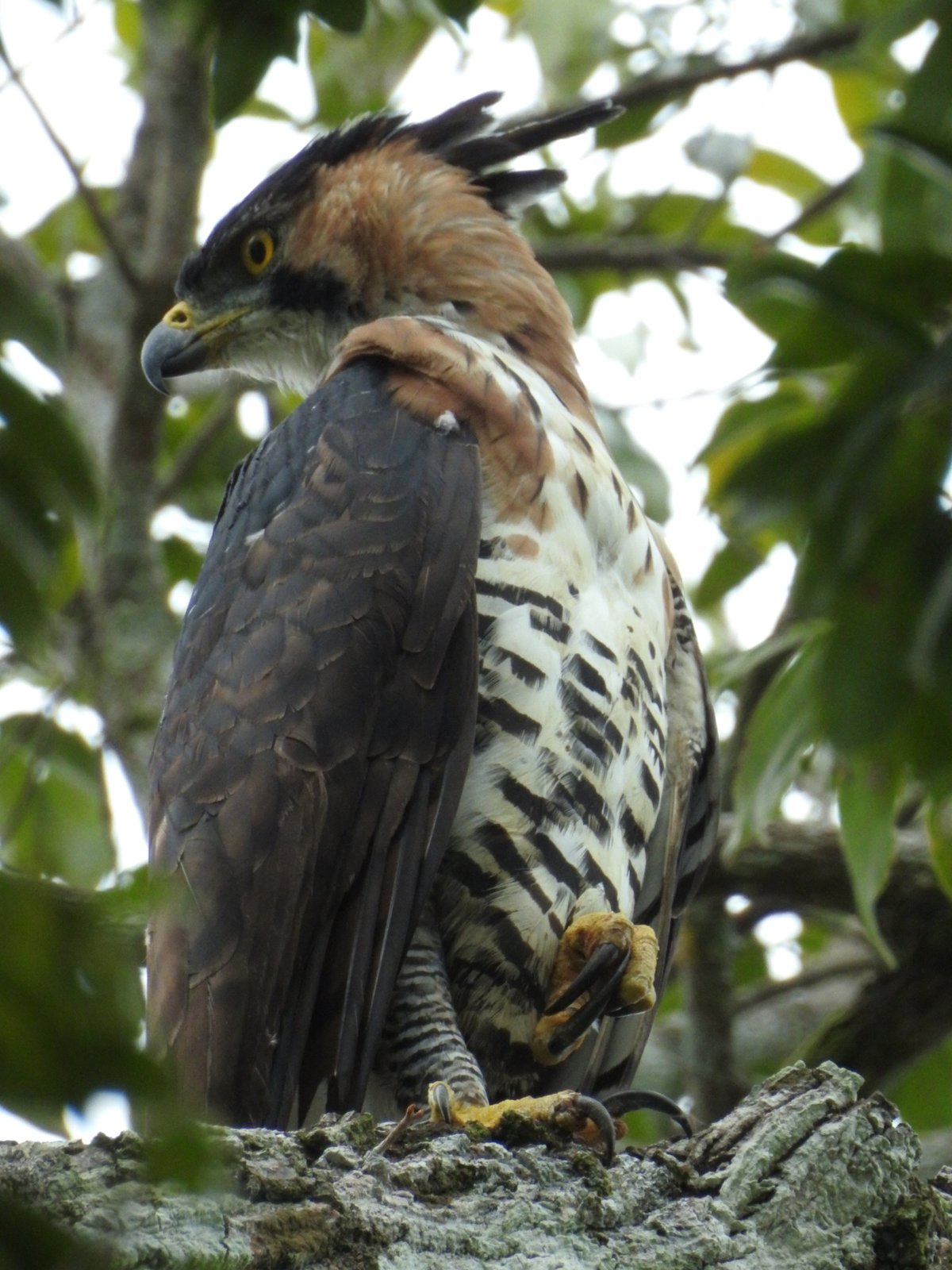
The Ornate Hawk-Eagle is a powerful forest eagle with a long, erectile black crest and a rufous neck. It hunts mainly larger birds and mammals in the canopy and needs extensive, undisturbed forest. In the region it occurs only on Trinidad, where it is rare.
Voice
A loud series of whistles, whi-whee-whee-wheep, usually in flight; from a perch also a rising ka-lee-oo followed by an accelerating, laughing series. Juveniles beg with a repeated wheeu.
Recording: Jacob Wijpkema — CC BY-NC-SA 4.0 · shortened to the first 60 s, mono · xeno-canto
Identification
56–68 cm. Adults have a black crown with a long, pointed crest, rufous cheeks, neck sides and breast sides, and a white throat outlined by a black malar stripe. The upperparts are blackish, the underparts white with broad black bars on the flanks, belly and feathered legs. The black tail has three or four pale grey bands. In flight the wings are broad and rounded, with whitish, barred underwings. Juveniles have a white head and white underparts, with only some barring on the flanks and legs, and a brownish-black back; adult plumage is reached only after several years.
Confusion species
Adult Black Hawk-Eagle Spizaetus tyrannus is mainly black; young Black Hawk-Eagles are brown and streaked, not white. Pale juvenile Grey-headed Kites Leptodon cayanensis resemble young Ornate Hawk-Eagles but are smaller, with a small bill, a black eye-stripe and unfeathered legs. White Hawk Pseudastur albicollis is white with black wings and a white tail with one black band, and has no crest.
Habitat
Tall humid forest and montane rainforest, from the lowlands into the higher parts of the mountains; it avoids heavily fragmented forest. Roughly half to two-thirds of its prey are birds such as guans, pigeons and toucans; the rest are squirrels, agoutis and other mammals. Prey can weigh several times as much as the eagle itself. The nest is a large stick platform high in an emergent tree.
Where the bird is most at home, classified by the vegetation types of the Caribbean.


Range and movements
In the region only on Trinidad, in the forests of the Northern Range and a few larger forest areas elsewhere on the island, rare everywhere. Outside the region from Mexico through Central America and much of South America to northern Argentina.
- Resident
- dark = core range, pale = thinly spread
How and when to look
Best in the morning, when birds soar and call high over the forests of the Northern Range. Viewpoints with a wide outlook over forested valleys give the best chance. A bird perched in the canopy is rarely found.
Conservation status
Near Threatened. The species needs large, continuous forests and disappears where forest is cleared or fragmented; for that reason it was uplisted to Near Threatened in 2016. On Trinidad the population is small and therefore vulnerable.
Scientific name
Spizaetus ornatus | (Daudin, 1800)
Daudin described the species in 1800 as Falco ornatus; because it was later moved to another genus, the author and year stand in brackets. The genus Spizaetus was introduced in 1816 by Vieillot. Spizaetus is Greek, from spizias 'hawk' and aetos 'eagle': 'hawk-eagle'. ornatus is Latin for 'adorned', after the crest and the colourful rufous, black and white plumage. The specimen the first description was based on came from Cayenne, French Guiana.