All species › Passerines › Swallows and martins › Caribbean Martin
Caribbean Martin | Progne dominicensis
Caribische purperzwaluw | Golondrina caribeña
The Caribbean Martin is the most widespread breeding martin in the region, nesting on most islands except Cuba. After breeding most birds leave for South America; a female from Dominica fitted with a geolocator wintered in western Bahia, Brazil. It was formerly lumped with Sinaloa Martin Progne sinaloae of Mexico.

Voice
A gurgling, throaty chew-chew and a bubbling twitter, especially at the nest site.
Recording: David Boyle — CC BY-NC-SA 4.0 · converted to mono · xeno-canto
Identification
18–20 cm, large, with broad wings and a forked tail. The male is glossy blue-black on head, upperparts, throat and breast; lower breast and belly are pure white and sharply demarcated. The female is duller, with a brownish wash above, a grey-brown throat, breast and flanks, and a white belly. Juveniles resemble the female but are browner and less glossy.
Confusion species
In Cuban Martin Progne cryptoleuca the male is entirely dark; females are very similar, but the Caribbean Martin female usually shows more brown on breast and flanks. Purple Martin Progne subis also has an all-dark male, and a female with a scaled breast and streaked belly. Grey-breasted Martin Progne chalybea on Trinidad and Tobago is smaller, with a grey-brown throat and breast in both sexes. American Black Swift Cypseloides niger is all dark, with narrow, sickle-shaped wings.
Habitat
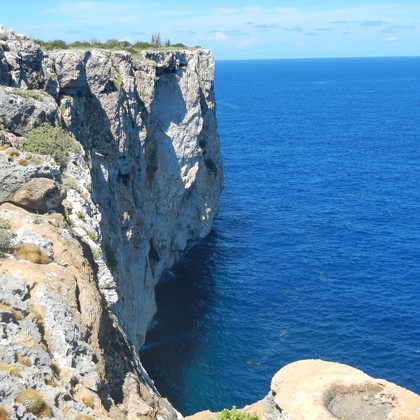
Open country with scattered trees, towns and villages, coasts with rocky headlands and cliffs, and the surroundings of lakes and reservoirs; locally up to about 1800 m in the mountains. It eats large flying insects and often perches on wires and roofs. It nests in cavities in cliffs, buildings and banks and in old woodpecker holes; the clutch is 3–6 eggs.
Where the bird is most at home, classified by the vegetation types of the Caribbean.





Range and movements
Breeds on Jamaica, Hispaniola (Haiti and the Dominican Republic), Puerto Rico, the Virgin Islands, most islands of the Lesser Antilles and Tobago; there are only a few records from Trinidad. On the ABC Islands it appears on passage in spring and autumn; in the Bahamas and the Cayman Islands it is a vagrant, and it does not breed on Cuba. From about October to January the birds are largely absent; a small wintering group has been found on Barbados, and large roosts on the coast of Suriname.
- Resident
- Summer visitor (c. Oct–Mar)
- Winter visitor (c. Apr–Sep)
- Passage (Mar–Apr, Oct–Nov)
- dark = core range, pale = thinly spread
How and when to look
From February to August in almost any coastal town on Puerto Rico, Hispaniola and the Lesser Antilles, on wires, roofs and antennas. A male is identified by the white belly sharply contrasting with the dark breast.
Conservation status
Not threatened. The species is fairly common on most islands and uses buildings as nest sites. Little is known about its wintering area and the numbers there.
Scientific name
Progne dominicensis | (Gmelin, 1789)
Gmelin described the species in 1789 as Hirundo dominicensis; because it was later moved to another genus, the author and year stand in brackets. The genus Progne was introduced in 1826 by Boie. Progne (also Procne) is the daughter of King Pandion of Athens in Greek myth, who was turned into a swallow; in Latin also a word for 'swallow'. dominicensis means 'of Santo Domingo', the old name for Hispaniola, where the species was described. The specimen the first description was based on came from Hispaniola.