All species › Passerines › Swallows and martins › Cuban Martin
Cuban Martin | Progne cryptoleuca
Cubaanse purperzwaluw | Golondrina azul cubana
The Cuban Martin breeds only on Cuba and the Isla de la Juventud and in summer is a familiar sight in Cuban towns and villages, where colonies nest in buildings. Where the birds spend the non-breeding season has not been confirmed; probably in South America. It was long treated as a subspecies of Purple Martin.
Voice
A gurgling, throaty chew-chew and other bubbling calls, especially at the colony.
Recording: Nils Navarro — CC BY-NC-SA 4.0 · shortened to the first 60 s, mono · xeno-canto
Identification
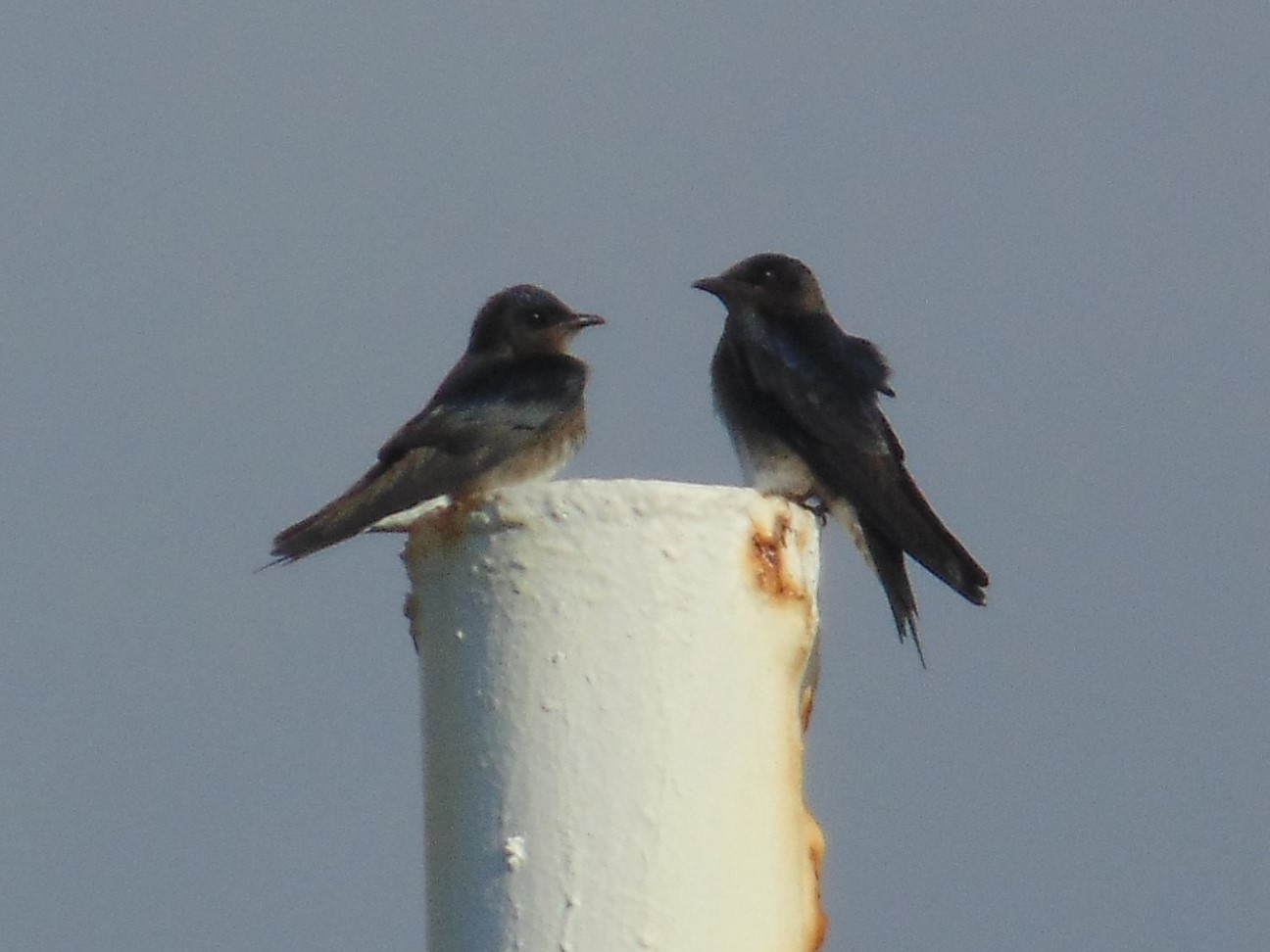
18–20 cm, large, with broad wings and a forked tail. The male is entirely glossy dark purple-blue; the white bases of the belly feathers are hidden and not visible in the field, which the scientific name cryptoleuca ('hidden white') refers to. The female is duller above, with a grey-brown throat, breast and flanks and a clean white belly sharply set off from the breast. Juveniles resemble the female but are browner and less glossy.
Confusion species
The male cannot be told in the field from the male Purple Martin Progne subis, which occurs only on passage, mainly August–October. Female Purple Martin has a scaled breast, a pale collar and a dingy, streaked belly. In Caribbean Martin Progne dominicensis, at most a rare visitor to Cuba, the male also has a white belly; its female usually shows more brown on breast and flanks. American Black Swift Cypseloides niger has narrower, sickle-shaped wings.
Habitat
Towns, villages, open country, marshes, coasts and mangroves, often near water. It eats large flying insects. It breeds in colonies in cavities in buildings and under eaves, in banks and in old woodpecker holes; in rural areas mainly in woodpecker holes in coconut palms.
Where the bird is most at home, classified by the vegetation types of the Caribbean.




Range and movements
Breeds throughout Cuba and on the Isla de la Juventud. Birds leave after breeding; the wintering area is probably in South America. Elsewhere a vagrant, with records from Florida, Aruba, Curaçao and Barbados, among others.
- Resident
- dark = core range, pale = thinly spread
How and when to look
From March to September in almost every Cuban town or village, around churches, old buildings and squares, where the birds fly noisily around their nests. Females are the most reliable to identify; on Cuba males in the breeding season are almost always assigned to this species.
Conservation status
Not threatened. The species is common on Cuba and uses buildings as nest sites.
Scientific name
Progne cryptoleuca | Baird, 1865
Baird described the species in 1865 and placed it straight away in the genus where it still stands. The genus Progne was introduced in 1826 by Boie. Progne (also Procne) is the daughter of King Pandion of Athens in Greek myth, who was turned into a swallow; in Latin also a word for 'swallow'. cryptoleuca is Greek, from kruptos 'hidden' and leukos 'white', after the white bases of the belly feathers, which are largely concealed. The specimen the first description was based on came from Remedios, Cuba.