All species › Waders, gulls and terns › Gulls and terns › Common Tern
Common Tern | Sterna hirundo
Visdief | Charrán común
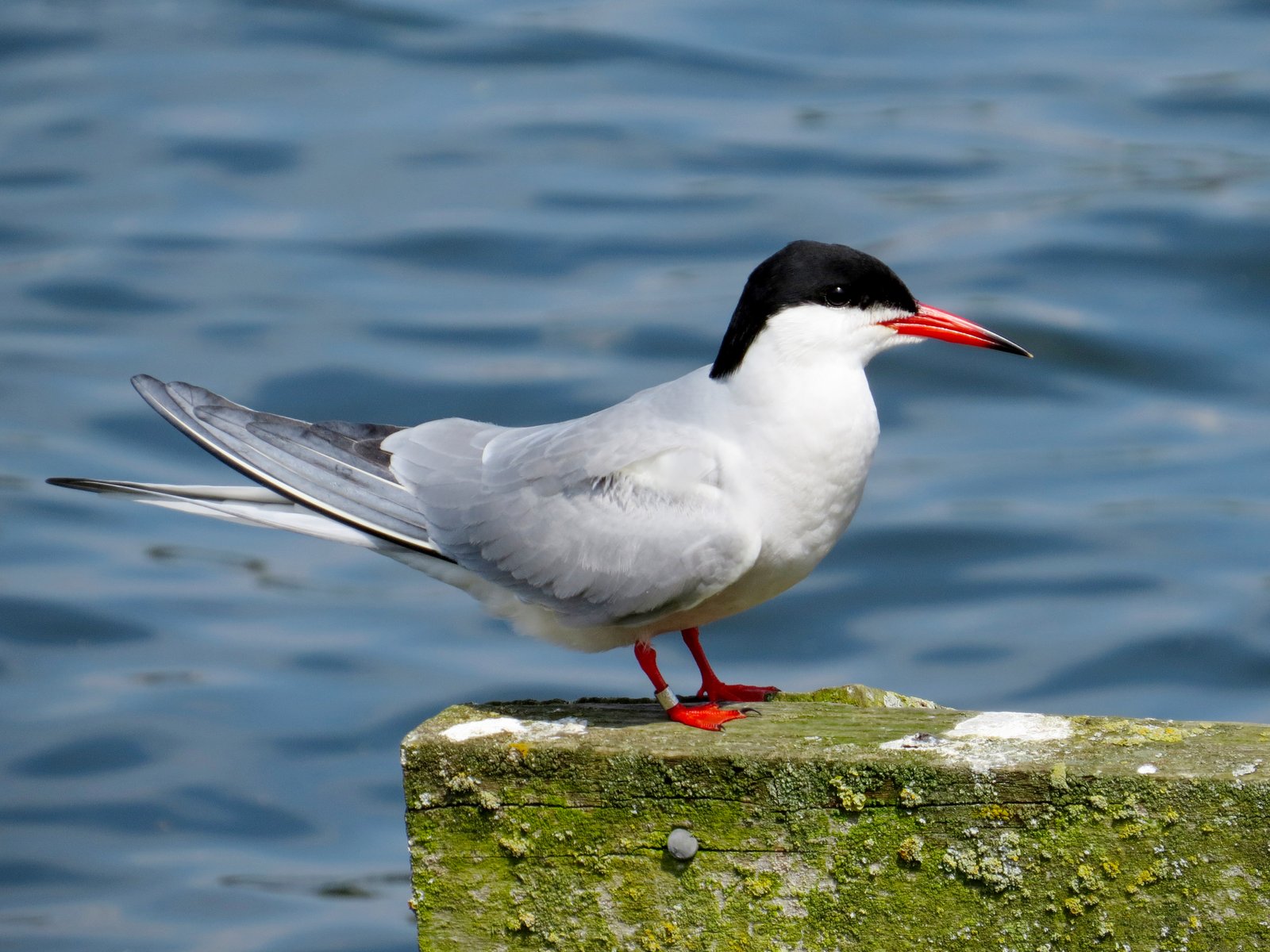
The Common Tern is one of the most widespread terns of the northern hemisphere and in the Caribbean mainly a passage migrant between North America and the coasts of South America. Small local colonies also breed on a few islands. Because it resembles several other terns, careful identification is needed.
Voice
A drawn-out, falling kee-yar stressed on the first syllable, plus short kip calls and, when disturbed, a rapid kek-kek-kek. Noisy at the colony.
Recording: Lionel FREDERIC — CC BY-NC-SA 4.0 · converted to mono · xeno-canto
Identification
31–35 cm, slender, with narrow wings and a deeply forked tail whose outer feathers do not reach beyond the wing tips at rest. Breeding adults have a black cap, pale grey upperparts, grey-washed underparts and a red, black-tipped bill; the legs are red and fairly long. On the upperwing the outer primaries form a dark wedge, and from below the primaries show a broad, blurred dark trailing edge, with only the inner primaries translucent. Non-breeding birds have a white forehead and underparts, a mostly black bill and a dark carpal bar. Juveniles have a brownish, scaly back, a clear dark carpal bar and a pale bill base.
Confusion species
Arctic Tern Sterna paradisaea has shorter legs, a shorter bill and translucent primaries with a narrow, sharp black trailing edge. Roseate Tern Sterna dougallii is paler and whiter, with very long tail streamers and a mostly dark bill. Forster's Tern Sterna forsteri has silvery-white primaries, a longer tail and, outside the breeding season, a black eye mask instead of a black nape. Sandwich Tern Thalasseus sandvicensis is larger, with a yellow-tipped black bill.
Habitat
Coastal waters, bays, lagoons, salt pans and river mouths; it rests on sandbars, small beaches, piers and buoys. It breeds in colonies on bare or sparsely vegetated islets and sandy or rocky cays. It fishes by plunge-diving from a brief hover.
Where the bird is most at home, classified by the vegetation types of the Caribbean.






Range and movements
Passage migrant throughout the region, mainly from April to June and from August to November, most numerous in the Greater Antilles, the ABC Islands and Trinidad and Tobago. Small numbers winter or remain through the summer, especially young birds in the south. It breeds in small numbers in the Bahamas and off Cuba, and on a few islets in the ABC Islands. Beyond the region it breeds across much of North America, Europe and Asia and winters along the coasts of South America, Africa and southern Asia.
- Resident
- Summer visitor (c. Oct–Mar)
- Winter visitor (c. Apr–Sep)
- Passage (Mar–Apr, Oct–Nov)
- dark = core range, pale = thinly spread
How and when to look
Flocks of resting terns on sandbars, piers and salt pans offer the best chance to compare Common Terns with other species. Leg length, bill tip and the primary pattern are the deciding features.
Conservation status
Not threatened globally. Colonies are vulnerable to disturbance, introduced rats and egg collecting. In parts of the Caribbean, migrating terns are trapped for food.
Scientific name
Sterna hirundo | Linnaeus, 1758
Linnaeus described the species in 1758 and placed it straight away in the genus where it still stands. He introduced the genus Sterna in that same work. Sterna goes back to Old English stearn, which appears in the poem The Seafarer; the Frisians used a related word for terns. hirundo is Latin for 'swallow', after the forked tail and light build the tern shares with that bird. The specimen the first description was based on came from Sweden.