All species › Passerines › New World sparrows › Grasshopper Sparrow
Grasshopper Sparrow | Ammodramus savannarum
Sprinkhaangors | Chingolo saltamontes
The Grasshopper Sparrow is a small, flat-headed sparrow of grassland, named after its song, a buzzing trill like that of a grasshopper. It ranges from Canada to Colombia, with several resident populations in the Caribbean: distinct subspecies in Jamaica, Hispaniola, Puerto Rico and on Curaçao and Bonaire. North American birds also winter in the north of the region. In Puerto Rico it is called gorrión chicharra.
Voice
The song is a thin, buzzing insect-like sound introduced by one or two short ticks, tik-tuk-zeeeee, often from a grass stem, post or wire. There is also a longer, more varied song of squeaky trills. The call is a soft tsik.
Recording: Jeff Stewart — CC BY-NC-SA 4.0 · converted to mono · xeno-canto
Identification
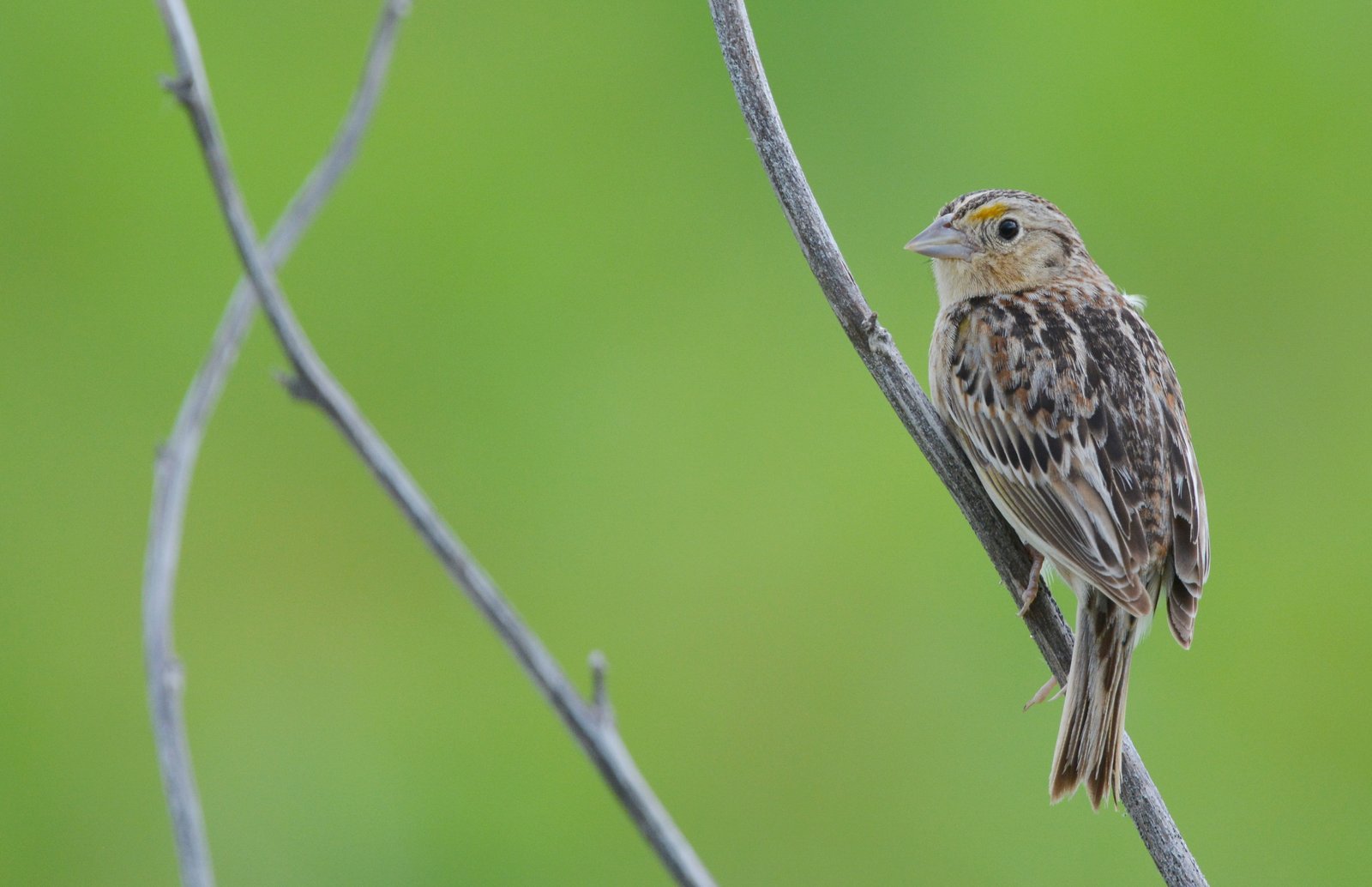
11–13 cm, compact, with a flat head, a relatively large bill and a short, pointed tail. The crown is dark with a pale central stripe. In front of the eye there is a yellow-orange spot, and the bend of the wing is also yellow, though usually hidden. A pale ring surrounds the eye. The upperparts are finely scaled and streaked in rufous, grey and black. The breast and flanks are plain buff, the belly white. The sexes are alike. Juveniles have fine streaks on the breast and flanks and largely lack the yellow loral spot.
Confusion species
Savannah Sparrow Passerculus sandwichensis, a winter visitor, has a streaked breast and flanks, a yellow supercilium and a longer, notched tail. Clay-colored Sparrow Spizella pallida and Chipping Sparrow Spizella passerina are slimmer and longer-tailed, with a smaller bill and a rounded head. Yellow-faced Grassquit Tiaris olivaceus and female Blue-black Grassquit Volatinia jacarina share the same grassland but are olive-green or plain brown, without the back pattern.
Habitat
Dry to moist grassland with tussocks of tall grass and bare patches: savanna, pastures, rough field margins and abandoned cane land, and on Curaçao and Bonaire also grassy patches within thorn scrub. It lives hidden on the ground, searching for insects and seeds. The nest is on the ground under an overhanging grass tussock.
Where the bird is most at home, classified by the vegetation types of the Caribbean.




Range and movements
Resident in Jamaica, Hispaniola (Haiti and the Dominican Republic) and Puerto Rico, locally common in suitable grassland; very rare on Vieques. A distinct subspecies lives on Curaçao and Bonaire. North American birds are scarce winter visitors to the Bahamas and Cuba. Outside the region it breeds from southern Canada through the United States, Mexico and Central America to Colombia.
- Resident
- Summer visitor (c. Oct–Mar)
- Winter visitor (c. Apr–Sep)
- Passage (Mar–Apr, Oct–Nov)
- dark = core range, pale = thinly spread
How and when to look
In the breeding season, in Puerto Rico mainly from May to July, males sing from exposed perches in coastal-plain grassland. The buzzing song resembles an insect. When not singing, the bird hides in the grass and flushes only at close range, dropping back in after a short flight.
Conservation status
Not globally threatened, but it has declined sharply in North America through loss of grassland. The subspecies on Curaçao and Bonaire is barely holding its own. In the Greater Antilles the species depends on open grassland, which is lost to urban development, reforestation and agricultural intensification.
Scientific name
Ammodramus savannarum | (Gmelin, 1789)
Gmelin described the species in 1789 as Fringilla savannarum; because it was later moved to another genus, the author and year stand in brackets. The genus Ammodramus was introduced in 1827 by Swainson. Ammodramus is Greek, from ammos 'sand' and -dromos 'runner': 'sand-runner'. savannarum is Modern Latin for 'of the savannahs', from Spanish zavana 'open, treeless plain', after its grassland habitat. The specimen the first description was based on came from Jamaica.