All species › Waders, gulls and terns › Skuas › Great Skua
Great Skua | Stercorarius skua
Grote jager | Págalo grande
The Great Skua is the only large skua that breeds in the northern hemisphere, from Iceland and the Faroes to Scotland and Norway. Outside the breeding season it wanders across the Atlantic. In the Caribbean it is a rare sight on the open sea, noted mainly during seawatches from the eastern coasts of the Lesser Antilles.
Voice
Almost silent at sea. At the breeding grounds a harsh ha-ha-ha-ha and quacking, croaking calls.
Recording: Stanislas Wroza — CC BY-NC-SA 4.0 · shortened to the first 60 s, mono · xeno-canto
Identification
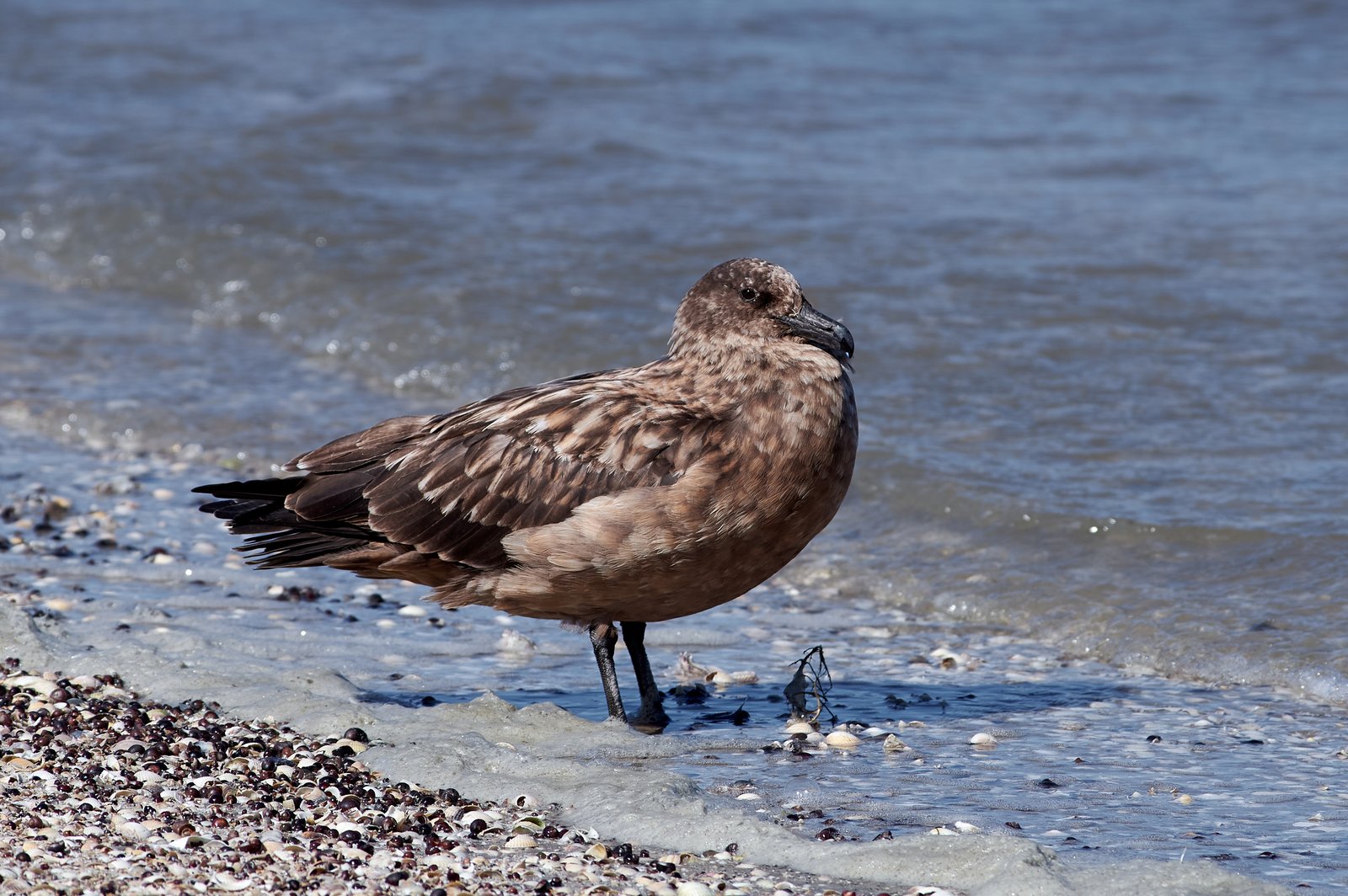
50–58 cm. Large and stocky, with a broad chest, broad wings, a short, wedge-shaped tail and a heavy, dark bill; in size and build more gull than jaeger. The plumage is warm dark brown, with pale, rufous or golden streaks and spots on the back, mantle and wing coverts that give the upperside a mottled look. Head and underparts are brown, often with a slightly darker cap. In flight there is a large white flash at the base of the primaries above and below. Juveniles are plainer and darker, with a warmer reddish-brown tone and fewer pale spots above.
Confusion species
South Polar Skua Stercorarius maccormicki is colder grey-brown, without warm streaks above; pale birds have a pale head and underparts contrasting with dark wings. Pomarine Jaeger Stercorarius pomarinus is slimmer, with narrower wings, a longer tail with elongated, twisted central feathers in adults, a smaller white primary flash and, in pale birds, a black cap and pale belly; juvenile Pomarines are barred on rump and undertail. Parasitic Jaeger Stercorarius parasiticus is much smaller and lighter, with a slender bill and fast, agile flight. Immature large gulls lack the white primary flashes.
Habitat
Open ocean and waters over the continental shelf, often near fishing vessels and flocks of seabirds. It eats fish and offal and chases other seabirds, such as gulls, boobies and shearwaters, to rob them of their prey; on the breeding grounds it also takes eggs, chicks and adults of other species.
Where the bird is most at home, classified by the vegetation types of the Caribbean.


Range and movements
Rare and known mainly from the Lesser Antilles. Most records come from seawatches on Guadeloupe, at Pointe des Châteaux, La Désirade and Petite Terre, chiefly in April and May, and from aerial surveys at sea around Guadeloupe and Martinique. Older records are from Barbados (1960) and Klein Curaçao (1970). There are no confirmed records from the Greater Antilles or the Bahamas. Beyond the region it breeds in Iceland, the Faroes, Scotland, Norway and Svalbard, and winters in the Atlantic from the Bay of Biscay to off West Africa; young birds also reach the western Atlantic, off North America.
How and when to look
There is a chance almost only during seawatches from eastern headlands of the Lesser Antilles or on pelagic trips, mainly in spring. A large, dark skua in the northern summer is more likely a South Polar Skua. The warm brown, pale-streaked upperparts are the best feature; without good photographs many large skuas in the region remain unidentified.
Conservation status
Not threatened. The breeding population, mostly in Scotland, Iceland and the Faroes, grew during the twentieth century but was hit hard by avian influenza from 2021 onwards. In the Caribbean a rare visitor with no regular presence.
Scientific name
Stercorarius skua | (Brünnich, 1764)
Brünnich described the species in 1764 as Catharacta Skua; because it was later moved to another genus, the author and year stand in brackets. The genus Stercorarius was introduced in 1760 by Brisson. Stercorarius is Latin for 'of dung', from stercus 'dung': the food disgorged by seabirds when pursued by skuas was once taken for excrement. skua comes from Faroese skúgvur, the name for this bird; the island of Skúvoy is renowned for its colony. The specimen the first description was based on came from the Faroe Islands and Iceland.