All species › Waders, gulls and terns › Gulls and terns › Least Tern
Least Tern | Sternula antillarum
Amerikaanse dwergstern | Charrancito americano
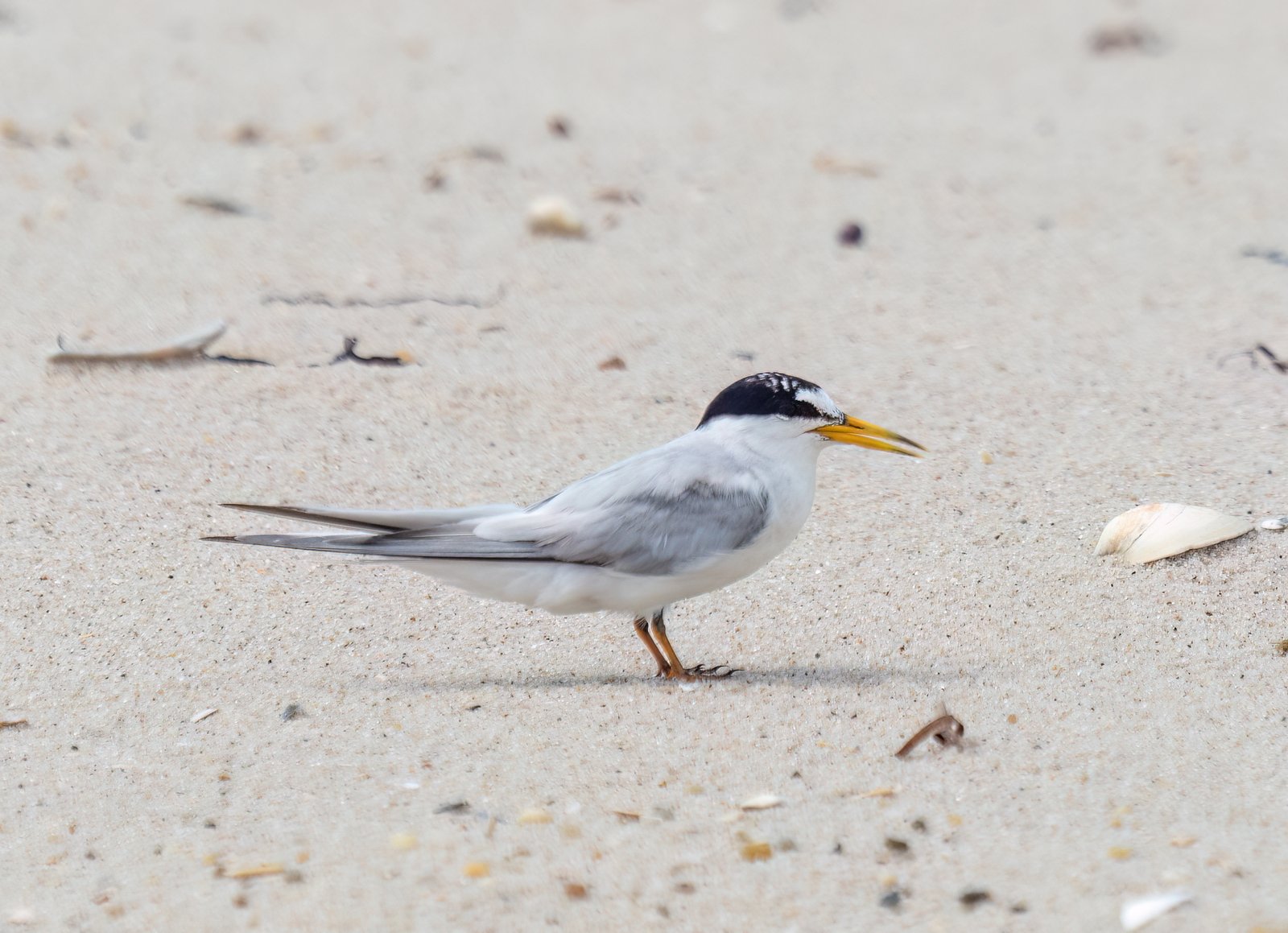
The Least Tern is the smallest tern of the region and a common summer visitor to most islands. It breeds in loose colonies on bare sand flats, beaches, the edges of salt ponds and reclaimed land, and in North America also on gravel roofs. With rapid wingbeats it hovers over shallow water before dropping on a small fish.
Voice
A high, sharp kreet and a fast, chattering kidick-kidick; much noise at the colony, with dives at intruders.
Recording: Paul Driver — CC BY-NC-SA 4.0 · converted to mono · xeno-canto
Identification
22–24 cm, small, with narrow wings and a short, forked tail. In breeding plumage a black cap with a sharp white forehead triangle reaching above the eye, pale grey upperparts and white underparts. The bill is yellow with a black tip, the legs yellow to orange. The two or three outer primaries form a dark leading edge to the wingtip. In non-breeding plumage the bill is black, the forehead broadly white and the cap reduced to a black nape band. Juveniles have brown-scaled upperparts, a dark bar on the forewing and a dark bill.
Confusion species
Yellow-billed Tern Sternula superciliaris, only a rare visitor to Trinidad, is slightly larger with a thicker, entirely yellow bill. Common Tern Sterna hirundo, Roseate Tern Sterna dougallii and Forster's Tern Sterna forsteri are much larger, with longer tails and slower flight. Juvenile Black Terns Chlidonias niger have a dark breast-side patch and a greyer rump.
Habitat
Shallow coastal waters, lagoons, salt ponds, seagrass bays and river mouths. It breeds on open, bare ground with little vegetation: sandy beaches, shell banks, dry salt-pond edges, reclaimed land and waste ground near harbours.
Where the bird is most at home, classified by the vegetation types of the Caribbean.




Range and movements
Breeds throughout the region: the Bahamas, the Turks and Caicos Islands, Cuba, the Cayman Islands, Jamaica, Hispaniola, Puerto Rico, the Virgin Islands, many islands of the Lesser Antilles, Aruba, Bonaire and Curaçao, and San Andrés. On Trinidad and Tobago mainly a passage migrant. In winter it largely leaves the region. Beyond the region it breeds along the coasts and rivers of the United States, in Mexico and along the Caribbean coast of Central America and Venezuela, and winters along the coasts of South America.
- Resident
- Summer visitor (c. Oct–Mar)
- Passage (Mar–Apr, Oct–Nov)
- dark = core range, pale = thinly spread
How and when to look
From April to August at almost any salt pond or lagoon with bare shores, for example on the ABC Islands, Puerto Rico and the Bahamas. Colonies give themselves away by loudly calling, diving birds; keeping a distance stops eggs and chicks from overheating.
Conservation status
Not threatened. Beach colonies suffer heavily from disturbance by recreation, free-roaming dogs and cats, vehicles and high tides, and development of salt ponds and coastal flats removes breeding habitat. Locally, reclaimed land provides temporary new nesting sites.
Scientific name
Sternula antillarum | Lesson, 1847
Lesson described the species in 1847 and placed it straight away in the genus where it still stands. The genus Sternula was introduced in 1822 by Boie. Sternula is a Latin diminutive of Sterna and so means 'little tern'. antillarum means 'of the Antilles'; the species was described from Guadeloupe. The specimen the first description was based on came from Guadeloupe.