All species › Waders, gulls and terns › Gulls and terns › Lesser Black-backed Gull
Lesser Black-backed Gull | Larus fuscus
Kleine mantelmeeuw | Gaviota sombría
Lesser Black-backed Gull is a European gull that since the 1970s has wintered in increasing numbers on the American side of the Atlantic. In the Caribbean it has grown from a vagrant into a scarce but regular winter visitor, with records from the Bahamas to Trinidad. Birds in the region appear to belong mainly to the western European subspecies graellsii.
Voice
A laughing kyow-kyow, deeper and more nasal than that of Herring Gull, and a short, deep gak.
Recording: Francesco Sottile — CC BY-NC-SA 4.0 · converted to mono · xeno-canto
Identification
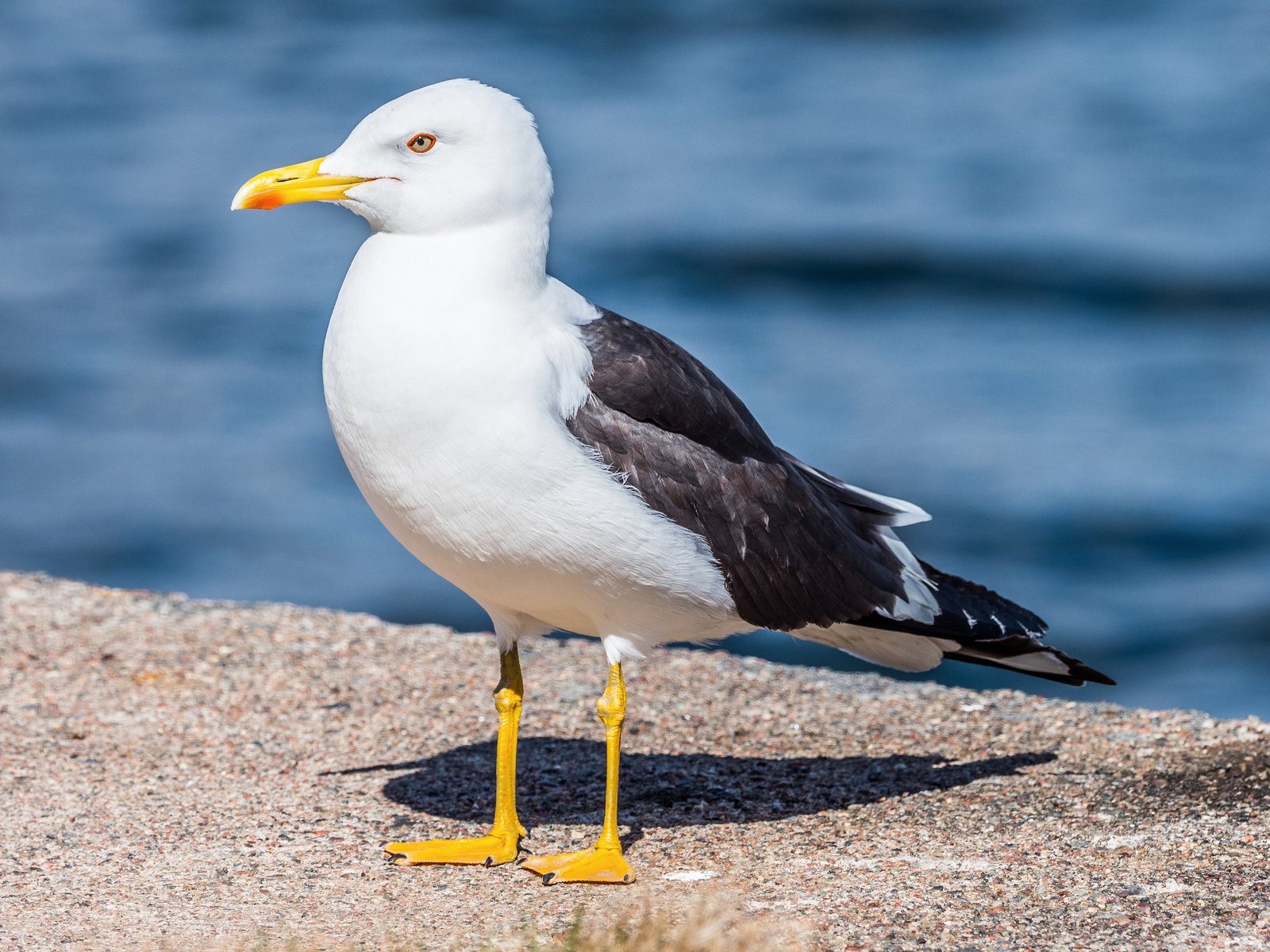
51–64 cm, slimmer and longer-winged than Herring Gull, with a fairly slender bill. Adults have a slate-grey to blackish-grey mantle, black wingtips with small white mirrors, a white head streaked brown in winter, a pale eye, a yellow bill with a red spot and yellow legs. Adult plumage is reached in the fourth year. Juveniles are dark brown with scaly upperparts, a rather white rump and tail base with a broad, clear-cut black terminal band, a black bill and flesh-coloured legs; in flight the inner primaries are as dark as the outer ones. Older immatures gradually acquire a dark grey mantle.
Confusion species
Great Black-backed Gull Larus marinus is much larger and heavier, with a black mantle, large white wingtips and pink legs. Young American Herring Gulls Larus smithsonianus have a brown, barred rump, a largely dark tail and a pale window in the inner primaries. Laughing Gull Leucophaeus atricilla is smaller, with a dark bill and legs and no white mirrors. Kelp Gull Larus dominicanus, recorded on Trinidad, is heavier, with a black mantle and greenish-yellow legs.
Habitat
Harbours, beaches, tidal flats, salt ponds, lagoons and fish landing sites. Often rests among Laughing Gulls and terns on sandbars and piers. Eats fish, invertebrates and refuse, and follows fishing boats.
Where the bird is most at home, classified by the vegetation types of the Caribbean.





Range and movements
Winter visitor to the Bahamas and Puerto Rico, where small groups occur in the harbours around San Juan; rare in Cuba, with scattered records on the other Greater Antilles and in the Lesser Antilles, including Barbados, Grenada and Carriacou and, since 2019, Union Island (Saint Vincent and the Grenadines). Regular in small numbers on the west coast of Trinidad. Outside the region it breeds from Iceland and Greenland through western and northern Europe to Russia and winters from western Europe to West Africa and, in growing numbers, along the eastern seaboard of North America.
- Resident
- Winter visitor (c. Apr–Sep)
- Passage (Mar–Apr, Oct–Nov)
- dark = core range, pale = thinly spread
How and when to look
Best chances are in harbours and at fish landing sites in winter, for example around San Juan in Puerto Rico and on the west coast of Trinidad. Adults stand out among pale grey gulls by their dark mantle and yellow legs.
Conservation status
Not threatened. The species increased strongly in Europe and Iceland in the twentieth century; in North America wintering numbers have risen for decades, while some European colonies have recently declined.
Scientific name
Larus fuscus | Linnaeus, 1758
Linnaeus described the species in 1758 and placed it straight away in the genus where it still stands. He introduced the genus Larus in that same work. Larus is Latin, from Ancient Greek laros, and appears to have referred to a gull or another large seabird. fuscus is Latin for 'dark', black or brown, after the dark mantle and wings. The specimen the first description was based on came from Sweden.