All species › Nightjars › Nightjars › Puerto Rican Nightjar
Puerto Rican Nightjar | Antrostomus noctitherus
Puerto Ricaanse nachtzwaluw | Guabairo de Puerto Rico
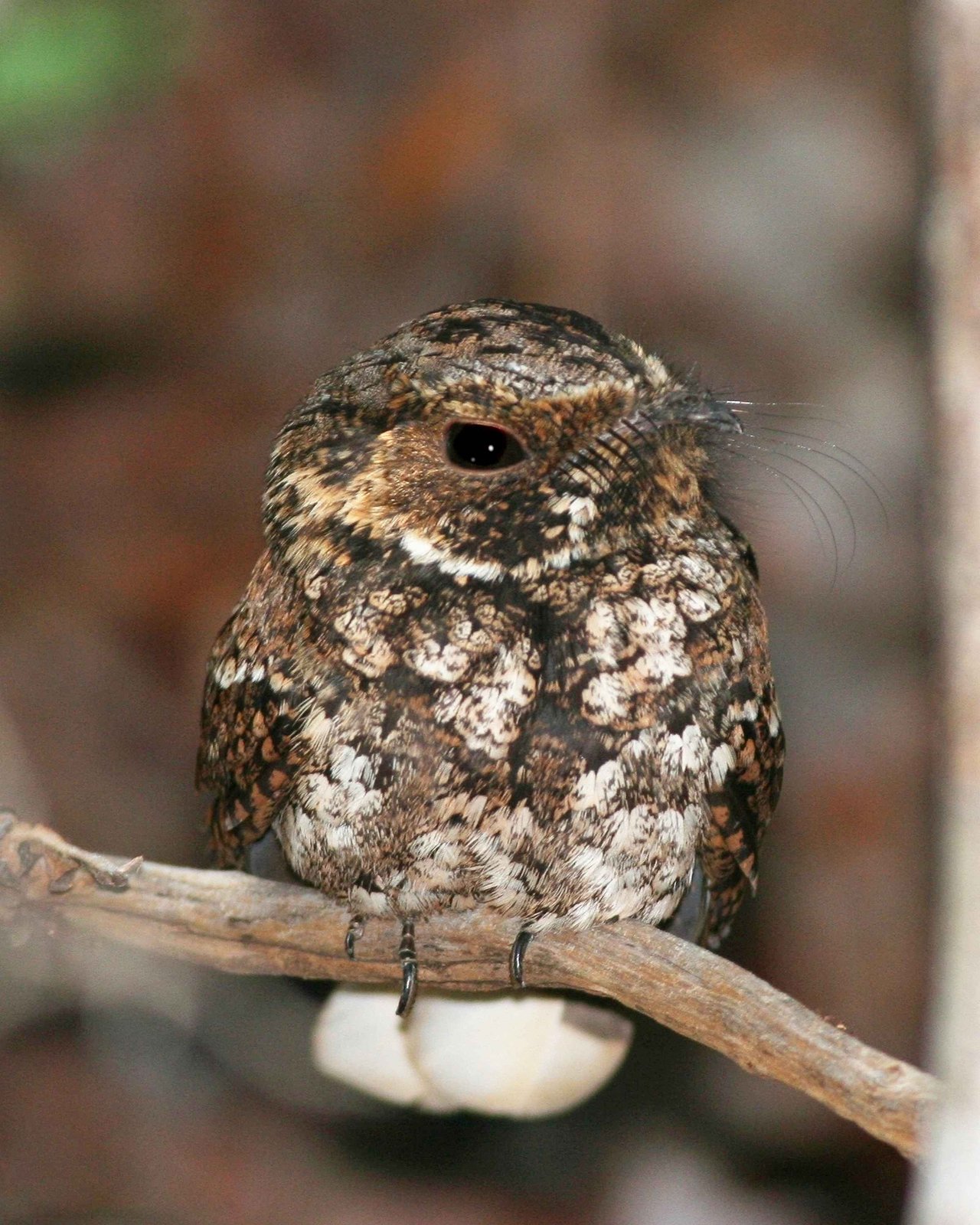
The Puerto Rican Nightjar is a small nightjar that lives only in the dry forests of south-western Puerto Rico. It was known from a single skin collected in 1888 and from bones found in caves, and was thought extinct until it was rediscovered in Guánica dry forest in 1961. It is one of the island's characteristic endemics.
Voice
The song is a rapid series of clear whistled notes, roughly whip-whip-whip, heard mainly at dusk and on moonlit nights. Also short, soft calls.
Recording: Ross Gallardy — CC BY-NC-SA 4.0 · converted to mono · xeno-canto
Identification
22–23 cm, small and compact, with a large head, large dark eyes, a short grey bill with stiff bristles and grey legs. The plumage is mottled black, brown and grey in a fine pattern that is hard to pick out against leaf litter. The male has a blackish throat with a white transverse band and large white patches on the underside of the outer tail feathers, obvious in flight. In the female the throat band is buff and the tail tips are narrow and buff.
Confusion species
Chuck-will's-widow Antrostomus carolinensis, a scarce winter visitor to Puerto Rico, is much larger and warmer rufous-brown and rarely sings in winter. Antillean Nighthawk Chordeiles gundlachii has long, pointed wings with a white bar and a forked tail, and hunts over open ground rather than in forest.
Habitat
Dry coastal forest and dry scrub forest on limestone, preferably closed dry forest with a deep leaf-litter layer and an open understorey; in more open scrub forest at lower densities. It hunts flying insects from a low perch. One or two eggs are laid on the leaf litter, mostly from April to June; the male does most of the incubation, which lasts 18–20 days, and the young fledge after about two weeks.
Where the bird is most at home, classified by the vegetation types of the Caribbean.



Range and movements
Only in south-western Puerto Rico, in the dry hills between roughly Cabo Rojo and Ponce. The main areas are Guánica State Forest, Susúa State Forest and the Guayanilla hills; in 2005 a nest was also found in Maricao State Forest. The species does not occur outside Puerto Rico.
- Resident
- dark = core range, pale = thinly spread
How and when to look
Guánica dry forest is the best-known site; the song carries well from the roads and trails in and around the forest just after sunset and before dawn. The forest should not be entered off the trails: nests lie on the ground and can be trampled or disturbed.
Conservation status
Vulnerable. In 1962 the population was put at fewer than 100 breeding pairs; the 2023 estimate is 2,700–9,900 mature birds, after which the species was downlisted from Endangered to Vulnerable. Threats are the loss of dry forest to building and development, and predation by introduced animals such as mongooses, cats and rats.
Scientific name
Antrostomus noctitherus | (Wetmore, 1919)
Wetmore described the species in 1919 as Setochalcis noctitherus; because it was later moved to another genus, the author and year stand in brackets. The genus Antrostomus was introduced in 1838 by Bonaparte. Antrostomus is Greek, from antron 'cave' and stoma 'mouth': 'cave-mouth', after the enormous gape. noctitherus combines Latin nox, noctis 'night' with Greek -thēras 'hunter': 'night-hunter'. The specimen the first description was based on came from Bayamón, Puerto Rico.