All species › Waterfowl › Ducks and geese › Redhead
Redhead | Aythya americana
Amerikaanse tafeleend | Pato cabecirrojo
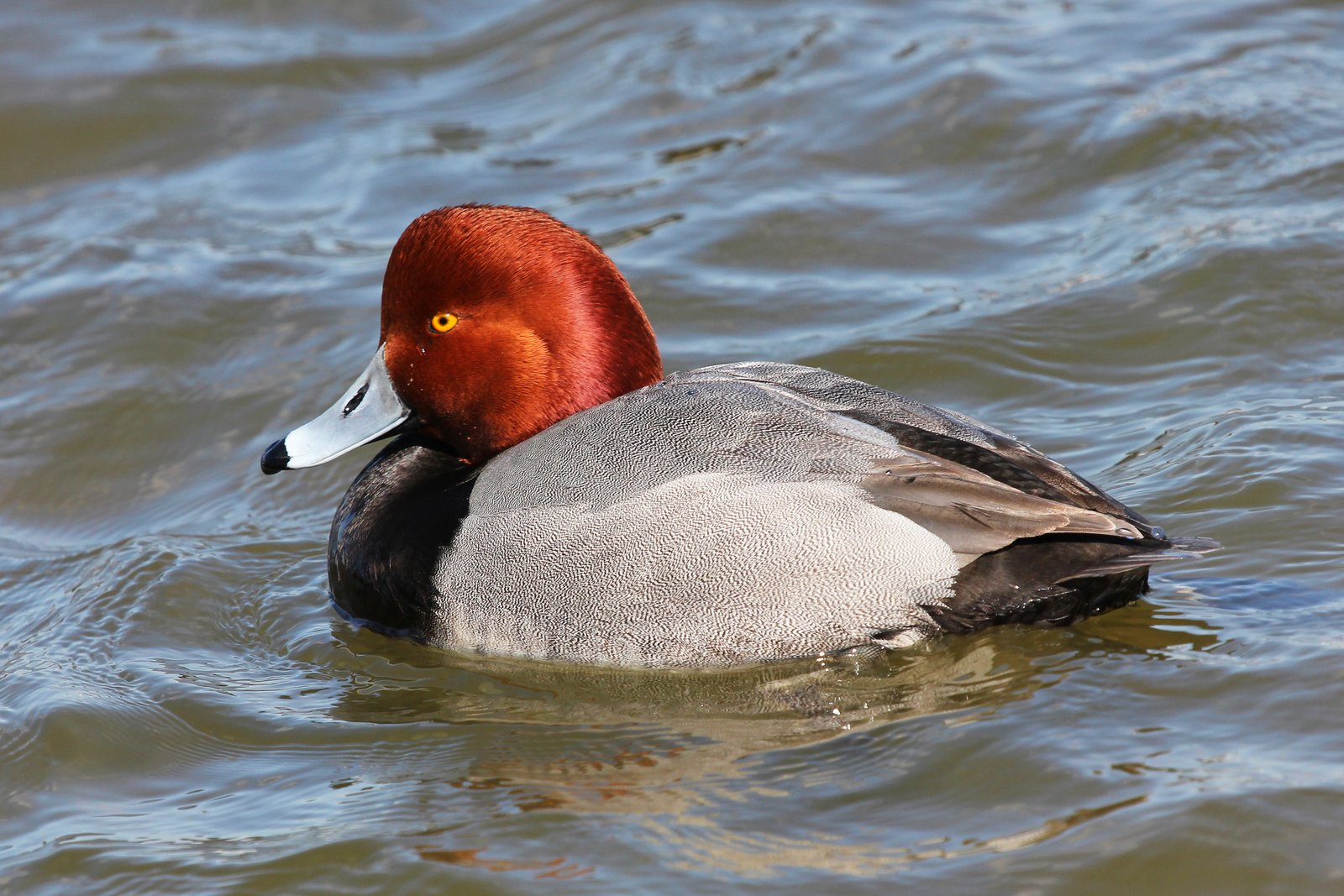
The Redhead is a diving duck of the prairie marshes of North America that reaches the Caribbean only as a scarce winter visitor. The drake is identified by its round rufous head and tricoloured bill; the female is plain brown. Most records come from Cuba and the Bahamas.
Voice
Largely silent in winter. The courting drake gives a cat-like, upslurred meeow; the female a low, harsh krrr.
Recording: Stanislas Wroza — CC BY-NC-SA 4.0 · converted to mono · xeno-canto
Identification
40–56 cm, a sturdy diving duck with a round head, steep forehead and fairly short bill. The drake has a plain rufous head and neck, black breast and black stern, and a grey back and flanks, finely vermiculated. The eye is yellow. The bill is blue-grey with a narrow white band and a black tip. The female is plain warm brown, with a paler area around the bill base, a pale eye-ring and often a faint pale line behind the eye; her bill shows the same pale band and black tip but is duller. In flight a broad grey stripe runs across the secondaries, without bright white. Eclipse drakes resemble females but keep the yellow eye.
Confusion species
Ring-necked Duck Aythya collaris is smaller, with an angular, peaked head and a black back; the drake shows a white spur in front of the grey flanks, and the female a clear eye-ring, eye-line and a white ring around the bill. The drake Lesser Scaup Aythya affinis has a black head and a much paler back, and the female a sharply defined white patch at the bill base and a yellow eye. A female Redhead stands out by its round head, uniform brown tone and the bill with pale band and black tip.
Habitat
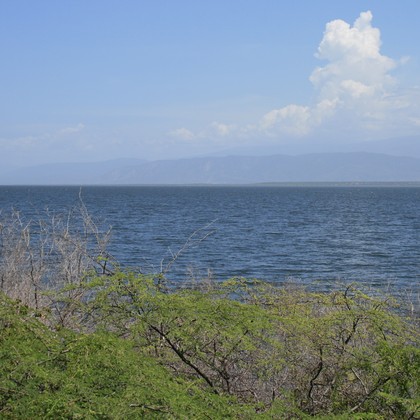
Fresh and brackish lagoons, larger ponds and lakes, and sheltered shallow coastal bays. It feeds by diving, mainly on aquatic plants, their tubers and seeds, supplemented with small invertebrates. In winter often with other diving ducks, especially Lesser Scaup and Ring-necked Ducks.
Where the bird is most at home, classified by the vegetation types of the Caribbean.


Range and movements
Scarce winter visitor to Cuba and the Bahamas, in small numbers. On Hispaniola (the Dominican Republic), Jamaica and the Cayman Islands a very rare visitor; from the other islands there are few or no records. Breeds in the prairie marshes and interior of western and central North America; winters in the southern United States, chiefly along the Gulf of Mexico, and in Mexico and Guatemala.
- Resident
- Winter visitor (c. Apr–Sep)
- dark = core range, pale = thinly spread
How and when to look
The best chance is in winter on larger fresh and brackish waters in Cuba and the Bahamas, among flocks of Lesser Scaup and Ring-necked Ducks. A round-headed bird with a tricoloured bill in such a flock deserves a second look.
Conservation status
Least Concern. Breeding numbers depend heavily on water levels in the prairie marshes. In the Caribbean only a few birds are involved and there is no specific protection for the species; the wetlands used by the wintering birds are under pressure from draining and development.
Scientific name
Aythya americana | (Eyton, 1838)
Eyton described the species in 1838 as Fuligula americana; because it was later moved to another genus, the author and year stand in brackets. The genus Aythya was introduced in 1822 by Boie. Aythya is from Greek aithuia, an unidentified diving seabird mentioned by Aristotle and Hesychius. americana means 'American', after its North American breeding range. The specimen the first description was based on came from North America (not specified).