All species › Birds of prey › Hawks, eagles and kites › Short-tailed Hawk
Short-tailed Hawk | Buteo brachyurus
Kortstaartbuizerd | Gavilán colicorto
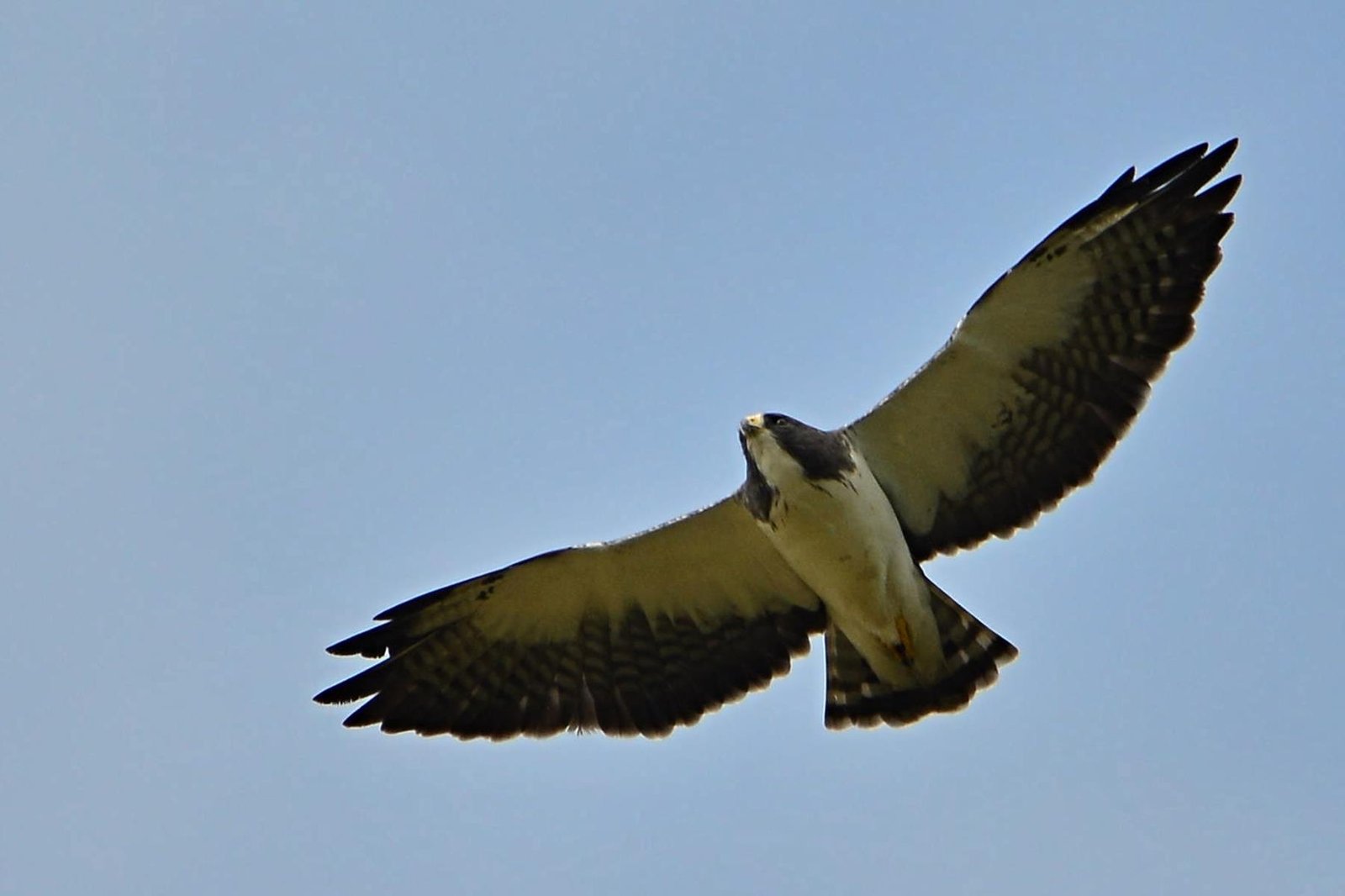
The Short-tailed Hawk is a small buteo that spends most of the day high in the air. It hunts almost entirely on the wing: it hangs into the wind with motionless wings over the forest edge, then drops in steps or a single steep stoop onto a bird in the treetops. Within the region it occurs regularly only in Trinidad.
Voice
Usually silent. Near the nest and when disturbed a high, drawn-out keeeea, sometimes in quick series.
Recording: Rolf A. de By — CC BY-NC-SA 4.0 · shortened to the first 60 s, mono · xeno-canto
Identification
39–44 cm, compact, with broad wings and a short tail. There are two morphs. The light morph is dark grey-brown above, with a dark cap extending below the eye to form a dark 'helmet'; throat and underparts are unmarked white. The dark morph is entirely blackish-brown. In flight both morphs show pale grey, finely barred flight feathers with a dark trailing edge; in light birds white underwing coverts contrast with the greyer flight feathers, in dark birds the coverts are dark. The tail is grey with narrow dark bands and a broader terminal band. In Trinidad the light morph predominates. Juveniles resemble adults, but light birds have paler cheeks and fine streaks on the flanks.
Confusion species
Broad-winged Hawk Buteo platypterus has a rufous-barred breast and a tail with a single broad white band. Grey-lined Hawk Buteo nitidus is finely barred grey below. Zone-tailed Hawk Buteo albonotatus is larger and slimmer than the dark morph, with longer wings, white tail bands and a rocking, vulture-like flight.
Habitat
Forest and forest edge in the lowlands and hills, including degraded forest, cacao and citrus plantings and semi-open country with woodlots, as long as there are trees to nest in. It hunts mainly small birds taken from the canopy or forest edge, and also lizards and large insects. The nest is high in a tree.
Where the bird is most at home, classified by the vegetation types of the Caribbean.




Range and movements
A fairly common resident in Trinidad, mainly in and along the Northern Range and the forests of the centre and south. A vagrant to Tobago. Outside the region it breeds in Florida, Mexico, Central America and South America to northern Argentina.
- Resident
- dark = core range, pale = thinly spread
How and when to look
Around midday over forest edges and valleys in the Northern Range, for example in the Arima Valley: look for a small buteo hanging high and motionless in the wind for long periods. The light morph is told from other buteos by the dark helmet above a white throat.
Conservation status
Not threatened. The species has a large range and holds its own in the forested parts of Trinidad.
Scientific name
Buteo brachyurus | Vieillot, 1816
Vieillot described the species in 1816 and placed it straight away in the genus where it still stands. The genus Buteo was introduced in 1799 by De Lacépède. Buteo is the Latin word for a buzzard. brachyurus is Greek, from brakhus 'short' and oura 'tail', after the short tail. The specimen the first description was based on came from Cayenne, French Guiana (designated later).