All species › Birds of prey › Hawks, eagles and kites › Zone-tailed Hawk
Zone-tailed Hawk | Buteo albonotatus
Bandstaartbuizerd | Gavilán colifajeado
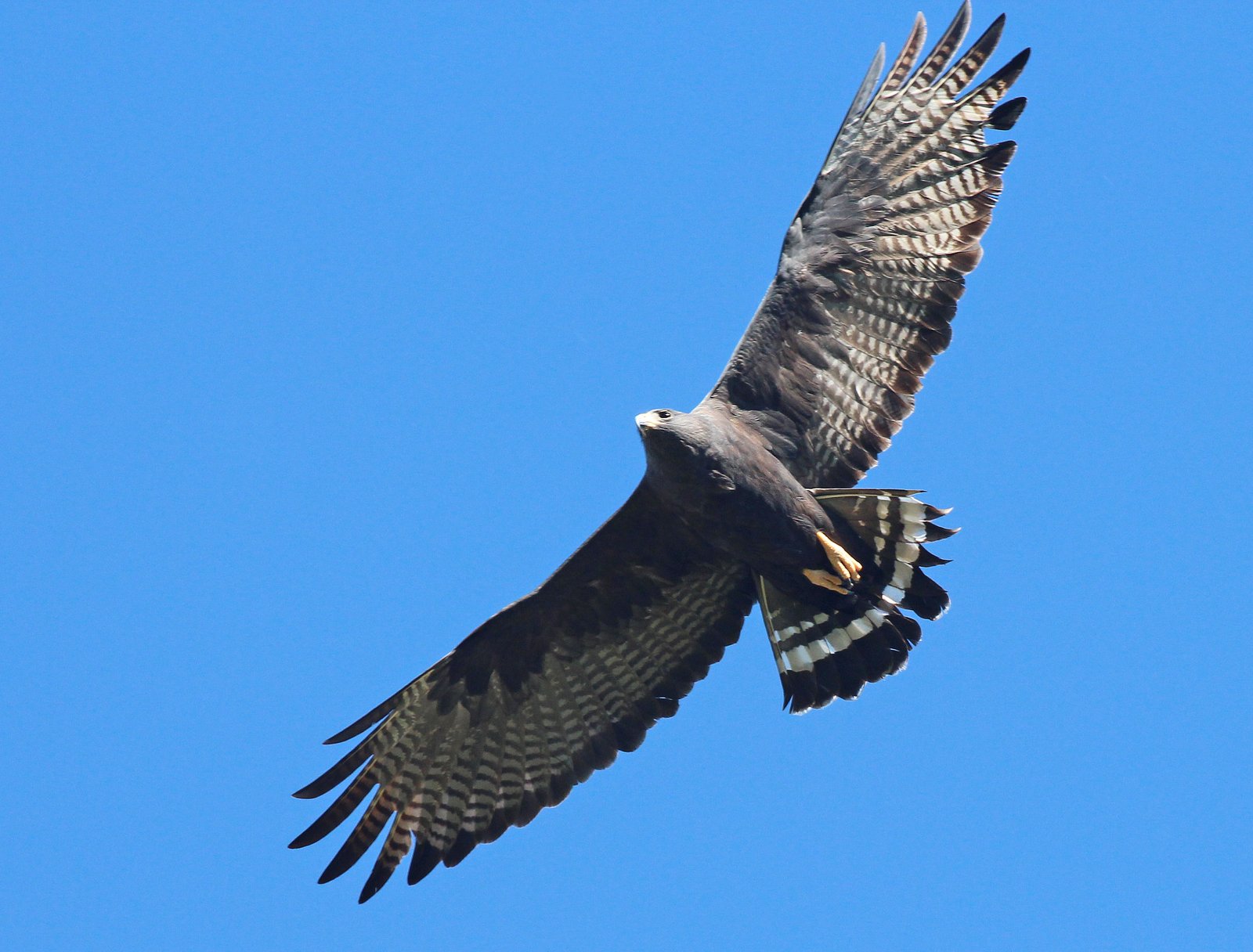
The Zone-tailed Hawk is a slim, black buteo with long wings that closely resembles Turkey Vulture in posture and flight. It soars among or near vultures, wings held in a V and rocking slightly, then suddenly dives at prey that does not see a vulture as a threat. Within the region it occurs only in Trinidad.
Voice
Usually silent. Near the nest a loud, plaintive scream that drops in pitch at the end, roughly kree-eeeer, and when disturbed a lower, drawn-out raaaau.
Recording: Matt Wistrand — CC BY-NC-SA 4.0 · converted to mono · xeno-canto
Identification
46–56 cm, with long, narrow wings and a fairly long tail. Adults are entirely blackish, with yellow legs and cere and pale grey lores. In flight the flight feathers are silver-grey below with fine dark barring and a broad black trailing edge, giving a two-toned underwing as in Turkey Vulture. The tail is black with three or four white to pale grey bands; in males the lowest band is the broadest, females have narrower bands. Juveniles are similar but have small white spots on the breast and a tail with narrow grey and black bars and a broad dark tip.
Confusion species
Turkey Vulture Cathartes aura has a bare red head, no tail bands and a much smaller, pale bill. Common Black Hawk Buteogallus anthracinus and Great Black Hawk Buteogallus urubitinga have broad wings, a short tail with a broad white band and long legs. Dark-morph Short-tailed Hawk Buteo brachyurus is smaller and more compact, with shorter wings and without the vulture-like rocking.
Habitat
Wooded hills and mountains, especially forest with clearings, ravines and steep slopes, and the transition to farmland. In Trinidad mainly in the Northern Range. It hunts from soaring flight, taking lizards, birds, small mammals and frogs, often low along a slope or over the forest edge. The nest is high in a tree.
Where the bird is most at home, classified by the vegetation types of the Caribbean.



Range and movements
A scarce resident in Trinidad, mainly in the Northern Range and some wooded hills in the centre and south. Not known as a resident in Tobago. Outside the region from the south-western United States through Mexico and Central America, and locally in South America to Paraguay and northern Argentina.
- Resident
- dark = core range, pale = thinly spread
How and when to look
Every 'Turkey Vulture' over the Northern Range deserves a second look, especially around midday when raptors rise on thermals. The tail bands, feathered head and yellow cere settle it; at a distance a bird that suddenly speeds up or stoops stands out.
Conservation status
Not threatened. The species has a large range but is scarce everywhere. In Trinidad the population is small, so the loss of hill forest weighs heavily there.
Scientific name
Buteo albonotatus | Kaup, 1847
Kaup described the species in 1847 and placed it straight away in the genus where it still stands. The genus Buteo was introduced in 1799 by De Lacépède. Buteo is the Latin word for a buzzard. albonotatus is Latin, from albus 'white' and notatus 'marked', after the white tail bands. The specimen the first description was based on came from Mexico (unspecified).