All species › Parrots › Parrots › St. Lucia Amazon
St. Lucia Amazon | Amazona versicolor
Sint-Lucia-amazone | Amazona de Santa Lucía
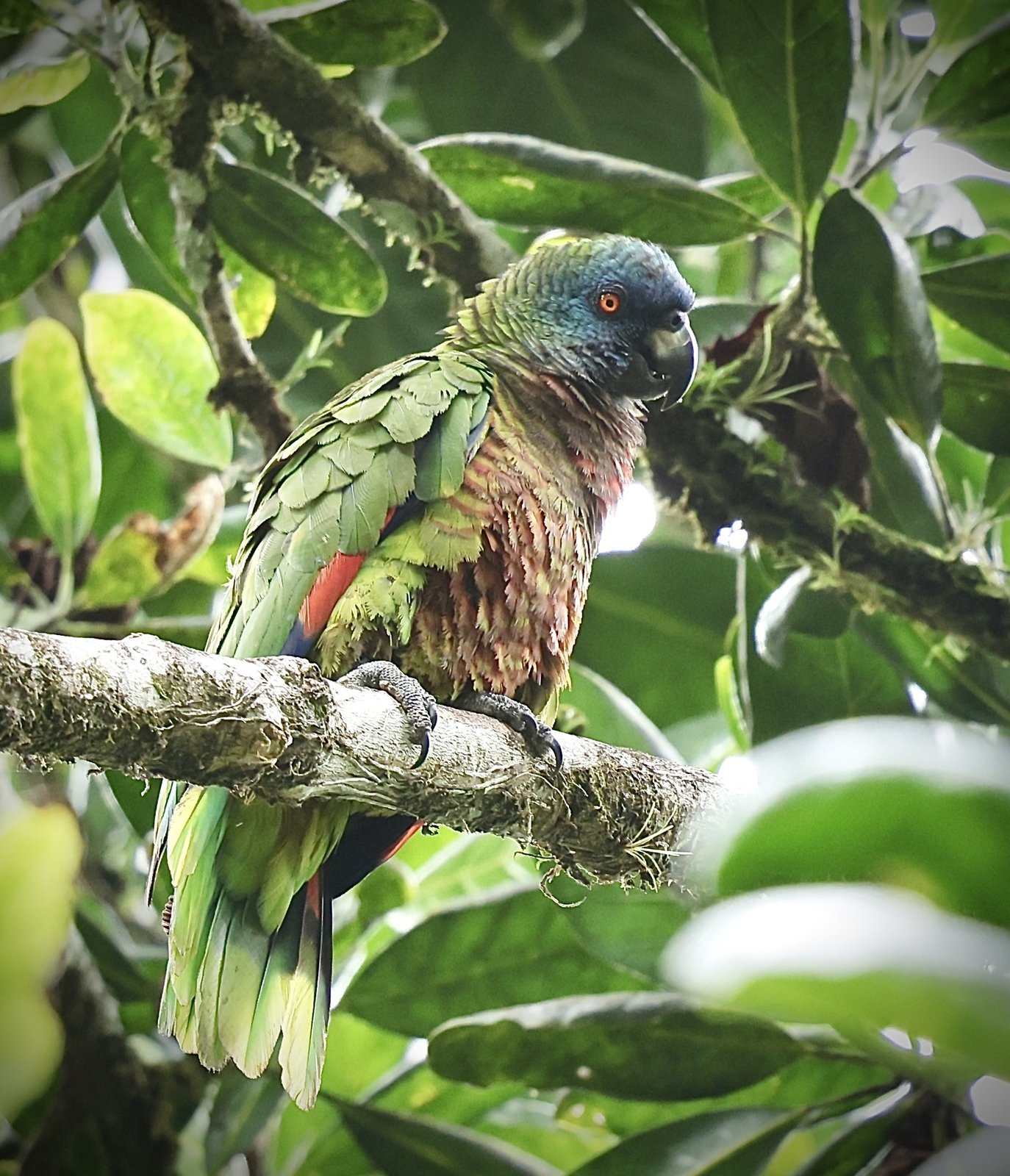
The St Lucia Amazon is the only parrot on St Lucia and the island's national bird, known locally as jacquot. By the late 1970s the population had fallen to about 150 birds; protection, public education and a strict hunting ban have since allowed a strong recovery. It is a large, colourful amazon with a blue face and a red breast band.
Voice
Loud and varied: harsh, hoarse kwah calls and rolling, grating series, mainly in flight and around the roost. Pairs often call together.
Recording: Barry Edmonston — CC BY-NC-SA 4.0 · converted to mono · xeno-canto
Identification
42–46 cm, one of the largest amazons in the Lesser Antilles, with a broad tail. Forehead, lores and cheeks are blue, merging into green with dark scaling on the hindcrown. The upperparts are green. A red band crosses the upper breast; the rest of the underparts are green with a reddish-brown to red wash and dark fringes. The wing shows a red speculum and dark blue primaries; the tail is green with a broad yellowish-green terminal band. The bill and eye-ring are grey. The sexes are alike.
Confusion species
No other amazon occurs on St Lucia. Its nearest relatives live on other islands: St Vincent Amazon Amazona guildingii on St Vincent, and Red-necked Amazon A. arausiaca and Imperial Amazon A. imperialis on Dominica. St Vincent Amazon has a whitish head and yellow and orange in the wing; Red-necked Amazon lacks the blue head and has a red throat patch.
Habitat
Moist montane forest and rainforest in the interior, mainly between about 500 and 900 m, with excursions into cloud forest on the summits and to the edges of secondary forest. It feeds on fruit, seeds, nuts and blossom of canopy trees. Nests in cavities in large old trees; the clutch is usually two eggs, laid early in the dry season.
Where the bird is most at home, classified by the vegetation types of the Caribbean.



Range and movements
Confined to St Lucia, in the forested mountains of the interior, including the Central Forest Reserve around Quilesse, Des Cartiers, Edmund and Barre de l'Isle. It does not occur anywhere else.
- Resident
- dark = core range, pale = thinly spread
How and when to look
Best early in the morning along the Des Cartiers Rainforest Trail or at Barre de l'Isle, when pairs and small groups fly noisily over the forest. A lookout with a view across a valley gives the best chance; perched birds in the canopy are often overlooked despite their colours.
Conservation status
Vulnerable. From a low of about 150 birds in the late 1970s the population grew to about 300 by 1990; recent estimates put it at 1,150 to 1,500 mature individuals and increasing. The small range leaves it exposed to hurricanes and forest loss; hunting and trapping are prohibited.
Scientific name
Amazona versicolor | (Müller, 1776)
Müller described the species in 1776 as Psittacus versicolor; because it was later moved to another genus, the author and year stand in brackets. The genus Amazona was introduced in 1830 by Lesson. Amazona comes from 'Amazone', the French name Buffon gave to various tropical American parrots because they came from the Amazon region. versicolor is Latin for 'variegated, many-coloured', after the mix of blue, green, red and yellow. The specimen the first description was based on came from Saint Lucia (originally given in error as Havana).