All species › Passerines › Ovenbirds and woodcreepers › Streaked Xenops
Streaked Xenops | Xenops rutilans
Gestreepte xenops | Picolezna rayado
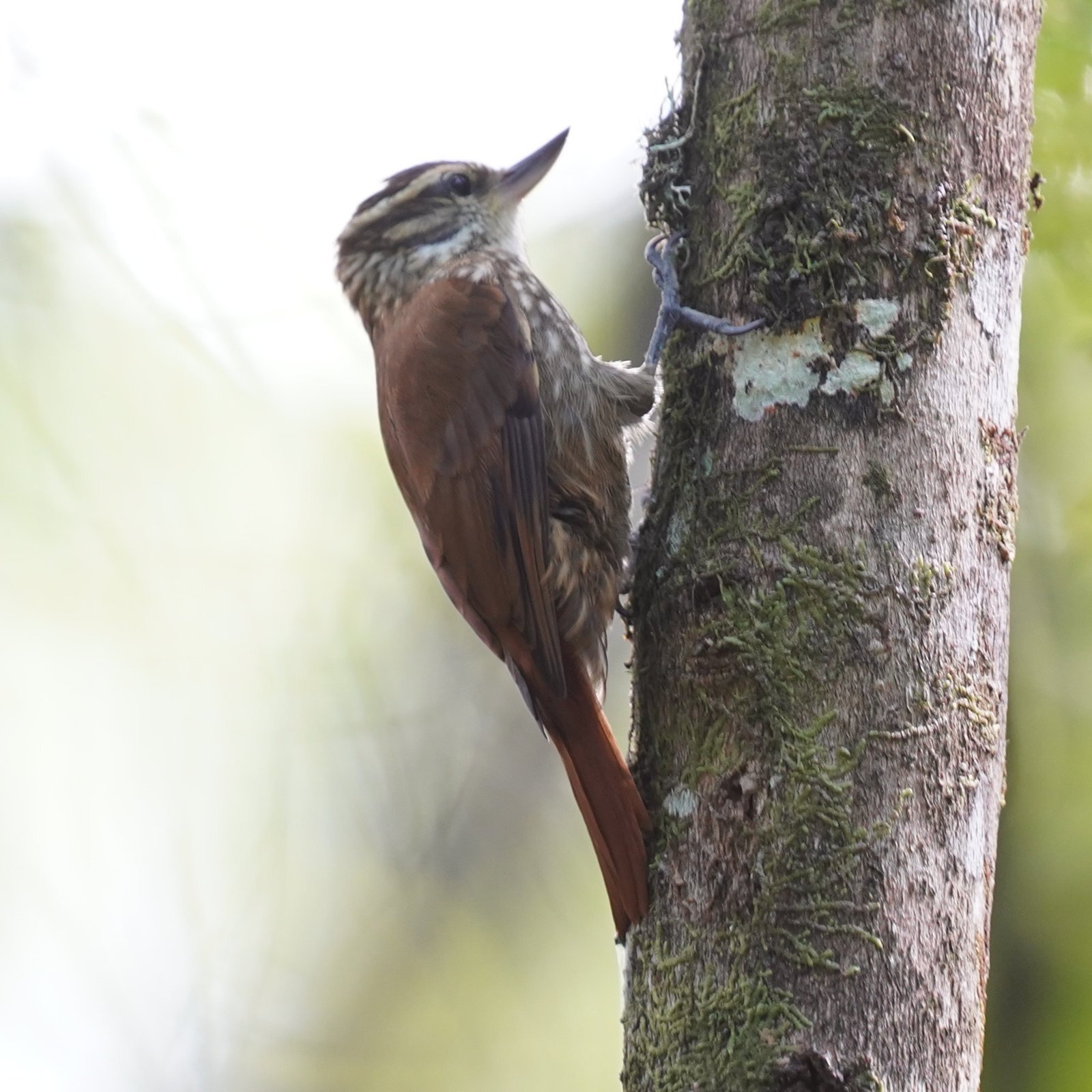
The Streaked Xenops is a small ovenbird with a short, wedge-shaped bill whose lower mandible is upturned. Like a tit it works along thin dead twigs and vines, often hanging upside down, chiselling and prying insect larvae out of the soft wood. On Trinidad it is a rather scarce forest bird, usually seen with mixed flocks.
Voice
The song is a rising then falling series of 5–10 high, dry, squeaky notes that accelerates at the end. The call is a high, piercing peet or cheet.
Recording: Juan Freile — CC BY-NC-SA 4.0 · converted to mono · xeno-canto
Identification
12–13 cm, small and compact, with a short tail and a short, thick, wedge-shaped bill with an upturned lower mandible. The crown is dark brown with pale streaks, the supercilium buff, and the pure white malar stripe stands out in the otherwise brown face. The back is rufous-brown with faint pale streaks, rump and tail chestnut. The underparts are olive-brown with broad buffy-white streaks. A pale wing band shows in flight. The sexes are alike.
Confusion species
On Trinidad no other species closely resembles it: the white malar stripe and the upturned bill are diagnostic. Woodcreepers, such as the small Olivaceous Woodcreeper Sittasomus griseicapillus, climb trunks propped on the tail and have a straight or curved bill; Olivaceous Woodcreeper is also unstreaked. Plain Xenops Xenops minutus of the South American mainland does not occur on Trinidad.
Habitat
Humid and semi-evergreen forest, its edges and older secondary growth, on Trinidad mainly in the hills and mountains. It lives singly or in pairs and almost always joins mixed foraging flocks in the middle and upper strata. It eats insects and their larvae, chiselled out of dead twigs and rotten wood or pried from under bark; it also catches flying termites in the air. It nests in a self-excavated cavity in a dead branch or stump.
Where the bird is most at home, classified by the vegetation types of the Caribbean.



Range and movements
In the region only on Trinidad, where it is rather scarce in the forests of the Northern Range and locally in other wooded parts of the island; it is absent from Tobago. Outside the region from Costa Rica and Panama through much of South America, along the Andes and in Brazil, to Bolivia, Paraguay and northern Argentina.
- Resident
- dark = core range, pale = thinly spread
How and when to look
In the forests of the Northern Range it pays to work through mixed flocks: the xenops gives itself away by tapping on dead twigs and by its high call. The bird is small and active and often seen only from below, where the streaked underparts and white malar stripe are the first features to show.
Conservation status
Not threatened. The species has a very large range; habitat is lost locally through deforestation.
Scientific name
Xenops rutilans | Temminck, 1821
Temminck described the species in 1821 and placed it straight away in the genus where it still stands. The genus Xenops was introduced in 1811 by Illiger. Xenops is Greek, from xenos 'strange' and ōps 'face', after the odd, upturned bill. rutilans is Latin for 'glowing reddish', after the rufous tail and wings. The specimen the first description was based on came from Brazil (not specified).