All species › Cuckoos › Cuckoos › Striped Cuckoo
Striped Cuckoo | Tapera naevia
Gestreepte koekoek | Cuclillo rayado
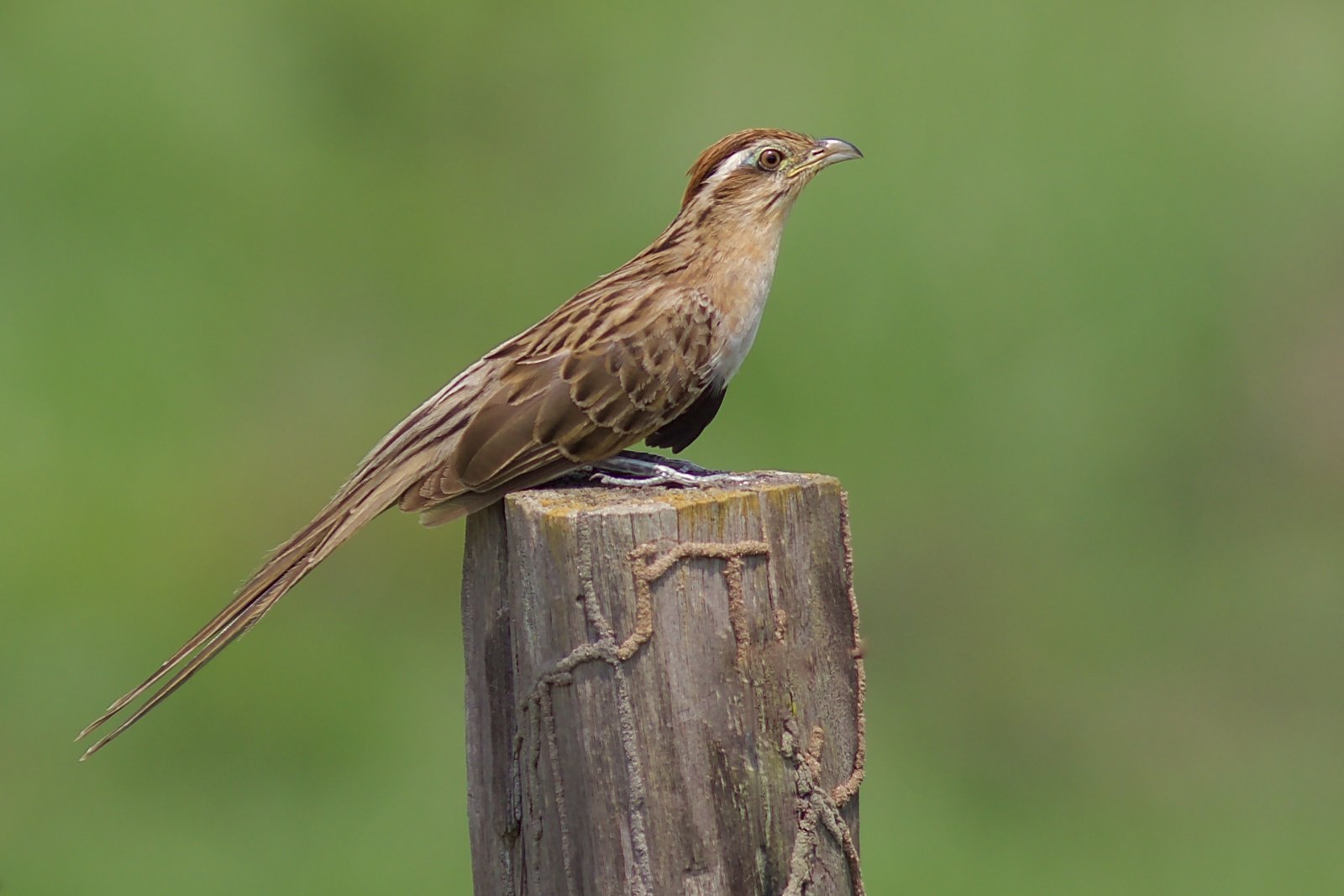
The Striped Cuckoo is a brown-streaked, crested cuckoo that is heard far more often than seen: its plaintive whistled call carries for hours from the scrub of open country. In the region it occurs only in Trinidad. Unlike most American cuckoos it is a brood parasite: the female lays her eggs in the nests of other birds, which raise the young.
Voice
A clear, plaintive whistle of two or three notes, wu-weee or wu-wu-weee, the last note highest. It is repeated monotonously for long periods, often from a prominent branch, post or bush, and is ventriloquial, so the direction of the sound is often unclear. Young birds give a shorter whistle. The species responds strongly to an imitation of its call.
Recording: Paul Molina Abril — CC BY-NC-SA 4.0 · converted to mono · xeno-canto
Identification
26–30 cm, with a long, graduated tail. The upperparts are grey-brown to sandy brown with broad blackish streaks; the crown is rufous with black streaks and forms a crest that is raised when excited. A pale supercilium contrasts with a dark stripe behind the eye. Throat and breast are pale buffish, the rest of the underparts dirty white without clear markings. The bill is short and slightly curved. The alula is black and is flared during display and when agitated, showing as a dark patch against the pale breast. The sexes are alike; young birds are darker, with pale spots on the crown and upperparts instead of streaks. In flight the wings look short and rounded and the tail long.
Confusion species
In Trinidad no other species closely resembles it. The other native cuckoos of the island, Common Squirrel Cuckoo Piaya cayana and Little Cuckoo Coccycua minuta, are plain chestnut without streaks. Mangrove Cuckoo Coccyzus minor is unstreaked grey-brown, with a black eye mask and an ochre belly. The combination of streaked upperparts, an erectile rufous crest and a long, graduated tail is distinctive.
Habitat
Open and semi-open country with scattered bushes and trees: overgrown pastures and field edges, rough ground, scrub, forest edges and the edges of mangroves and marshes, mainly in the lowlands. It lives alone and hidden, foraging on or near the ground, mainly on grasshoppers, caterpillars and other large insects. It often calls from a visible perch, but dives quickly into cover when disturbed. The female lays her white to bluish eggs in the nests of birds with closed or domed nests, chiefly spinetails and also wrens. Within the first days after hatching the cuckoo chick kills the host's young by biting them with its bill, and is then raised alone.
Where the bird is most at home, classified by the vegetation types of the Caribbean.




Range and movements
In the region only in Trinidad, where it is scattered across open lowland country and forest edges; it has not been recorded on Tobago. Outside the region from southern Mexico through Central America into South America, east of the Andes to Bolivia, Paraguay and northern Argentina.
- Resident
- dark = core range, pale = thinly spread
How and when to look
In open country in Trinidad, in rough pastures, field edges and scrub in the lowlands, the species is noticed mainly by its call. While calling the bird often sits fairly exposed on a post, bush or wire, but against a background of dry grass and twigs the streaking blends it into its surroundings. When calling it often raises the crest and flares the black alulas.
Conservation status
Not threatened. The species has a large range and benefits from open, man-made country with scrub. In Trinidad it is widespread and is mostly detected by call.
Scientific name
Tapera naevia | (Linnaeus, 1766)
Linnaeus described the species in 1766 as Cuculus naevius; because it was later moved to another genus, the author and year stand in brackets. The genus Tapera was introduced in 1819 by Thunberg. Tapera comes from the Tupi name Taperá, 'house-dwelling (bird)', originally for a kind of swallow. naevia is Latin, from naevius 'spotted, marked', after the streaked plumage. The specimen the first description was based on came from Cayenne, French Guiana.