All species › Passerines › Mockingbirds and thrashers › Tropical Mockingbird
Tropical Mockingbird | Mimus gilvus
Tropische spotlijster | Centzontle tropical
The Tropical Mockingbird is the southern counterpart of Northern Mockingbird, replacing it in the Lesser Antilles, Trinidad and Tobago, the ABC Islands and San Andrés. The two have been treated as one species. It is one of the most visible birds of open country and settlements, likes to perch high on a shrub, post or roof and sings a great deal. On Curaçao and Bonaire it is called chuchubi.
Voice
A long, varied song of mellow to harsh notes, trills and phrases with much repetition, often from a high perch and also by moonlight. It rarely imitates other birds; the song is hardly separable from that of Northern Mockingbird. The call is a harsh chak.
Recording: José — CC BY-NC-SA 4.0 · converted to mono · xeno-canto
Identification
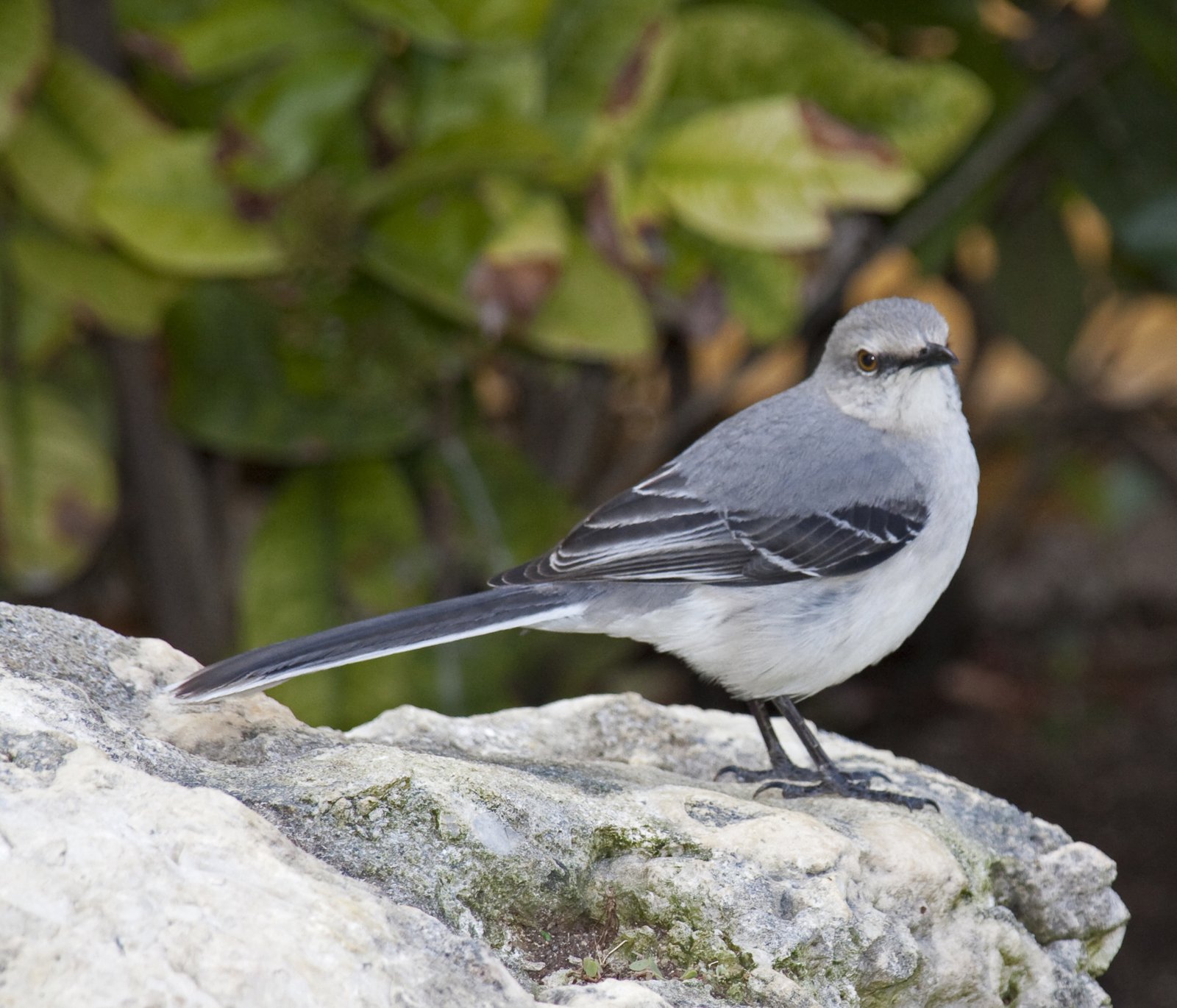
23–26 cm, slender, with a long tail and a thin, slightly curved black bill. Head and upperparts are grey, with a whitish supercilium and a dark eye-stripe. The underparts are off-white and unmarked. The wings are blackish with white edges and two white wing bars, without a large white patch at the base of the primaries. The tail is long and dark, with broad white tips to the outer feathers. The iris is yellow to orange-yellow. The sexes are alike. Juveniles are browner, with dark spotting on breast and flanks.
Confusion species
Northern Mockingbird Mimus polyglottos has a large white patch at the base of the primaries, visible in flight, and largely white outer tail feathers; the two species hardly overlap in the region. Grey Kingbird Tyrannus dominicensis has a dark mask, a heavy straight bill and a shorter tail. Scaly-breasted Thrasher Allenia fusca is brown with spotted underparts and lives in forest.
Habitat
Open and semi-open country: dry scrub, cactus scrub, coastal scrub, savanna, pasture, plantations, parks and gardens right into villages and towns. It avoids closed forest and mangroves. It forages on the ground or low in vegetation and eats arthropods, fruit, seeds, small lizards, eggs and human food. The nest is an open cup in a shrub or small tree.
Where the bird is most at home, classified by the vegetation types of the Caribbean.






Range and movements
Resident in the Lesser Antilles from Barbuda and Antigua south through Guadeloupe, Dominica, Martinique, Saint Lucia, Saint Vincent and the Grenadines to Grenada (antillarum); on the northern islands it appeared only in the twentieth century. Also on Trinidad and Tobago (tobagensis), Aruba, Curaçao and Bonaire (rostratus) and San Andrés and Providencia (magnirostris). Outside the region from southern Mexico through Central America to northern and eastern South America.
- Resident
- dark = core range, pale = thinly spread
How and when to look
On the ABC Islands, Tobago, Grenada and Saint Lucia it is seen almost everywhere in open country, including at hotels and in car parks. In a flying bird the lack of a white wing patch is the best difference from Northern Mockingbird.
Conservation status
Not threatened. Common in the region and benefiting from deforestation and open, inhabited land; in the Lesser Antilles the species spread northwards during the twentieth century.
Scientific name
Mimus gilvus | (Vieillot, 1808)
Vieillot described the species in 1808 as Turdus gilvus; because it was later moved to another genus, the author and year stand in brackets. The genus Mimus was introduced in 1826 by Boie. Mimus is Latin for 'mimic', after the habit of imitating other sounds. gilvus is Latin for 'pale yellow, dun', after the pale greyish plumage. The specimen the first description was based on came from French Guiana (suggested; originally 'Guiana and the warmest parts of America').