All species › Pelicans, herons and ibises › Ibises and spoonbills › White-faced Ibis
White-faced Ibis | Plegadis chihi
Witmaskeribis | Morito cariblanco
The White-faced Ibis is the western counterpart of the Glossy Ibis: it breeds in western North America and Mexico and in southern South America. It has been spreading east for decades and is seen increasingly often east of the Mississippi. In the Caribbean it is a very rare vagrant, often overlooked among Glossy Ibises.
Voice
Usually silent. In flight and in flocks a low, hoarse graa or grunting ka-onk, similar to the calls of Glossy Ibis.
Recording: Manuel Grosselet — CC BY-NC-SA 4.0 · converted to mono · xeno-canto
Identification
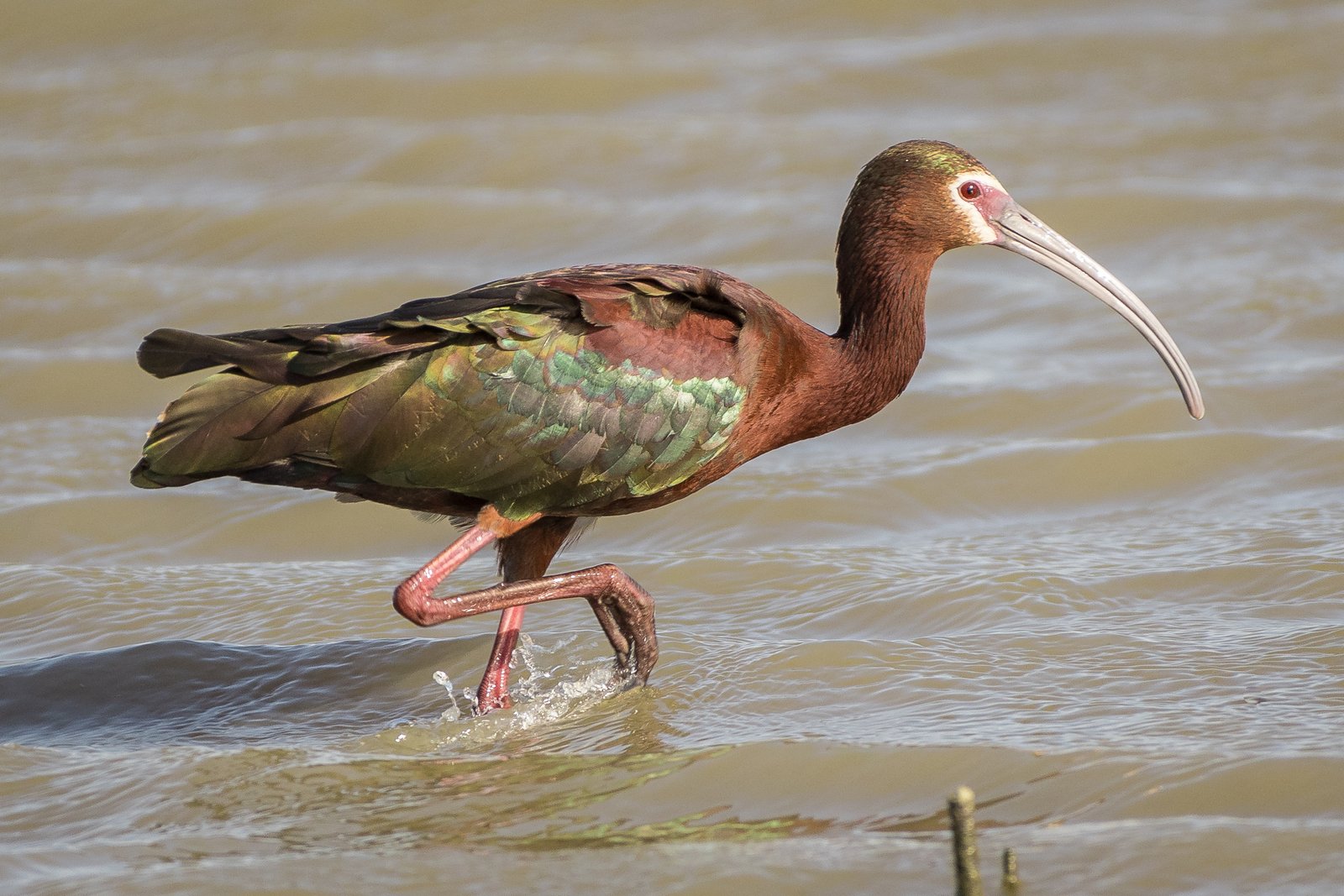
46–56 cm, slightly smaller than Glossy Ibis and almost identical in build, with a long, curved bill. In breeding plumage head, neck and underparts are chestnut, the wings glossy green and purple. The bare skin between eye and bill is pink to reddish and is bordered all round by a narrow band of white feathers that continues behind the eye and under the chin. The eye is red all year, the legs red in the breeding season. Outside the breeding season head and neck are dull brown with fine white streaks, the white border disappears and the facial skin is duller pink; the red eye remains the best feature. Juveniles have a dark eye and are scarcely separable from young Glossy Ibises.
Confusion species
Glossy Ibis Plegadis falcinellus has a dark eye, dark blue-grey facial skin with a pale blue border that does not continue behind the eye, and dark legs. Hybrids between the two species occur in the United States, with intermediate features. Young American White Ibises Eudocimus albus and Scarlet Ibises Eudocimus ruber are brown, but have a white belly and rump and a pink to reddish bill. A White-faced Ibis among Glossy Ibises can often be picked out only by the eye and facial skin.
Habitat
Shallow freshwater marshes, flooded pasture, rice fields, the shores of lakes and ponds, and brackish lagoons. It feeds in groups by probing mud and shallow water with the bill for insects, larvae, earthworms, snails and crayfish. In the region also on irrigated lawns such as golf courses, often among Glossy Ibises.
Where the bird is most at home, classified by the vegetation types of the Caribbean.





Range and movements
Vagrant. In the Bahamas a bird stayed for months on a golf course at Lyford Cay, New Providence, in 2023 and 2024. A first record for the West Indies was described by Cuban ornithologists in 2018. Two records are known from Aruba (1978 and 2009). There are no records from the other islands, but its similarity to Glossy Ibis means it may be overlooked. Beyond the region it breeds from south-western Canada and the western United States to Mexico, and in South America from Bolivia and southern Brazil to central Argentina and central Chile; North American birds winter from California and Louisiana to Mexico.
How and when to look
Flocks of Glossy Ibises on wet pasture, rice fields and golf courses may hold a White-faced Ibis. In good light check the eye and the border around the facial skin; a red eye points to this species even outside the breeding season. Close-range photographs help with assessment.
Conservation status
Not threatened. The North American population has recovered strongly since the ban on DDT and is still growing and spreading east. Habitat is lost locally through the draining of marshes.
Scientific name
Plegadis chihi | (Vieillot, 1817)
Vieillot described the species in 1817 as Numenius chihi; because it was later moved to another genus, the author and year stand in brackets. The genus Plegadis was introduced in 1829 by Kaup. Plegadis is Greek, from plēgas, plēgados 'sickle', after the curved bill. chihi is an onomatopoeic name given to the bird by Vieillot in 1817, based on Félix de Azara's description from Paraguay. The specimen the first description was based on came from Paraguay and the grasslands of Buenos Aires, Argentina.