All species › Pelicans, herons and ibises › Ibises and spoonbills › Roseate Spoonbill
Roseate Spoonbill | Platalea ajaja
Rode lepelaar | Espátula rosada
The Roseate Spoonbill is the only pink spoonbill in the world and the only spoonbill breeding in the region. It feeds in shallow, often brackish water by sweeping its half-open, flat bill from side to side through the water. In Cuba it is called sevilla. It owes its pink colour to pigments in its food.

Voice
Usually silent. At the colony and when flushed a low, hoarse huh-huh-huh and grunting sounds; also bill clattering.
Recording: Paul Marvin — CC BY-NC-SA 4.0 · converted to mono · xeno-canto
Identification
71–86 cm, with a long, flat bill widening at the tip into a spoon. Adults have a white neck and upper back and a pink body and wings, with deep red shoulders and a red patch on the breast; the tail is orangey. The head is bare and greenish, yellowish in the breeding season, with a black band around the back of the head. The bill is grey, the legs reddish. Juveniles are whitish with a faint pink wash, have a feathered white head and a pale, yellowish to pink bill; they become fully pink in about three years. It flies with the neck outstretched, in lines or small groups, on rapid beats alternating with glides.
Confusion species
American Flamingo Phoenicopterus ruber has a much longer neck and legs, is pink to orange-pink throughout and has a bent bill. Scarlet Ibis Eudocimus ruber, in Trinidad, is uniformly scarlet, with a thin, curved bill. Young, almost white Roseate Spoonbills can resemble Eurasian Spoonbill Platalea leucorodia, but that species has a dark to black bill and no pink in the plumage. White herons have a pointed, straight bill and fly with the neck retracted.
Habitat
Salt pans, shallow coastal lagoons, tidal mud and mangrove edges; also brackish and saline inland lakes and locally freshwater marshes. It feeds while wading in shallow water on small fish, shrimps, crabs and aquatic insects, sifted out with the spoon. It breeds in colonies in mangroves or shrubs, often with herons and ibises.
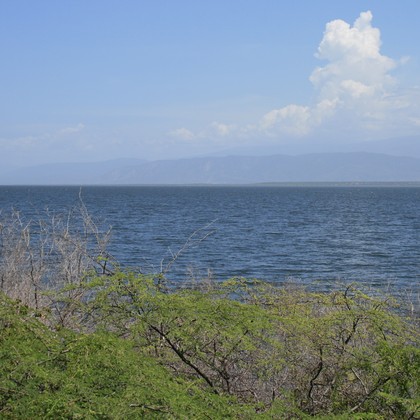
Where the bird is most at home, classified by the vegetation types of the Caribbean.




Range and movements
Resident in Cuba, most numerous along the south coast and on the cays; in Hispaniola mainly in the Dominican Republic, including Lago Enriquillo and the north-west; and on Great Inagua in the southern Bahamas. Elsewhere in the Bahamas and in the Turks and Caicos Islands an irregular visitor. Scarce to rare in Jamaica, the Cayman Islands and Puerto Rico. A vagrant to the Lesser Antilles; an irregular visitor to Trinidad and the ABC Islands. Outside the region in Florida, Texas and Louisiana, along the coasts of Mexico and Central America, and across much of South America east of the Andes.
- Resident
- Summer visitor (c. Oct–Mar)
- Winter visitor (c. Apr–Sep)
- Passage (Mar–Apr, Oct–Nov)
- dark = core range, pale = thinly spread
How and when to look
In Cuba along the south coast and in the lagoons of the north-coast cays, including Cayo Coco; in the Dominican Republic at Lago Enriquillo; on Great Inagua in the salt pans. Feeding birds are best seen at low water, when small groups walk through the lagoons with swinging heads.
Conservation status
Not threatened. In the nineteenth century the species was almost wiped out in the north of its range by plume hunting, and it has since recovered. In the Caribbean the colonies are vulnerable to disturbance, egg collecting and the clearing of mangroves.
Scientific name
Platalea ajaja | Linnaeus, 1758
Linnaeus described the species in 1758 and placed it straight away in the genus where it still stands. He introduced the genus Platalea in that same work. Platalea is the Latin word for the spoonbill, going back to Greek platus 'broad, flat', after the bill. ajaja is the bird's Tupi name, as recorded by Georg Marcgrave in Brazil. The specimen the first description was based on came from Rio São Francisco, eastern Brazil.