All species › Pelicans, herons and ibises › Ibises and spoonbills › Glossy Ibis
Glossy Ibis | Plegadis falcinellus
Zwarte ibis | Morito común
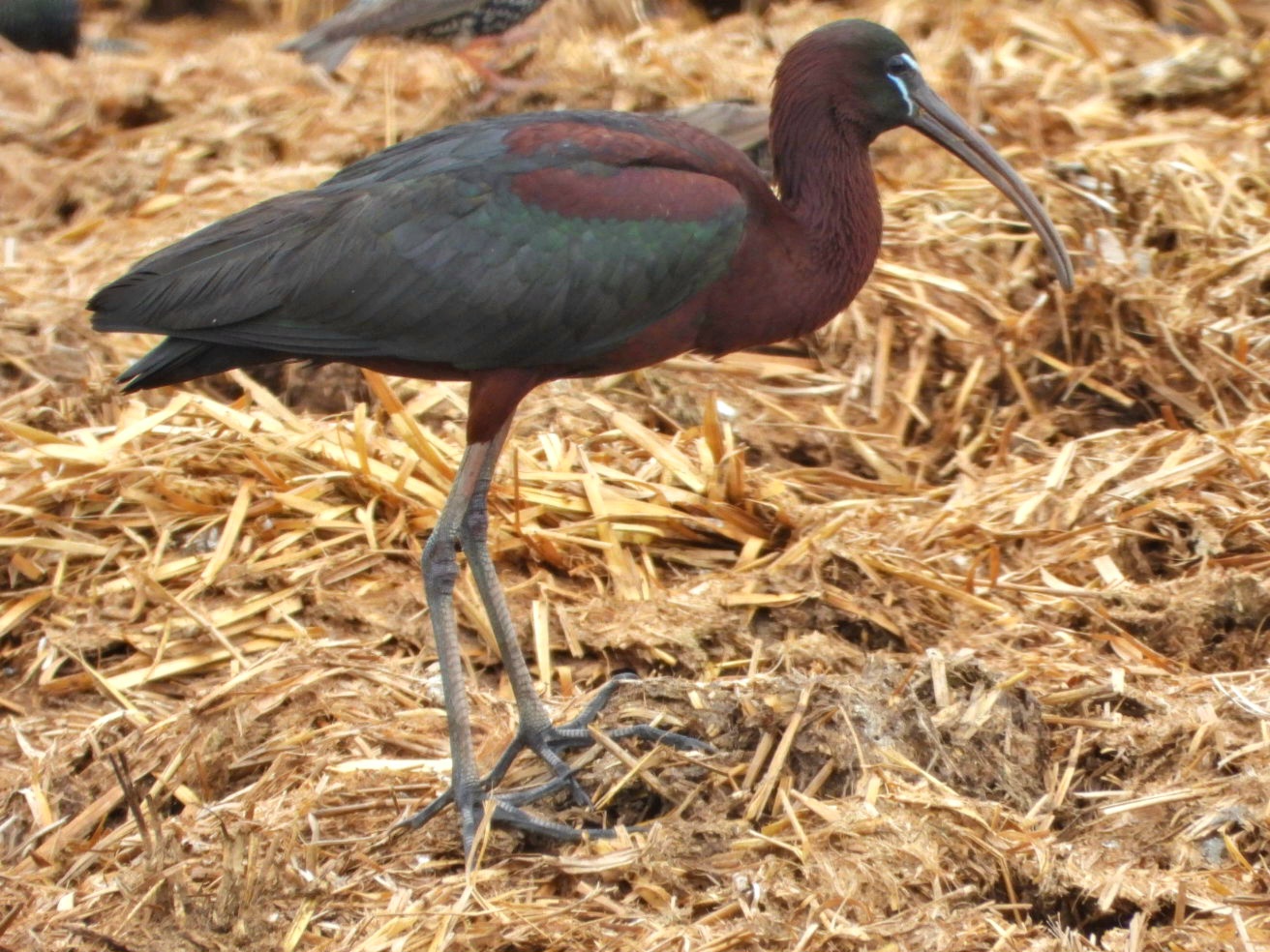
The Glossy Ibis is a dark ibis that turns out at close range to be chestnut with a green and purple metallic sheen. It is the most widespread ibis in the world and probably reached the Americas from the Old World in the nineteenth century. In the Caribbean it breeds locally in the Greater Antilles and wanders far into the Lesser Antilles. In Cuba it is called coco prieto.
Voice
Usually silent. In flight and at the colony a low, hoarse grunting grrrr and bleating, quacking sounds.
Recording: Xavier Riera — CC BY-NC-SA 4.0 · converted to mono · xeno-canto
Identification
48–66 cm, slimmer and smaller than American White Ibis, with a long, curved bill and fairly long legs. In breeding plumage head, neck and underparts are deep chestnut, the wings glossy green and purple. Between eye and bill lies bare, dark skin, bordered above and below by a narrow pale blue line that does not continue behind the eye. Outside the breeding season head and neck are dull brown, finely streaked white, and the gloss is reduced. The bill is olive-brown, the legs dark reddish brown, the eye dark. Juveniles are duller brown, with little gloss and a whitish-streaked head. It flies with the neck outstretched in lines or loose groups; at a distance it looks wholly black.
Confusion species
Tricolored Heron Egretta tricolor and Little Blue Heron Egretta caerulea are also dark, but have a straight bill and fly with the neck retracted. Young American White Ibises Eudocimus albus are brown but have a white belly and rump. Limpkin Aramus guarauna is brown with white spots and has a shorter, less curved bill. White-faced Ibis Plegadis chihi of western America, a very rare vagrant in the region, has a red eye and a white feathered border around the face in breeding plumage.
Habitat
Freshwater marshes, rice fields, flooded pasture and ditches, shallow lagoons and salt pans, and the edges of mangroves. It feeds in groups by probing mud and shallow water with the bill for insects, larvae, snails, crayfish and other small animals. It breeds in colonies in shrubs or trees over water, often alongside herons.
Where the bird is most at home, classified by the vegetation types of the Caribbean.






Range and movements
Locally resident in Cuba, where it is most numerous, Hispaniola (Haiti and the Dominican Republic), Jamaica and Puerto Rico, in fluctuating numbers. A scarce visitor to the Bahamas and the Cayman Islands. In the Lesser Antilles an irregular to rare visitor, including Barbados, Guadeloupe and Martinique. Regular in Trinidad in marshes and rice fields, rare in Tobago; an irregular visitor to the ABC Islands. Outside the region in southern and eastern Europe, Asia, Africa, Australia and along the Atlantic coast of North America.
- Resident
- Summer visitor (c. Oct–Mar)
- Winter visitor (c. Apr–Sep)
- Passage (Mar–Apr, Oct–Nov)
- dark = core range, pale = thinly spread
How and when to look
In Cuba in the rice fields and marshes of Zapata and the south coast; in Hispaniola at Lago Enriquillo and the marshes of the north-west. Groups feeding in a rice field give themselves away at a distance by their downcurved bills.
Conservation status
Not threatened. In the region it is hunted locally, and habitat is lost through the draining of marshes; rice fields offer alternative feeding grounds. Pesticide use in agriculture can affect its food supply.
Scientific name
Plegadis falcinellus | (Linnaeus, 1766)
Linnaeus described the species in 1766 as Tantalus Falcinellus; because it was later moved to another genus, the author and year stand in brackets. The genus Plegadis was introduced in 1829 by Kaup. Plegadis is Greek, from plēgas, plēgados 'sickle', after the curved bill. falcinellus is a Latin diminutive of falx, falcis 'sickle': 'little sickle', likewise after the bill. The specimen the first description was based on came from Java and Sulawesi.