All species › Falcons › Falcons › Amur Falcon
Amur Falcon | Falco amurensis
Amoerroodpootvalk | Cernícalo del Amur
The Amur Falcon makes one of the longest migrations of any raptor: from East Asia via India in a single crossing of the Arabian Sea to East and southern Africa. The region lies just west of that route, so it mainly turns up along the south coast of Arabia, in small numbers and mostly in late autumn.

Voice
Almost always silent in the region. At roosts a high, shrill kew-kew-kew.
Recording: Martin Billard — CC BY-NC-SA 4.0 · converted to mono · xeno-canto
Identification
26–30 cm, wingspan 63–71 cm. Slim and long-winged, slightly smaller than a Red-footed Falcon. The male is dark slate-grey with rufous thighs and undertail, orange-red legs, cere and eye ring, and white underwing coverts that contrast sharply in flight with the blackish flight feathers. The female has a grey crown, a short dark moustache, grey upperparts barred dark, and white underparts with black drops and arrowheads, with pale orange-buff thighs. The juvenile resembles the female but is browner, with pale fringes above and streaks below.
Confusion species
Red-footed Falcon (Falco vespertinus) is best told by the wholly dark underwing of the male and the orange-buff crown and unstreaked orange underparts of the female. Eurasian Hobby (Falco subbuteo) has a longer moustache, streaked rather than spotted underparts and no red legs. Sooty Falcon (Falco concolor) is larger and uniformly grey without a white underwing. Young birds are hardest and need good photos of underwing and head.
Habitat
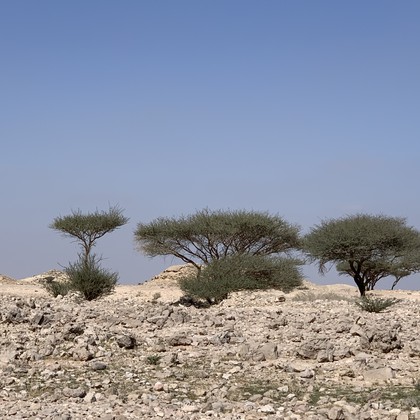
On passage open country: fields and irrigated farmland, coastal plains, grassland and thorn scrub, often on wires or in trees by farms. Hunts large insects, sometimes by hovering.
Where the bird is most at home, classified by the habitats of North Africa and the Middle East.


Range and movements
In Oman a scarce but regular passage migrant, mainly along the coasts of Dhofar and the east in October and November, occasionally also in spring. In Yemen (Aden and the south coast) and on Socotra a few autumn records. Elsewhere in the region a rare vagrant: a handful of records in the United Arab Emirates, Saudi Arabia and Israel, and two in Kuwait since the first in May 2010. Not known with certainty from North Africa. Breeds in south-east Siberia, north-east China and Korea and winters in East and southern Africa.
- Resident
- Winter visitor (c. Apr–Sep)
- dark = core range, pale = thinly spread
How and when to look
The best chance is in November in Dhofar or on Masirah: check farm fields and wires along the coast for small falcons. A male with white underwings is unmistakable; a female or juvenile needs a good view of crown and underparts to rule out Red-footed Falcon.
Conservation status
Not threatened, with a very large world population. On migration in Nagaland (north-east India) tens of thousands were caught each year until about 2012; local conservation programmes have greatly reduced this. In the region a scarce passage migrant, mainly in Oman, without specific threats.
Scientific name
Falco amurensis | Radde, 1863
Radde described the species in 1863 and placed it straight away in the genus where it still stands. The genus Falco was introduced in 1758 by Linnaeus. Falco is Late Latin for 'falcon', from falx, falcis 'sickle', after the sickle-shaped claws of the bird. amurensis refers to the Amur, the river on the Russia–China border where the species breeds and the type was collected. The specimen the first description was based on came from Zeya River, Amur region, Russia.