All species › Falcons › Falcons › Red-Footed Falcon
Red-Footed Falcon | Falco vespertinus
Roodpootvalk | Cernícalo patirrojo
The Red-footed Falcon is a small, sociable falcon of the steppes of eastern Europe and Central Asia that winters in southern Africa. In the region it is a passage migrant: in spring flocks cross the Sahara towards the Mediterranean, resting on wires and in orchards in Tunisia, Libya, Egypt and the Levant.

Voice
Usually silent on passage. At roosts and colonies a high, rapid kikiki, higher and less shrill than Common Kestrel.
Recording: Arjun Dutta — CC BY-NC-SA 4.0 · converted to mono · xeno-canto
Identification
28–31 cm, wingspan 65–76 cm. A slim falcon with fairly long, pointed wings and a medium-length tail. The male is uniform dark slate-grey with silvery-grey primaries, rufous thighs and undertail coverts, and orange-red legs, cere and eye ring. The female has an orange-buff crown and unstreaked orange-buff underparts, a white throat and cheeks with a small black mask round the eye, and blue-grey upperparts barred black. The juvenile is browner, with a pale head, a dark mask and streaked underparts. Often hovers, but also hawks insects in the air like a hobby, and rests in small groups on wires.
Confusion species
The male Amur Falcon (Falco amurensis) has white underwing coverts rather than a wholly dark underwing; the female has a grey crown and white underparts spotted black. Sooty Falcon (Falco concolor) is also slate-grey, but larger and longer-winged, without rufous thighs and with yellow feet. A young Red-footed Falcon resembles a young Eurasian Hobby (Falco subbuteo), but that has a darker back, a longer moustache and no pale crown. Lesser Kestrel (Falco naumanni) has a rufous back and a barred underwing.
Habitat
On passage open country with perches: fields, irrigated farmland, orchards and oases, steppe and coastal plains, often by telephone wires and tree lines. Hunts large insects, especially beetles, dragonflies and grasshoppers, and roosts in groups in trees.
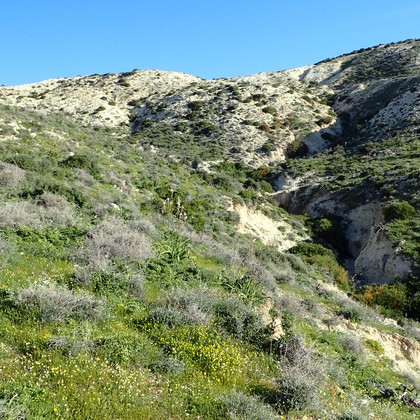
Where the bird is most at home, classified by the habitats of North Africa and the Middle East.


Range and movements
Passage migrant, mainly in spring when many birds cross the central and eastern Sahara northwards: then regular in Tunisia (for example Cap Bon), Libya, Egypt (Nile valley and Sinai) and Israel, sometimes in flocks of dozens. Scarce in Algeria and Morocco, and in small numbers in the Levant, Iraq and Arabia, in eastern Arabia mainly as a vagrant. In autumn most birds travel more directly south and it is much scarcer in the region. Breeds from eastern Europe (Hungary, Romania, Ukraine) across the steppes to Central Asia and winters in south-western Africa.
- Resident
- Summer visitor (c. Apr–Sep)
- Passage (Mar–Apr, Oct–Nov)
- dark = core range, pale = thinly spread
How and when to look
In April and May watch for small flocks of small falcons on wires at Cap Bon in Tunisia, in the oases and the Nile valley, and in the kibbutz fields around Eilat and in northern Israel. A uniform slate-grey male with red legs is unmistakable; in a female look at the orange crown and unstreaked underparts.
Conservation status
Vulnerable. The world population of 300,000–400,000 mature birds has declined strongly in recent decades through agricultural intensification, the loss of steppe and grassland and the disappearance of rookeries whose nests it takes over. In the wintering areas the felling of roost trees and hunting play a role, and on migration insecticides.
Scientific name
Falco vespertinus | Linnaeus, 1766
Linnaeus described the species in 1766 and placed it straight away in the genus where it still stands. The genus Falco was introduced in 1758 by Linnaeus. Falco is Late Latin for 'falcon', from falx, falcis 'sickle', after the sickle-shaped claws of the bird. vespertinus is Latin for 'of the evening', from vesper 'evening'. The specimen the first description was based on came from the St Petersburg region.