All species › Mousebirds › Mousebirds › Blue-Naped Mousebird
Blue-Naped Mousebird | Urocolius macrourus
Blauwnekmuisvogel | Pájaro ratón nuquiazul
A slender, grey-brown mousebird with a very long, pointed tail, a crest and a turquoise-blue nape patch, which clambers through the acacia scrub of the Sahel in small parties. In the region it is a scarce visitor on the extreme southern edge: since the first photographs in 2018 it has been seen regularly in the border villages of southern Algeria, so it may be a regular visitor there.

Voice
A clear, whistled, slightly descending tieuw-tieuw or peeeuw, often repeated by the whole party as a contact call in flight.
Recording: Bram Piot — CC BY-NC-SA 4.0 · shortened to the first 60 s, mono · xeno-canto
Identification
About 35 cm, more than half of it tail. Plain sandy grey-brown with a pointed crest, a black mask around the eye and a striking turquoise-blue patch on the nape. The bare eye skin and the base of the bill are red, the bill tip black; legs reddish. The tail is long, narrow and strongly graduated. Sexes alike; juveniles lack the blue nape patch and have a greenish bill base. Clambers mouse-like through branches and flies fast and straight, alternating flapping and gliding, the long tail trailing like a stick.
Confusion species
No other mousebirds in the region. A flying Rose-ringed Parakeet (Psittacula krameri) also has a long pointed tail, but is green with a red bill. Fulvous Babbler (Argya fulva), which lives in the same oases, is also long-tailed and moves about in parties, but is warm rufous-brown, lacks crest and mask and has a dark bill.
Habitat
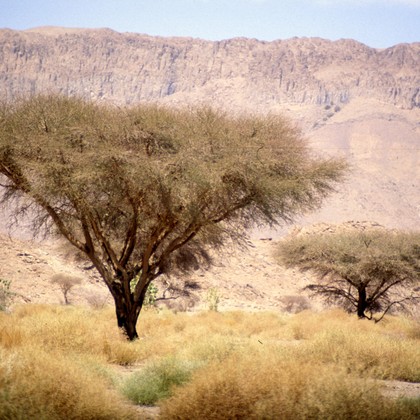
In the Sahel dry acacia scrub, open savanna, the banks of dry riverbeds and villages with gardens. In the region seen in the gardens and date gardens of oases and border villages in the southern Sahara. Eats fruit, leaves, buds and flowers; rests huddled together on a branch.
Where the bird is most at home, classified by the habitats of North Africa and the Middle East.

Range and movements
Scarce visitor. Since 29 July 2018, when a bird was photographed in a village in the Tin Zaouatine district in the south of Tamanrasset province, it has been seen regularly in the far south of Algeria, usually single birds, sometimes small parties, mainly in summer and autumn; in 2025 it was photographed repeatedly at Bordj Badji Mokhtar on the border with Mali. No certain modern records elsewhere in the region; old specimens labelled 'Egypt' probably come from what was then Anglo-Egyptian Sudan. Beyond the region across the whole Sahel, from Mauritania (north to around Choum) and Senegal to Ethiopia, Somalia, Kenya and Tanzania.
- Resident
- Summer visitor (c. Apr–Sep)
- Winter visitor (c. Oct–Mar)
- Passage (Mar–Apr, Oct–Nov)
- dark = core range, pale = thinly spread
How and when to look
Only in the border area of southern Algeria, which is difficult and not always safe to visit. Anyone who gets there should check the green gardens and date gardens of the border villages and listen for the whistled call of a party flying over.
Conservation status
Not globally threatened and common in the Sahel. In the region a scarce visitor on the very edge, crossing the border regularly since 2018; new records from Algeria and Libya are welcome at the national rarities committees.
Scientific name
Urocolius macrourus | (Linnaeus, 1766)
Linnaeus described the species in 1766 as Lanius macrourus; because it was later moved to another genus, the author and year stand in brackets. The genus Urocolius was introduced in 1854 by Bonaparte. Urocolius comes from the Greek oura, 'tail', and the genus Colius — for the very long tail of these mousebirds. macrourus is Greek for 'long-tailed', from makros 'long' and ouros 'tail'. The specimen the first description was based on came from Senegal.