All species › Waterfowl › Ducks, geese and swans › Eurasian Wigeon
Eurasian Wigeon | Mareca penelope
Smient | Silbón europeo
The whistling duck of the winter lagoons. Flocks of Eurasian Wigeon graze the banks and short grass around the lakes and lagoons of the Maghreb, the Nile Delta and Iraq, and their clear whee-oo carries over the water; further south and east, in Arabia, it quickly becomes scarce.

Voice
The male gives a clear descending whistle, whee-oo, the sound that betrays a flock; the female a low growl, krrr.
Recording: Sjouke Scholten — CC BY-NC-SA 4.0 · converted to mono · xeno-canto
Identification
Medium-sized, with a rounded head, a short blue-grey bill with a black tip and a pointed tail. The male has a chestnut head with a creamy-yellow forehead, a pinkish-grey breast, grey flanks, a white patch before the black rear and in flight a large white panel on the forewing. The female is warm rufous to greyish-brown, with a white belly and sharply demarcated flanks; in flight she shows a greyish forewing and a pale underwing with dark axillaries. First-winter males still lack the white wing panel.
Confusion species
The female resembles female Gadwall (Mareca strepera), which has an orange bill edge, a more angular head and a white speculum. American Wigeon (Mareca americana), a vagrant, has a green eye patch and white forehead in the male, and white rather than grey axillaries in both sexes. Female Falcated Duck (Mareca falcata) is darker with a longer, dark bill.
Habitat
Coastal lagoons, brackish and freshwater lakes with grassy banks, estuaries, wet meadows and treated-water lagoons. It grazes on land like a goose and also takes eelgrass and water plants from the surface. Roosts in dense flocks on open water.
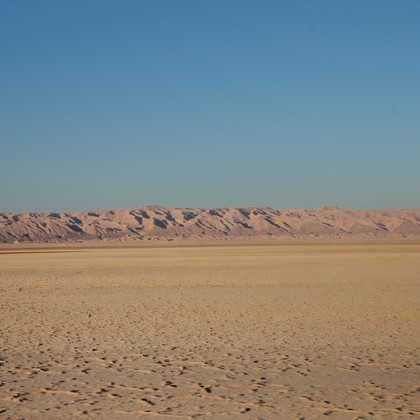
Where the bird is most at home, classified by the habitats of North Africa and the Middle East.


Range and movements
Numerous in winter along the coasts and on the lakes of Morocco (Merja Zerga, Moulouya), Algeria (El Kala), Tunisia (Ichkeul) and Libya, in Egypt (Nile Delta lakes, Bardawil), Israel, Syria and Iraq. Scarce but regular in Kuwait, Bahrain, Qatar, the Emirates and Oman, rare in Saudi Arabia and Yemen. Does not breed in the region. Beyond it, breeds from Iceland and Scandinavia to eastern Siberia and winters in western Europe, around the Mediterranean, in the Sahel, South Asia and East Asia.
- Resident
- Winter visitor (c. Apr–Sep)
- Passage (Mar–Apr, Oct–Nov)
- dark = core range, pale = thinly spread
How and when to look
Ichkeul in Tunisia and Merja Zerga in Morocco hold thousands of wigeon in January; the Nile Delta lakes and Bardawil on the north coast of Sinai are also good. Listen at the lagoons for the whistling males and search large flocks for a male with a white forehead and a green eye patch.
Conservation status
Not threatened. The wintering numbers in North Africa are important for the Mediterranean population. Hunting, drainage and pollution of the delta lakes are the main concerns.
Scientific name
Mareca penelope | (Linnaeus, 1758)
Linnaeus described the species in 1758 as Anas Penelope; because it was later moved to another genus, the author and year stand in brackets. The genus Mareca was introduced in 1824 by Stephens. Mareca comes from the Portuguese marreco, a word for a small duck. penelope refers to the duck said in Greek tradition to have saved Penelope when she was thrown into the sea; her name is from pene 'thread' and ops 'appearance', after the weaving ruse with which she kept her suitors at bay. The specimen the first description was based on came from Sweden.