All species › Waterfowl › Ducks, geese and swans › Northern Shoveler
Northern Shoveler | Spatula clypeata
Slobeend | Cuchara común
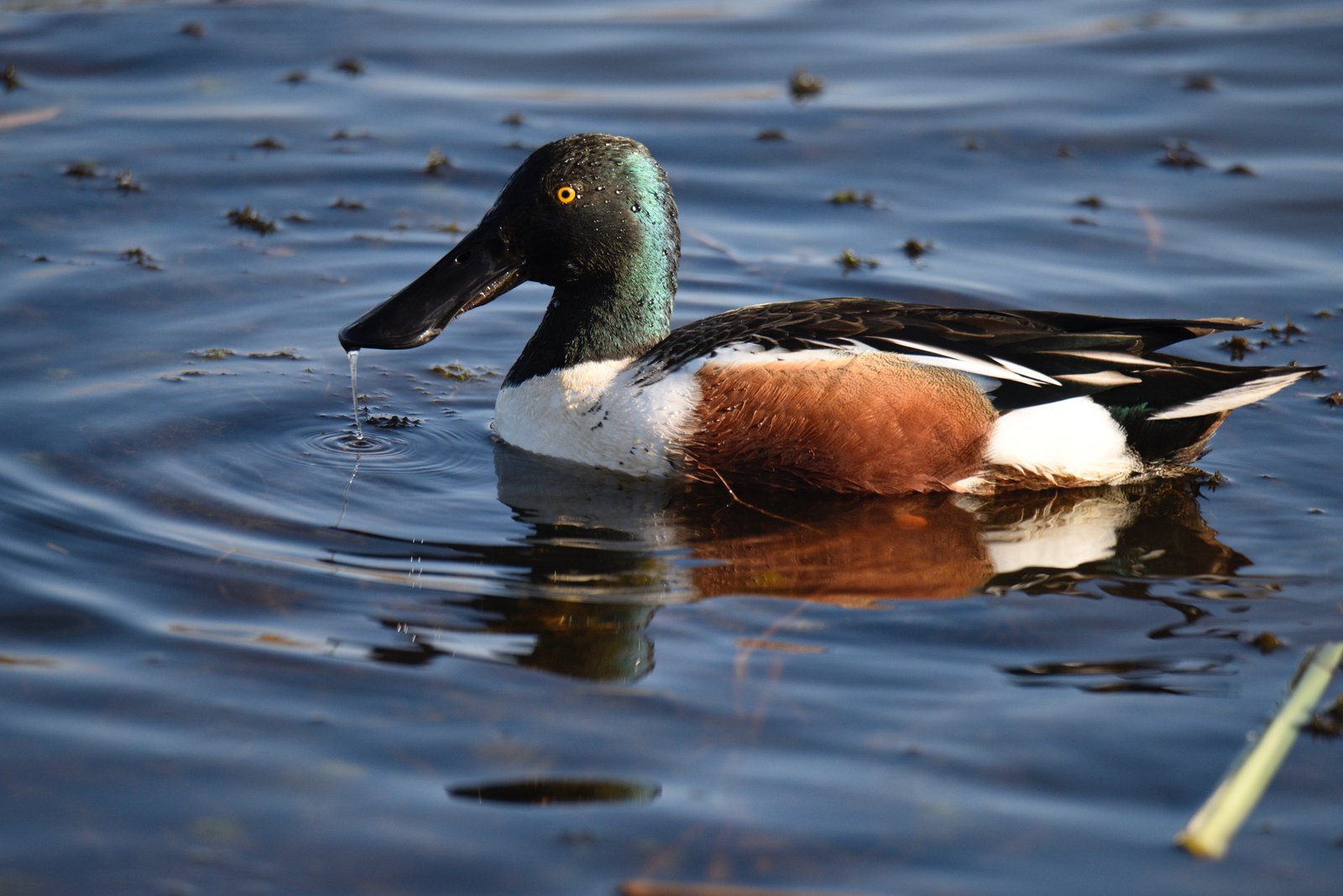
The spoon-billed duck is one of the most numerous ducks in the region in winter. On the Nile Delta lakes, in the Tunisian and Moroccan lagoons, in the marshes of southern Iraq and on treated-water lagoons in the Gulf states, flocks of Northern Shovelers sieve the water with their broad bills, often spinning in circles.
Voice
Fairly quiet. The male gives a hollow double took-took and a dry wing rattle on take-off; the female a hoarse descending quack, quack-quack-quack.
Recording: Sonothèque ADVL — CC0 · converted to mono · xeno-canto
Identification
Medium-sized, with a long bill strongly broadened at the tip that dominates the silhouette; sits low on the water with the bill angled down. The male has a glossy dark green head, a yellow eye, a white breast and chestnut flanks. The female is mottled brown, with an orange edge to the bill. In flight both sexes show a pale blue forewing with a white bar and a green speculum; the wings appear set far back behind the heavy front end. Males in transitional plumage often show a pale facial crescent in autumn and winter.
Confusion species
The bill makes confusion unlikely. Female Mallard (Anas platyrhynchos) has a smaller, ordinary bill and a blue speculum; female Gadwall (Mareca strepera) a narrow bill and a white speculum. In flight Garganey (Spatula querquedula) and Blue-winged Teal (Spatula discors) share the blue forewing, but are much smaller and smaller-billed.
Habitat
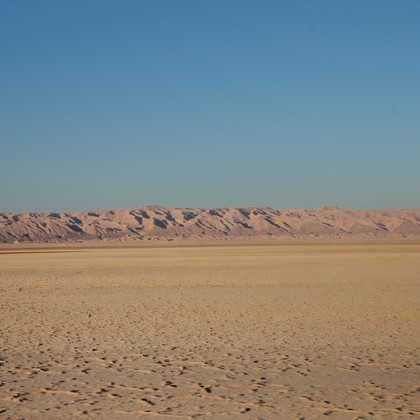
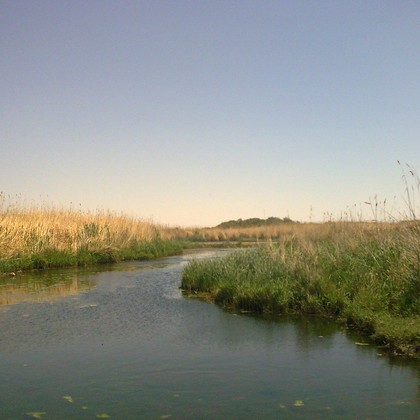
Shallow, nutrient-rich water over soft bottoms: coastal lagoons, brackish lakes and freshened chotts, the Nile Delta lakes, rice fields, fishponds, reservoirs and treated-water and sewage lagoons, which are its main roosts in Arabia. It sieves surface water for plankton, small crustaceans, insect larvae and seeds; flocks often spin together to draw food to the surface.
Where the bird is most at home, classified by the habitats of North Africa and the Middle East.

Range and movements
A winter visitor throughout the region, with large numbers in Egypt (Manzala, Burullus, Idku), Tunisia (Ichkeul and the lagoons), Algeria, Morocco (Merja Zerga, the Moulouya mouth), Israel, Iraq and along the Gulf coast; common in the Emirates, Bahrain, Qatar and Kuwait, scarcer in Oman, Yemen and the interior of Saudi Arabia. Also a migrant along the Red Sea and through Saharan oases. Breeds in small numbers in Morocco, Algeria and Tunisia and exceptionally elsewhere. Beyond the region it breeds in Europe, Asia and North America and winters as far as East Africa, South Asia and Central America.
- Resident
- Summer visitor (c. Oct–Mar)
- Winter visitor (c. Apr–Sep)
- Passage (Mar–Apr, Oct–Nov)
- dark = core range, pale = thinly spread
How and when to look
In December and January the Egyptian delta lakes, Ichkeul in Tunisia and the treated-water lagoons of Al Wathba and Abu Dhabi or Jahra Pool in Kuwait are good sites. Watch for small groups spinning in circles: they are almost always shovelers. Marbled Teal and White-headed Duck often join them.
Conservation status
Not threatened. Numbers in the region vary from year to year with water levels. Hunting on the Nile Delta lakes and in Iraq and the drainage of wetlands are the main threats; the growth of wastewater lagoons in the Gulf states has, by contrast, given the species more roosts there.
Scientific name
Spatula clypeata | (Linnaeus, 1758)
Linnaeus described the species in 1758 as Anas clypeata; because it was later moved to another genus, the author and year stand in brackets. The genus Spatula was introduced in 1822 by Boie. Spatula is Latin for 'spoon' or 'spatula', after the broad, spoon-shaped bill of the shoveler. clypeata is Latin for 'shield-bearing', from clypeus 'shield'. The specimen the first description was based on came from southern Sweden.