All species › Pelicans, herons and ibises › Herons and bitterns › Great Egret
Great Egret | Ardea alba
Grote zilverreiger | Garceta grande
A large, slender white heron with a long, kinked neck, the size of a Grey Heron. In the region it is mainly a winter visitor, from the Moroccan merjas to the mangroves of the Gulf; as a breeding bird it is scarce and confined to a few large wetlands.

Voice
Usually silent; when flushed a low, rough, rattling krrra or grrak, deeper than Grey Heron. Various croaking and gargling sounds in the colony.
Recording: Xavier Riera — CC BY-NC-SA 4.0 · converted to mono · xeno-canto
Identification
All white, large and slender, with a very long, strongly kinked neck and long legs. Outside the breeding season the dagger-shaped bill is yellow and the legs black, with yellowish toes and often a yellowish lower leg. In breeding plumage the bill becomes largely black, the bare lores green, and it carries long lacy plumes on the back, but no crest. The gape line clearly extends behind the eye. Flight slow and stately, with the neck retracted and the legs projecting well beyond the tail.
Confusion species
Little Egret (Egretta garzetta) is much smaller, with a black bill, black legs and yellow feet. Medium Egret (Ardea intermedia) is smaller, with a shorter bill, a rounder head and a less strongly kinked neck; the gape line ends below the eye. Cattle Egret (Ardea ibis) is much smaller and stocky. The white morph of Western Reef Heron (Egretta gularis) is smaller, with a heavy, slightly drooping bill and dark legs. A Grey Heron (Ardea cinerea) against the light can look pale but has grey upperparts and black wingtips.
Habitat
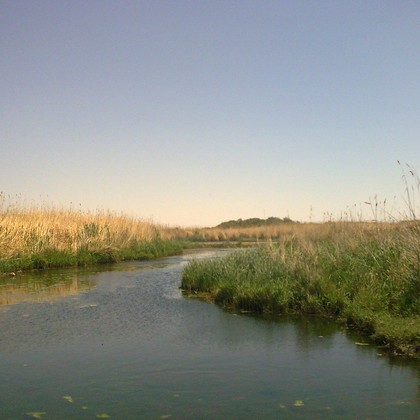
Reed marshes, open shores of lakes and rivers, flooded grassland and rice fields, fish ponds, coastal lagoons and tidal flats, and in Arabia also mangroves and creeks. It hunts standing or slowly stalking, mainly for fish but also for rodents and large insects in dry fields. Breeds in colonies in reeds or trees, often with other herons and cormorants.
Where the bird is most at home, classified by the habitats of North Africa and the Middle East.


Range and movements
As a breeder mainly in the marshes of southern Iraq (Hawizeh, the Central Marshes and Hammar); in Egypt it breeds in small numbers in the Nile Delta and at Lake Nasser. In the Maghreb it has bred for some decades in small numbers in north-east Algeria and locally in Morocco and Tunisia. In winter widespread across the north: the Moroccan merjas and Souss-Massa, Ichkeul and the Tunisian lagoons, the Egyptian delta lakes, the Hula Valley and the fish ponds of the Jordan Valley, and the wetlands of Syria. In Arabia a common winter visitor along the Gulf coasts (Kuwait, Bahrain, Qatar, the Emirates), in Oman and along the Red Sea, in smaller numbers inland and in Yemen. On passage also at oases. Beyond the region almost worldwide, from Europe and Asia to Africa, Australia and the Americas; birds in eastern Arabia partly belong to the Asian form.
- Resident
- Summer visitor (c. Apr–Sep)
- Winter visitor (c. Oct–Mar)
- Passage (Mar–Apr, Oct–Nov)
- dark = core range, pale = thinly spread
How and when to look
In winter the fish ponds of the Hula and Beit She'an valleys in Israel, the Egyptian delta lakes and the mangroves of Abu Dhabi and Khor Kalba in the Emirates are good sites, often with dozens together. When in doubt against Medium Egret, always check the length of the gape line.
Conservation status
Not globally threatened, and strongly increasing in Europe and North Africa after centuries of persecution for its plumes. In the region drainage of marshes, disturbance of colonies and hunting threaten the small breeding populations; Iraqi birds suffered from the draining of the marshes in the 1990s.
Scientific name
Ardea alba | Linnaeus, 1758
Linnaeus described the species in 1758 and placed it straight away in the genus where it still stands. He introduced the genus Ardea in that same work. Ardea is the Latin word for 'heron'. alba is Latin for 'white'. The specimen the first description was based on came from Europe.