All species › Pelicans, herons and ibises › Herons and bitterns › Indian Pond Heron
Indian Pond Heron | Ardeola grayii
Indische ralreiger | Garcilla india
The Asian counterpart of Squacco Heron, a small, stocky heron that reaches the western edge of its range in the south-east corner of the region. In Oman and the Emirates it is a regular winter visitor to sewage ponds, pools and creeks; in 2024 the first breeding on the Arabian Peninsula was confirmed near Muscat.

Voice
Usually silent. On take-off a harsh, short kraak or krek; guttural croaking at the breeding site.
Recording: Stanislas Wroza — CC BY-NC-SA 4.0 · converted to mono · xeno-canto
Identification
A small, compact heron that looks brown and inconspicuous when perched and suddenly turns almost all white when it takes off: wings, rump and tail are white. In non-breeding plumage the head, neck and breast are heavily streaked brown on a pale ground and the back is dark grey-brown; the bill is yellowish with a dark tip, the legs greenish-yellow. In breeding plumage (from March) the head and neck become plain pale buff with long white plumes, and the back deep maroon to purple-brown. Juveniles resemble non-breeding adults but are duller and more heavily streaked.
Confusion species
Squacco Heron (Ardeola ralloides) is barely separable in non-breeding plumage: on average it is warmer, paler brown above and more finely streaked, but only breeding plumage is conclusive, when Squacco shows a warm ochre-brown back and a yellow bill with a blue base. Chinese Pond Heron (Ardeola bacchus) has a chestnut head and neck and a slate-grey back in breeding plumage; in winter it too is virtually identical. Cattle Egret (Ardea ibis) is all white even when perched. In flight it may recall Striated Heron (Butorides striata), but that species has dark wings.
Habitat
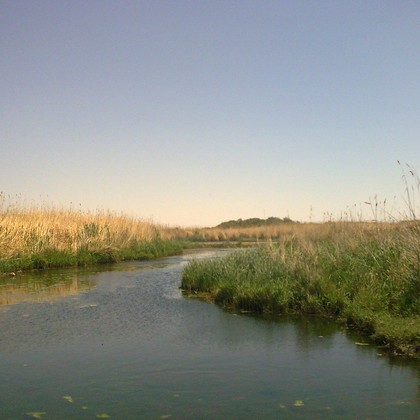
Sewage ponds, pools, flooded fields, canals and ditches, water channels in date gardens and the edges of mangroves and creeks. It stands motionless for long periods at the water's edge or in vegetation, taking fish, frogs and insects; less shy than Squacco Heron and often close to people.
Where the bird is most at home, classified by the habitats of North Africa and the Middle East.


Range and movements
Oman: regular winter visitor in small numbers, especially on the Batinah coast, around Muscat and in Dhofar (Salalah and the khawrs); in 2024 a pair bred at Al Ansab wetland near Muscat, the first breeding on the Arabian Peninsula. United Arab Emirates: scarce but regular winter visitor, with a few birds staying year-round. Resident on Socotra (Yemen), where breeding has recently been confirmed. A rare visitor or vagrant to Qatar, Bahrain and Kuwait; Kuwait has only a handful of records. Rare elsewhere in Yemen and in eastern Saudi Arabia. Beyond the region it breeds from southern Iran and Pakistan through India and Sri Lanka to Myanmar.
- Resident
- Summer visitor (c. Oct–Mar)
- Winter visitor (c. Apr–Sep)
- dark = core range, pale = thinly spread
How and when to look
Al Ansab near Muscat and the khawrs around Salalah are the most reliable sites in winter. Search the edges of well-vegetated pools: birds often sit stock-still and only stand out when they flush white. In March and April birds in breeding plumage can be seen, which allows certain separation from Squacco Heron.
Conservation status
Not globally threatened and common in its core range. In the region it seems to be increasing, helped by the creation of sewage ponds and artificial wetlands in Oman and the Emirates. Non-breeding birds turning up outside eastern Arabia cannot be safely separated from Squacco Heron, so its true occurrence further north remains uncertain.
Scientific name
Ardeola grayii | (Sykes, 1832)
Sykes described the species in 1832 as Ardea Grayii; because it was later moved to another genus, the author and year stand in brackets. The genus Ardeola was introduced in 1822 by Boie. Ardeola is Latin, a diminutive of ardea 'heron', so 'little heron'. grayii honours John Edward Gray (1800-1875), British zoologist at the British Museum. The specimen the first description was based on came from Deccan Plateau, India.