All species › Pelicans, herons and ibises › Herons and bitterns › Squacco Heron
Squacco Heron | Ardeola ralloides
Ralreiger | Garcilla cangrejera
A small, ochre heron that blends into the reeds when perched and flashes surprisingly white in flight. In the region it breeds in the marshes of the Maghreb, the Nile Delta, the Levant and southern Iraq, and on passage it crosses the Sahara and the Arabian Peninsula in large numbers.

Voice
Seldom heard. On take-off or in the colony a harsh, duck-like karr or kaa-kaa, mainly at dusk.
Recording: Xavier Riera — CC BY-NC-SA 4.0 · converted to mono · xeno-canto
Identification
Small and stocky, with a short, thick neck, warm ochre-brown when perched with the white wings largely hidden. On take-off the wings, rump and tail become bright white. In breeding plumage the head and neck are pale ochre with fine dark streaks and long black-and-white striped plumes on the nape, and the back is warm buff with long mantle plumes; the bill is bluish with a black tip and the legs pink to red. Outside the breeding season the head is more heavily streaked, the back duller brown and the bill greenish-yellow with a dark tip. Juveniles are browner and more heavily streaked.
Confusion species
Indian Pond Heron (Ardeola grayii) of eastern Arabia is hardly separable in non-breeding plumage; in breeding plumage it has a dark maroon back and no striped crest. Cattle Egret (Ardea ibis) is all white even when perched. Little Bittern (Botaurus minutus) is smaller and shows a striking pale wing panel on a dark wing in flight, but no white wings and tail. Juvenile Black-crowned Night-Heron (Nycticorax nycticorax) is larger, brown with white spots and has brown wings.
Habitat
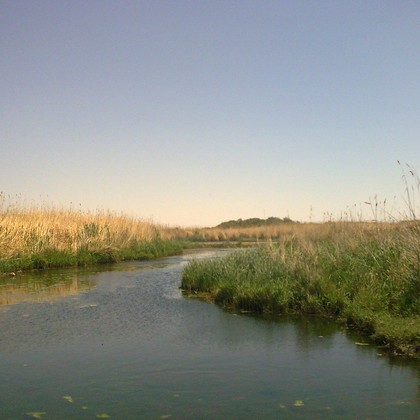
Reed marshes, willow and tamarisk scrub along water, rice fields, irrigation channels, fish ponds and the banks of rivers and lakes. Breeds in colonies, often with other herons, in bushes and trees over water or in reeds. On passage also at small waters in oases and at sewage ponds in the middle of the desert.
Where the bird is most at home, classified by the habitats of North Africa and the Middle East.


Range and movements
Breeds in Morocco in the merjas of the Atlantic coast (Merja Zerga, Bas Loukkos) and on the Moulouya, in north-east Algeria (El Kala, Lac Tonga, Lac Fetzara) and locally in Tunisia. In Egypt it is numerous in the Nile Delta and along the Nile to Aswan and Lake Nasser, and is also present there in winter. In the east it breeds in Israel (Hula Valley and coastal plain), Syria and above all in the marshes of southern Iraq, where birds also winter. On passage throughout the region: across the Sahara (Libya, Algeria), through the Jordan Valley and past Eilat, and widely in Saudi Arabia, the Gulf states, Oman and Yemen; a few winter in south-west Arabia. Beyond the region it breeds in southern Europe and from Turkey to Central Asia, and in sub-Saharan Africa and Madagascar; Palearctic birds winter in tropical Africa.
- Resident
- Summer visitor (c. Oct–Mar)
- Winter visitor (c. Apr–Sep)
- Passage (Mar–Apr, Oct–Nov)
- dark = core range, pale = thinly spread
How and when to look
In May and June practically guaranteed in the Nile Delta and at Merja Zerga. On passage, in April and September, it pays to check sewage ponds and oases in the desert, such as at Eilat, in the Arava and in the Emirates: Squacco Herons sometimes turn up in unexpected places there. Watch for flushing birds that suddenly turn white.
Conservation status
Not globally threatened. In North Africa breeding sites are lost to drainage of merjas, water abstraction and disturbance; the Iraqi population suffered badly from the draining of the marshes in the 1990s and partly recovered after reflooding. Birds crossing the Sahara are vulnerable to drought in the Sahel.
Scientific name
Ardeola ralloides | (Scopoli, 1769)
Scopoli described the species in 1769 as Ardea ralloides; because it was later moved to another genus, the author and year stand in brackets. The genus Ardeola was introduced in 1822 by Boie. Ardeola is Latin, a diminutive of ardea 'heron', so 'little heron'. ralloides combines Latin rallus 'rail' with Greek -oides 'resembling'. The specimen the first description was based on came from Carniola, Slovenia.