All species › Waders, gulls and terns › Gulls and terns › Sandwich Tern
Sandwich Tern | Thalasseus sandvicensis
Grote stern | Charrán patinegro
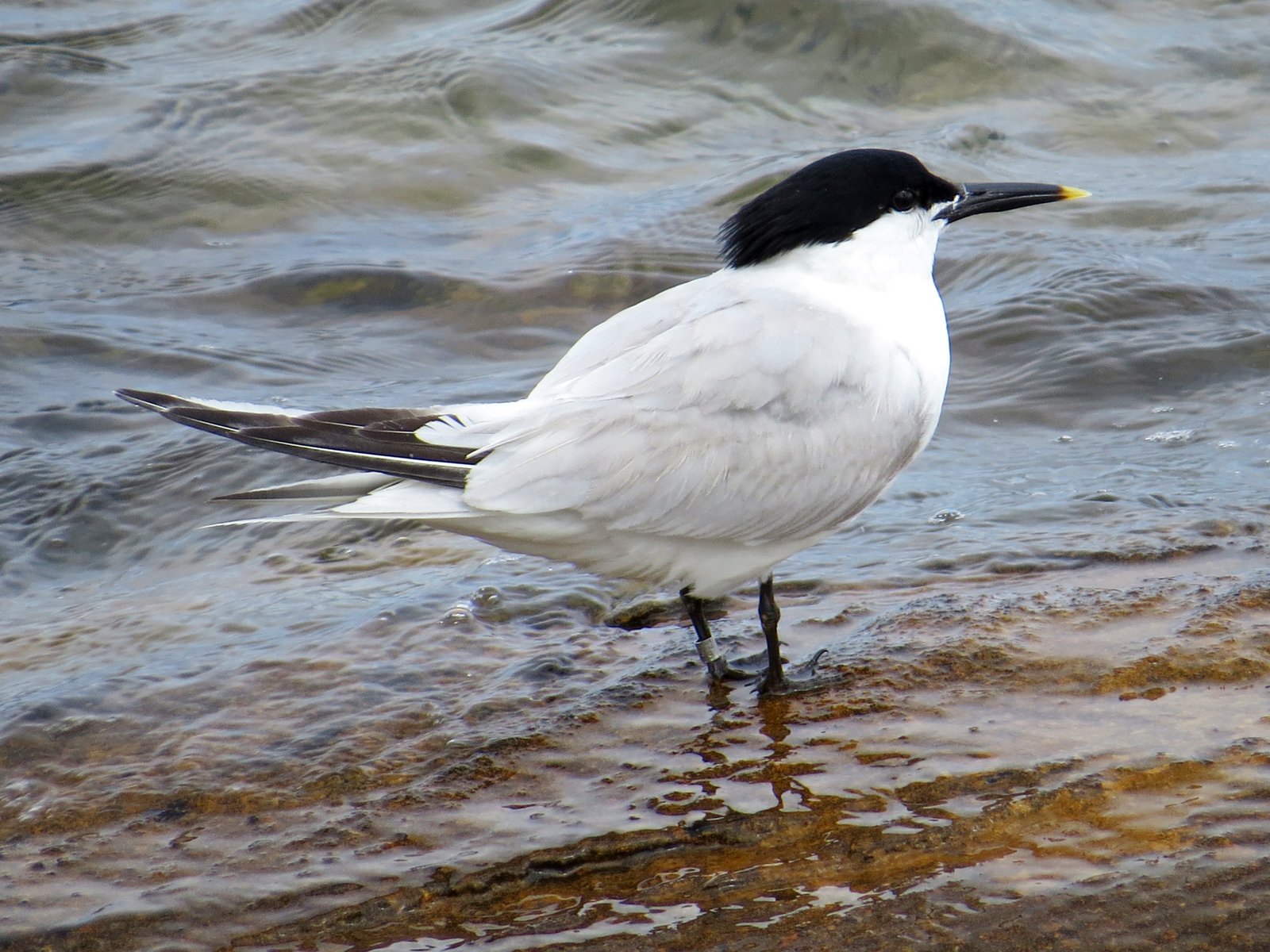
A slender, white sea tern with a long black bill tipped yellow and a shaggy crest, which plunges into the sea in a steep dive. It does not breed in the region, but as a winter visitor it is one of the commonest terns on Morocco's Atlantic coast, the Mediterranean and the Persian Gulf.
Voice
A loud, grating kirrick or kerrick, carrying far and characteristic of the species; young beg with a high, whistling sreee.
Recording: Paul Kelly — CC BY-NC-SA 4.0 · converted to mono · xeno-canto
Identification
Medium-sized, with long, narrow, pointed wings, a fairly short forked tail and a long, thin black bill with a yellow tip visible at close range. In summer plumage a black cap with a short, shaggy crest; in winter plumage (most often seen in the region) a white forehead and a black, streaked rear crown. The upperparts are very pale grey, so it looks whiter than other terns; the legs are short and black. In flight the outer primaries form a darker grey wedge. Juveniles have dark scaling on the mantle and a shorter bill without an obvious yellow tip.
Confusion species
Lesser Crested Tern (Thalasseus bengalensis) has an all orange-yellow bill and slightly darker grey upperparts. Greater Crested Tern (Thalasseus bergii) is larger, darker grey above, with a thick, greenish-yellow bill. Gull-billed Tern (Gelochelidon nilotica) has a short, thick black bill and broader wings and does not dive. Common Tern (Sterna hirundo) is smaller and greyer, with a red bill and longer tail streamers.
Habitat
Coastal waters, bays and lagoons, harbours and estuaries; rests on beaches, sandbanks and piers. Fishes in clear, shallow sea water for small fish with a steep plunge from 5–10 m. Rarely far out at sea or on fresh water.
Where the bird is most at home, classified by the habitats of North Africa and the Middle East.


Range and movements
Does not breed in the region. As a winter visitor and migrant common along the Atlantic coast of Morocco and Western Sahara (to Dakhla and further south), along the entire Mediterranean coast from Morocco to Egypt, and along the coasts of Israel, Lebanon and Syria. In the east a common winter visitor along the Persian Gulf (from Kuwait and Iraq to the Emirates), the Gulf of Oman and the coast of Oman, and in smaller numbers in the Red Sea and in Yemen. On migration also overland, for example over the Jordan Valley and the Nile. Beyond the region it breeds along the coasts of western Europe, the Mediterranean, the Black Sea and the Caspian, and in other forms in the Americas; birds winter as far as West and southern Africa and India.
- Resident
- Summer visitor (c. Oct–Mar)
- Winter visitor (c. Apr–Sep)
- Passage (Mar–Apr, Oct–Nov)
- dark = core range, pale = thinly spread
How and when to look
In winter it can be seen in almost every harbour and lagoon on Morocco's Atlantic coast, for example at Essaouira, Agadir and Oualidia, and along the corniches of the Gulf states. Its harsh call gives it away before you see it.
Conservation status
Not globally threatened. Breeding colonies outside the region are vulnerable to avian influenza, which caused heavy mortality in 2022, and to disturbance. In the region fisheries, pollution and disturbance of roosts are the main threats.
Scientific name
Thalasseus sandvicensis | (Latham, 1787)
Latham described the species in 1787 as Sterna sandvicensis; because it was later moved to another genus, the author and year stand in brackets. The genus Thalasseus was introduced in 1822 by Boie. Thalasseus derives from Ancient Greek thalassa 'sea'. sandvicensis means 'of Sandwich', the town in the English county of Kent that was the type locality. The specimen the first description was based on came from Sandwich, Kent, England.