All species › Waders, gulls and terns › Gulls and terns › Greater Crested Tern
Greater Crested Tern | Thalasseus bergii
Grote kuifstern | Charrán piquigualdo
A large, dark-grey crested tern with a thick, curved greenish-yellow bill, typical of the warm coasts of Arabia. It breeds in dense colonies on bare coral and sand islands in the Red Sea, the Persian Gulf and off Oman, and can be seen along those coasts all year.

Voice
A harsh, grating kirreck or krrow, lower and rougher than Sandwich Tern; at the colony a deafening chorus.
Recording: Romuald Mikusek — CC BY-NC-SA 4.0 · converted to mono · xeno-canto
Identification
Large and powerful, with long, fairly broad wings, a forked tail and a long, thick, slightly drooping bill that is cool greenish-yellow to lemon. In summer plumage a black cap with a scruffy crest, separated from the bill by a narrow white forehead band; in winter plumage the forehead is more broadly white and the crown speckled. The upperparts are clearly darker grey than in Sandwich and Lesser Crested Terns, with a paler rump and tail. Juveniles are darkly scaled, with dark wing bars and a dirty yellow bill.
Confusion species
Lesser Crested Tern (Thalasseus bengalensis) is clearly smaller and paler grey, with a slender orange-yellow bill and a black cap that reaches the bill in summer plumage. Caspian Tern (Hydroprogne caspia) is even larger with a heavy red bill. West African Crested Tern (Thalasseus albididorsalis) of the Atlantic coast is paler grey with an orange bill.
Habitat
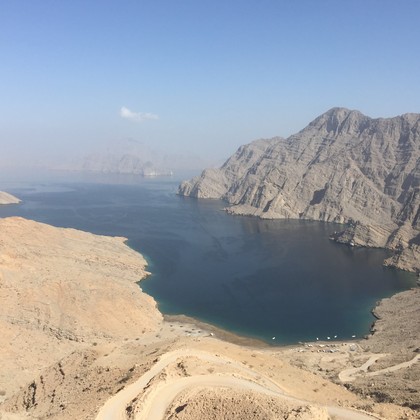
Coastal waters, coral reefs, bays, lagoons and harbours; rests on beaches, sandbanks, piers and buoys. Breeds densely on bare sand, coral and rock islands, often with Lesser Crested and Bridled Terns. Fishes mainly inshore, sometimes a few kilometres out to sea.
Where the bird is most at home, classified by the habitats of North Africa and the Middle East.


Range and movements
Breeds in the Red Sea on islands off Egypt, Saudi Arabia and Yemen (including the Farasan Islands), in the Persian Gulf on islands of Kuwait, Saudi Arabia, Bahrain, Qatar and the Emirates, along the coast of Oman (Daymaniyat and Hallaniyat Islands) and on Socotra. Outside the breeding season widespread along all these coasts, including the Gulf of Aden and north to Eilat and Aqaba, where it is scarce. In addition a small, isolated population breeds on islands in the Gulf of Sirte in Libya, among colonies of Lesser Crested Tern; from there come scattered records in Tunisia and Egypt. A vagrant to Morocco and Algeria. Beyond the region from East and southern Africa through India and Southeast Asia to Australia and the Pacific.
- Resident
- Summer visitor (c. Apr–Sep)
- Winter visitor (c. Oct–Mar)
- Passage (Mar–Apr, Oct–Nov)
- dark = core range, pale = thinly spread
How and when to look
On the corniches of Abu Dhabi, Dubai, Doha and Muscat it often sits on piers and buoys together with Sandwich and Lesser Crested Terns, allowing good comparison. In Yemen and Oman, around Salalah and Masirah, groups of juveniles can be seen on beaches in summer.
Conservation status
Not globally threatened. Colonies in the Gulf and the Red Sea are vulnerable to disturbance, egg collecting, island development and oil pollution; many of the key breeding islands are now protected. The Libyan population is small and hardly studied.
Scientific name
Thalasseus bergii | (Lichtenstein, 1823)
Lichtenstein described the species in 1823 as Sterna Bergii; because it was later moved to another genus, the author and year stand in brackets. The genus Thalasseus was introduced in 1822 by Boie. Thalasseus derives from Ancient Greek thalassa 'sea'. bergii honours the Prussian pharmacist and botanist Karl Heinrich Bergius, who collected the first specimens near Cape Town. The specimen the first description was based on came from the Cape of Good Hope.