All species › Pigeons and doves › Pigeons and doves › Afep Pigeon
Afep Pigeon | Columba unicincta
Afrikaanse houtduif | Paloma del Congo
The Afep Pigeon is a large, pale pigeon of Guineo-Congolian lowland forest that reaches only the far northern edge of the region. It lives high in the canopy and is heard more often than seen.

Voice
A deep, rolling, somewhat drumming coo, whu-whu-whu-whu-WHU, often introduced by a low growl; it carries far through the forest but is hard to locate. In display flight the bird claps its wings.
Recording: Paul Lenrumé — CC BY-NC-SA 4.0 · converted to mono · xeno-canto
Identification
About 36 cm, heavily built and strikingly pale. The hindneck is pale grey, the body pinkish grey, and the throat and belly white. The wings are dark grey and contrast clearly with the pale body. The tail is dark with a broad pale, almost white band across the middle and a blackish tip; the scientific name refers to this single band. The eye and bare orbital ring are red. The sexes are alike; juveniles are browner and duller.
Confusion species
African Olive Pigeon (Columba arquatrix) is much darker, white-spotted, with a yellow bill and yellow legs. Western Bronze-Naped Pigeon (Columba iriditorques) is much smaller and darker, with a bronze-glossed nape, and keeps lower in the forest. African Green Pigeon (Treron calvus) often shares the same fig trees but is green. The pale body, dark wings and tail band make the species unmistakable in its forest.
Habitat
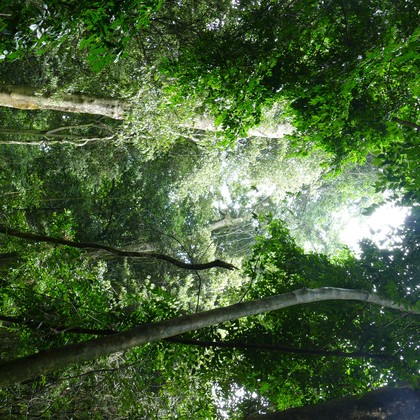
The canopy of tall, moist lowland forest and old secondary forest, and at the southern edge of its range gallery forest along rivers. It eats fruit, especially figs, and rarely comes to the ground.
Where the bird is most at home, classified by the vegetation units of southern Africa.

Range and movements
Within the region only in northern Angola, from Cabinda and Uíge to Lunda Norte, and in the far north-west of Zambia (Mwinilunga), in gallery forest and forest remnants. Beyond the region from Sierra Leone through West and Central Africa to Uganda; locally common in southern Cameroon and Gabon.
- Resident
- dark = core range, pale = thinly spread
How and when to look
In the region it is best looked for in the gallery forests around Mwinilunga and the Source of the Zambezi, and in the forests of northern Angola. Listen early in the morning for the deep cooing from the tall crowns, then search for fruiting figs. All year.
Conservation status
Not threatened and fairly common in the core of its range. Locally common in north-western Angola, but at the extreme southern margin, as in Zambia, it is scarce and dependent on fragmented gallery forest under pressure from logging, farming and fire. It is hunted for bushmeat.
Scientific name
Columba unicincta | Cassin, 1860
Cassin described the species in 1860 and placed it straight away in the genus where it still stands. The genus Columba was introduced in 1758 by Linnaeus. Columba is the Latin word for 'dove, pigeon'. unicincta is Latin for 'single-banded' — for the pale band across the tail. The specimen the first description was based on came from Ogooué River, Gabon.