All species › Pigeons and doves › Pigeons and doves › Speckled Pigeon
Speckled Pigeon | Columba guinea
Guineaduif | Paloma Guinea
The Speckled Pigeon is the large rufous pigeon of cliffs, koppies and buildings in southern Africa. Rows of white triangular spots on the wing and a broad bare red eye patch identify it at close range.

Voice
A deep resonant cooing that accelerates in tempo, doo-doo-doo-doo, heavier and more hollow than that of Feral Pigeon, often given from a ledge or roof edge. In display the male claps its wings audibly and then glides down on stiff, raised wings.
Recording: Lynette Rudman — CC BY-NC-SA 4.0 · converted to mono · xeno-canto
Identification
About 33 cm and heavily built. Head, neck and underparts are slate grey, with silvery-grey pointed hackles on the lower neck. Mantle and wing coverts are chestnut to wine red with rows of white triangular spots. A broad patch of bare red skin surrounds the eye, the legs are red and the bill dark. The rump is pale grey, the tail dark grey with a broad dark terminal band. The sexes are alike; juveniles are duller, with a narrower eye patch and less distinct white spotting.
Confusion species
Feral Pigeon (Columba livia) lacks the white wing spotting and the red eye patch and usually shows two black wing bars. African Olive Pigeon (Columba arquatrix) is dark wine red with dense small white spots, a yellow bill, yellow legs and a yellow eye ring, and lives in montane forest. Emerald-Spotted Wood Dove is far smaller and feeds on the ground in woodland. The combination of white triangles on the wing and a broad bare red eye surround is unique in the region.
Habitat
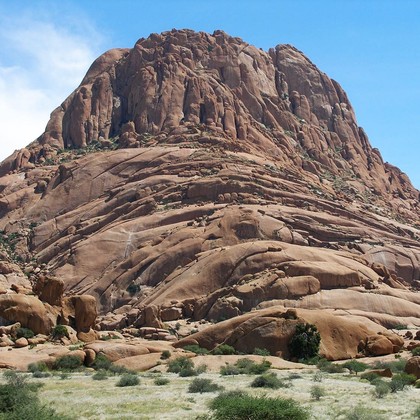
Cliffs, gorges, koppies and quarries, and increasingly buildings, bridges, silos and water towers. It feeds on the ground in fields, stubble and road verges on seeds, grain, buds and small invertebrates, and drinks daily at pools and troughs.
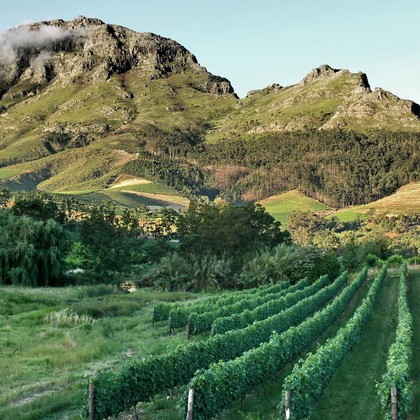
Where the bird is most at home, classified by the vegetation units of southern Africa.

Range and movements
Widespread across almost the whole region, from the Cape and Lesotho to Namibia, Botswana, Zimbabwe, Mozambique, Zambia, Malawi and Angola; scarce or absent along the Namib coast and in closed lowland forest. Beyond the region it occurs across sub-Saharan Africa from Senegal and Ethiopia southwards.
- Resident
- Summer visitor (c. Oct–Mar)
- Winter visitor (c. Apr–Sep)
- Passage (Mar–Apr, Oct–Nov)
- dark = core range, pale = thinly spread
How and when to look
Cliffs and koppies, and in towns the surroundings of grain silos, bridges and church towers. Early in the morning flocks fly out to the fields and return to the roost towards sunset. From a viewpoint, watch for the wing-clapping display flight of males. All year.
Conservation status
Not threatened and increasing. The species has benefited from the growth of towns, from bridges and tall buildings replacing natural rock ledges, and from the expansion of grain farming. Locally it is regarded as damaging to crops and is shot.
Scientific name
Columba guinea | Linnaeus, 1758
Linnaeus described the species in 1758 and placed it straight away in the genus where it still stands. He introduced the genus Columba in that same work. Columba is the Latin word for 'dove, pigeon'. guinea refers to Guinea in West Africa, the region from which the first described specimens were thought to originate. The specimen the first description was based on came from inland Guinea.