All species › Waterfowl › Ducks and geese › African Black Duck
African Black Duck | Anas sparsa
Afrikaanse zwarte eend | Ánade Negro
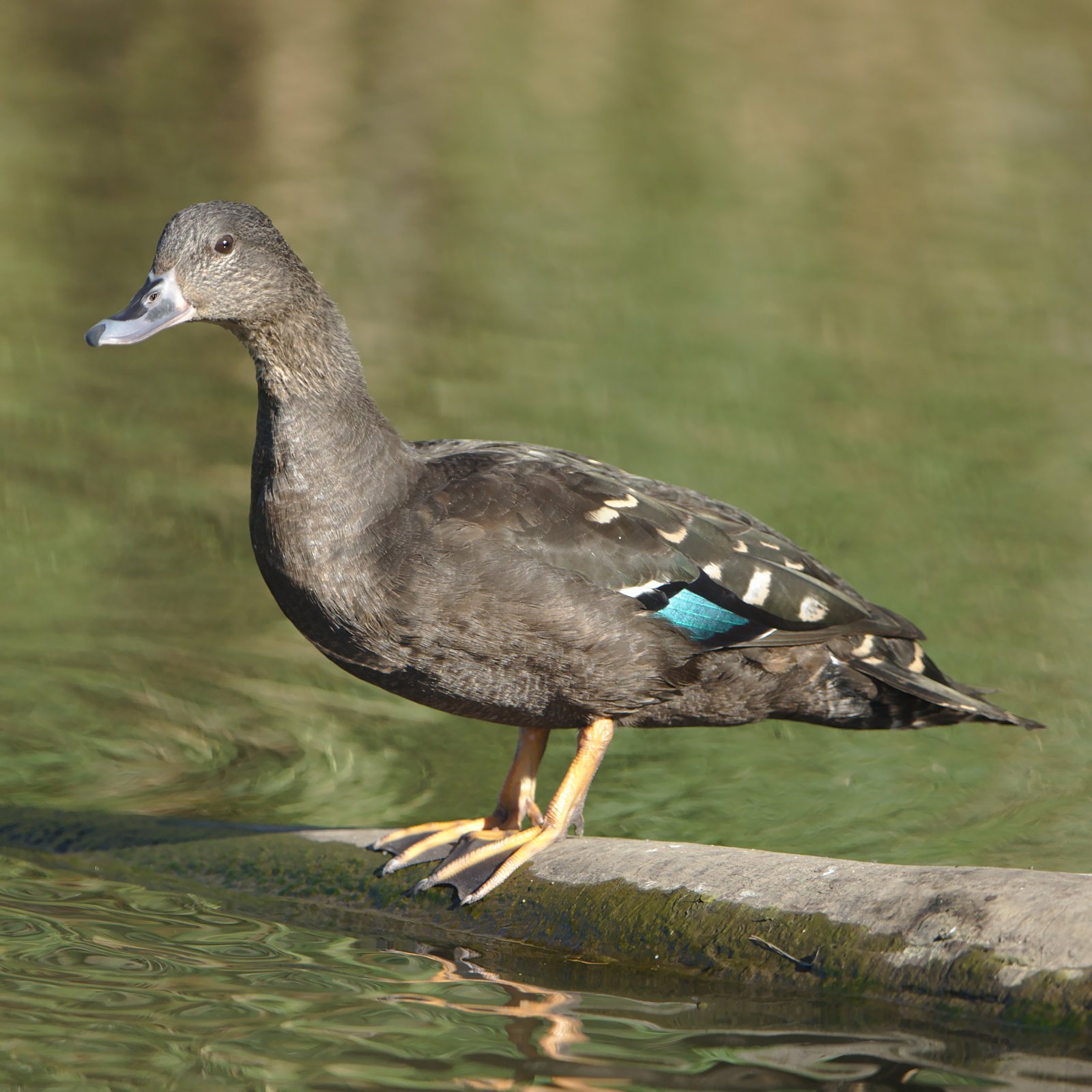
The African Black Duck is the duck of fast-flowing streams and rivers in hill and mountain country: a dark, shy dabbler that occupies a stretch of river in permanent pairs. The white spots on the back and the orange legs make it unmistakable at close range.
Click a thumbnail to switch the photo above.
Voice
The female gives loud, hoarse series of quacks, quack-quack-quack, mainly at dusk and in flight; the male a soft whistled peep.
Recording: Walter Wallner — CC BY-NC-SA 4.0 · converted to mono · xeno-canto
Identification
48–57 cm. The plumage is blackish-brown with conspicuous white or buffy-white bars on the back and scapulars and a white spot at the tail base. The bill is slate-grey with a black culmen and tip; the legs are orange-yellow. In flight it shows a glossy blue-green to purple speculum bordered white in front and behind, and white underwings. The sexes are alike; the male is larger. Juveniles are browner with duller spots and a paler belly.
Confusion species
Yellow-Billed Duck Anas undulata is greyer-brown and scaled, with a bright yellow bill and no white back spots. The female Mallard Anas platyrhynchos is paler brown and mottled, with an orange-brown bill and a pale tail. Knob-Billed Duck Sarkidiornis melanotos has a white head and neck speckled black and a glossy black back.
Habitat
Fast-flowing streams and rivers with rocks, rapids and wooded banks, from the coast high into the mountains. It dabbles in the current and among stones for larvae, crustaceans, seeds and fallen fruit, mainly at dusk. By day it rests under overhanging branches or on a rock in midstream. Outside the breeding season it also uses dams and reservoirs, usually along sheltered margins.
Where the bird is most at home, classified by the vegetation units of southern Africa.


Range and movements
Mainly in the east and south: in South Africa from the Western Cape along the south coast and through the east to Mpumalanga and Limpopo, Lesotho and Eswatini, then the eastern highlands of Zimbabwe and the mountains of Mozambique and Malawi, northern and north-western Zambia and the highlands of Angola; absent from the dry western interior, but occurs along the Orange River. Beyond the region in East Africa to Ethiopia and in isolated populations in West and Central Africa.
- Resident
- Summer visitor (c. Oct–Mar)
- Winter visitor (c. Apr–Sep)
- Passage (Mar–Apr, Oct–Nov)
- dark = core range, pale = thinly spread
How and when to look
In early morning or late afternoon walk slowly along a wooded mountain stream and look ahead: a pair often flushes low over the water and lands further up- or downstream. Bridges over fast rivers give a good view. Outside the breeding season the species can sometimes be found on dams among other ducks, usually along the shore.
Conservation status
Not threatened, but occurs at low density because of its strict territories. Sensitive to declining water quality, erosion, removal of riverside vegetation and the building of dams that eliminate fast-flowing stretches.
Scientific name
Anas sparsa | Eyton, 1838
Eyton described the species in 1838 and placed it straight away in the genus where it still stands. The genus Anas was introduced in 1758 by Linnaeus. Anas is the Latin word for 'duck'. sparsa is Latin for 'speckled', for the white spots on the dark upperparts. The specimen the first description was based on came from South Africa.