All species › Waterfowl › Ducks and geese › Northern Shoveler
Northern Shoveler | Spatula clypeata
Slobeend | Cuchara Común
The Northern Shoveler is a widespread dabbling duck of the northern hemisphere that reaches southern Africa only in very small numbers. The long spoon-shaped bill marks it as a shoveler at once; it is separation from the common Cape Shoveler that needs care.
Click a thumbnail to switch the photo above.
Voice
Mostly silent in the region. The male gives a hollow knocking took-took, the female a series of descending nasal quacks, quack-quack-quack.
Recording: Sonothèque ADVL — CC0 · converted to mono · xeno-canto
Identification
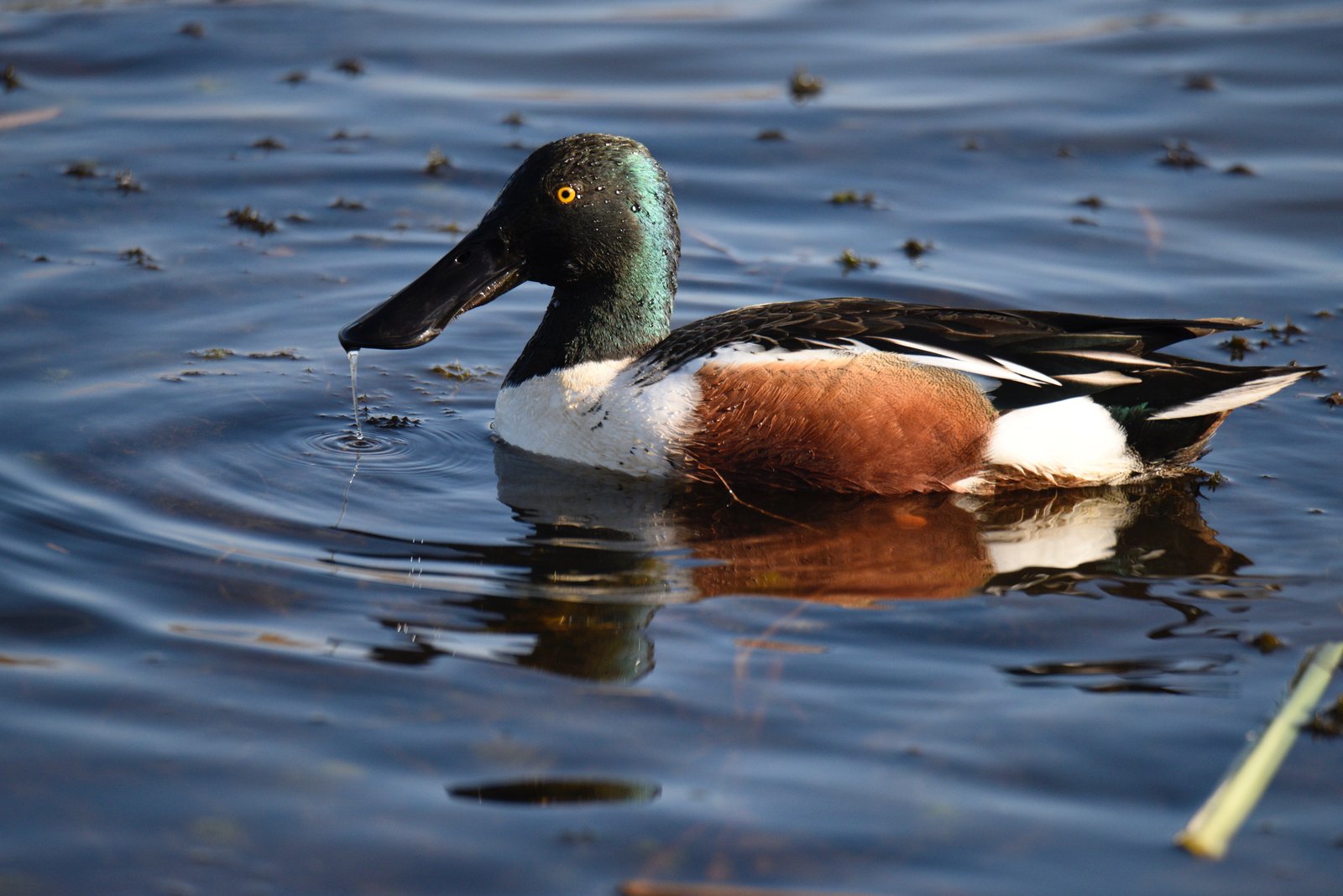
44–52 cm, with a very large spatulate bill and a front-heavy posture on the water. The breeding male has a glossy dark green head, a yellow eye, a white breast, chestnut flanks and belly and a black rear; in Africa males in eclipse and transitional plumage also occur. The female is warm pale brown and mottled, with a dark crown and eye-stripe, a brown eye and a grey-brown bill with orange edges. In flight it shows a pale blue forewing (greyer in the female), a white bar and a green speculum.
Confusion species
Cape Shoveler Spatula smithii is the main pitfall: it is darker and cooler grey-brown speckled throughout, with an all-black bill lacking orange edges, a dark tail and, in the male, a grey head with a yellow eye. The breeding male Northern Shoveler, with green head and white breast, is unmistakable. Other dabbling ducks have narrower bills.
Habitat
Shallow, nutrient-rich fresh and brackish water: sewage ponds, dams, vleis and pans. It sieves the surface for zooplankton, small aquatic insects and seeds, often among flocks of Cape Shoveler and other dabbling ducks.
Where the bird is most at home, classified by the vegetation units of southern Africa.

Range and movements
Rare and irregular; records mainly from Zambia, Zimbabwe, Malawi, Botswana, Namibia and South Africa, usually of single birds. For birds on park ponds or near habitation, escape from captivity cannot be excluded. It breeds across most of Europe, Asia and North America and winters south to North and East Africa, South Asia and Central America.
How and when to look
Check flocks of Cape Shoveler at sewage works for a paler, warmer brown bird with orange in the bill edges. A male in breeding plumage between January and March is straightforward. When recording a bird, note whether it carries rings or behaves unusually tamely.
Conservation status
Not threatened and among the most numerous ducks of the northern hemisphere. In the region a rarity without significance for the world population.
Scientific name
Spatula clypeata | (Linnaeus, 1758)
Linnaeus described the species in 1758 as Anas clypeata; because it was later moved to another genus, the author and year stand in brackets. The genus Spatula was introduced in 1822 by Boie. Spatula is Latin for 'spoon' or 'spatula', after the broad, spoon-shaped bill of the shoveler. clypeata is Latin for 'shield-bearing', from clypeus 'shield'. The specimen the first description was based on came from southern Sweden.