All species › Cranes, rails and allies › Rails and crakes › African Crake
African Crake | Crecopsis egregia
Afrikaanse kwartelkoning | Guión Africano
The African Crake is a compact, short-billed rail of moist grassland that moves south into southern Africa with the summer rains. It is often easy to see by day on grassy road verges and is much less secretive than most rails.

Voice
A rapid series of dry, grating notes, krrr-krrr-krrr-krrr, often long repeated, in the morning, the evening and also at night. Also a sharp kip in alarm.
Recording: Barry Edmonston — CC BY-NC-SA 4.0 · converted to mono · xeno-canto
Identification
About 21 cm, compact, with a short, stout pinkish-grey bill and a red eye. The upperparts are olive-brown with broad black feather centres, so that the back looks heavily blotched. The face, foreneck and breast are blue-grey, with a pale supercilium; the flanks, belly and undertail are strikingly and broadly barred black and white. The legs are greyish brown. The sexes are alike; juveniles are duller and browner. In flight it shows a short, dark wing without rufous, with the legs trailing.
Confusion species
The Corn Crake (Crex crex) is larger and paler, buffy with rufous wings that stand out in flight, and lacks crisp black-and-white barring. The African Rail (Rallus caerulescens) is larger, with a long red bill and an unmarked back, and lives in reeds. The Spotted Crake (Porzana porzana) is spotted white and has a yellow bill with a red base.
Habitat
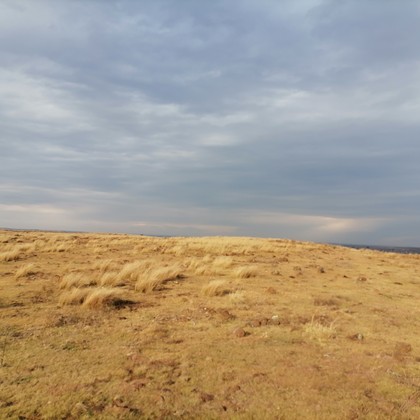
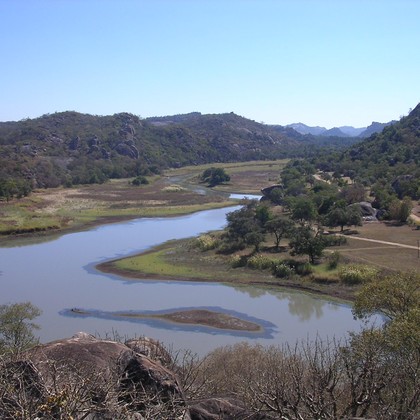
Moist and seasonally flooded grassland, grassy floodplains, the margins of vleis and dambos, tall grass in open woodland and road verges, usually not in dense marsh vegetation. It eats insects, worms, snails, small frogs and seeds. The nest is a shallow cup in a grass tuft on the ground.
Where the bird is most at home, classified by the vegetation units of southern Africa.

Range and movements
In the rainy season in the north and east of the region: Angola, Zambia, Malawi, Mozambique, Zimbabwe, northern Botswana and Namibia (Caprivi), and in South Africa mainly in Limpopo, Mpumalanga and KwaZulu-Natal, rarer further south. In the far north some birds remain all year. Beyond the region across much of sub-Saharan Africa, from Senegal to Kenya.
- Resident
- Summer visitor (c. Oct–Mar)
- Passage (Mar–Apr, Oct–Nov)
- dark = core range, pale = thinly spread
How and when to look
In summer, after the first good rains, drive slowly along grassy road verges and floodplains, for example in the Kruger Park, the Okavango or on the Zambian floodplains: the bird often walks in the open across a track or stands on a verge. Early in the season it calls a lot.
Conservation status
Not threatened and fairly common in suitable grassland. There are local declines through conversion of moist grassland to cropland and intensive grazing; numbers in the south fluctuate strongly with rainfall.
Scientific name
Crecopsis egregia | (Peters, 1854)
Peters described the species in 1854 as Ortygometra (Crex) egregia; because it was later moved to another genus, the author and year stand in brackets. The genus Crecopsis was introduced in 1893 by Sharpe. Crecopsis combines Crex, the genus of the Corn Crake, with the Greek opsis, 'appearance' — thus 'resembling a Corn Crake'. egregia is Latin for 'excellent, outstanding'. The specimen the first description was based on came from Tete, Mozambique.