All species › Cranes, rails and allies › Rails and crakes › Corn Crake
Corn Crake | Crex crex
Kwartelkoning | Guión de Codornices
The Corn Crake is a Eurasian breeder that spends the northern winter in the east of southern Africa. In its winter quarters it is almost always silent and hides in tall grass; most sightings are of birds briefly flushed during mowing or when walking through grass.
Voice
Almost silent in Africa. The familiar breeding call, a dry, two-part rasping crex-crex, like a comb drawn over a matchbox, is heard here only rarely, sometimes shortly before departure in March.
Recording: Marketa Rusarova — CC BY-NC-SA 4.0 · shortened to the first 60 s, mono · xeno-canto
Identification
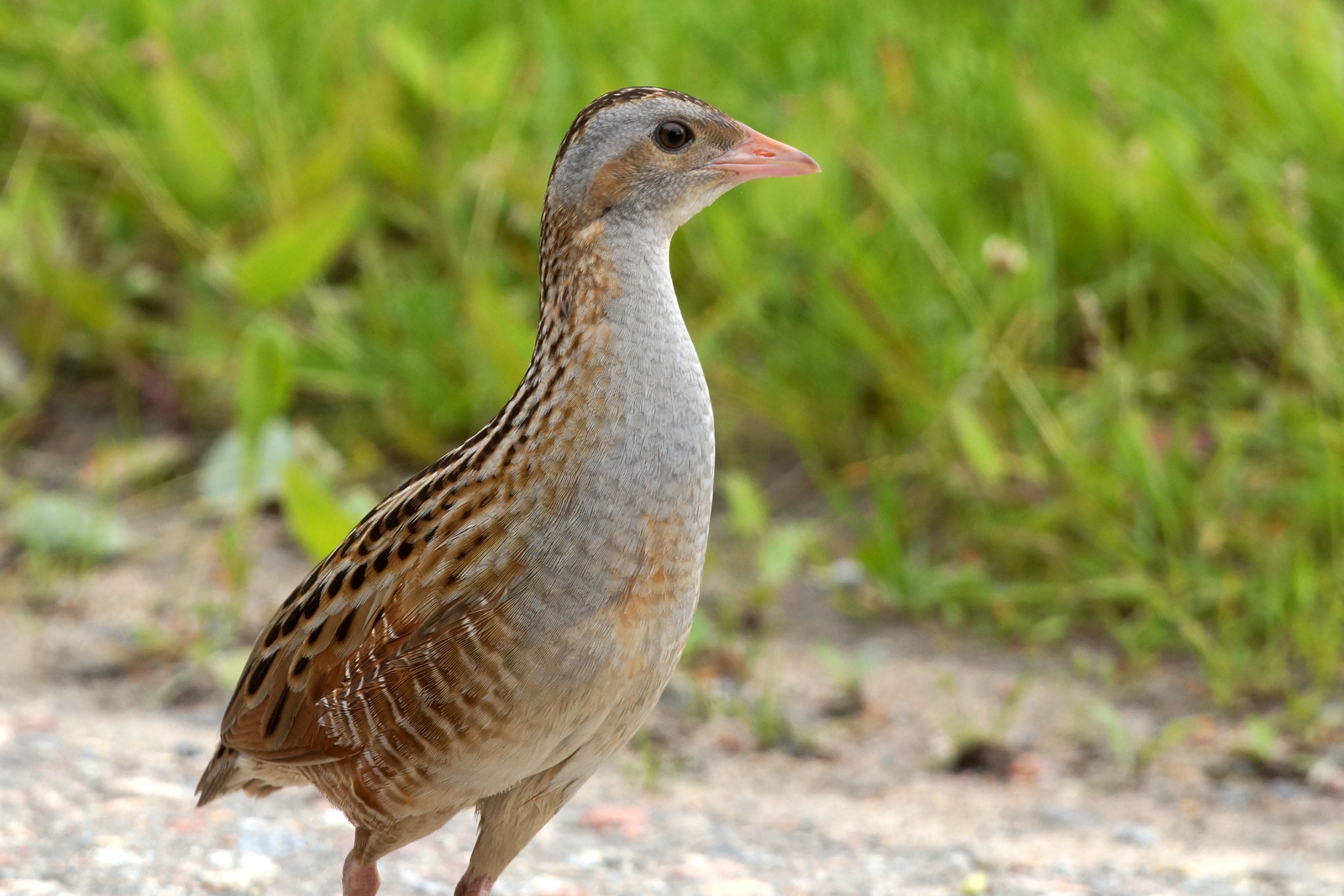
About 28 cm, a slim, gamebird-like rail with a short, stout bill. The plumage is buffy brown with black feather centres on the upperparts, a greyish supercilium and neck side, and rufous barring on the flanks. The wing coverts are bright rufous, which is obvious at once in flight. In flight the legs dangle and the flight looks weak and fluttering, though the bird often flies further than expected. Outside the breeding season the grey on head and breast is reduced and browner; the sexes are hardly separable in the field.
Confusion species
The African Crake (Crecopsis egregia) is smaller and darker, with a blue-grey breast, crisply black-and-white barred flanks and no rufous in the wing. The Common Quail (Coturnix coturnix) is smaller, flies fast and straight on rapid wingbeats and has neither dangling legs nor rufous wings. Buttonquails, such as the Common Buttonquail (Turnix sylvaticus), are much smaller and show a pale wing panel on dark flight feathers.
Habitat
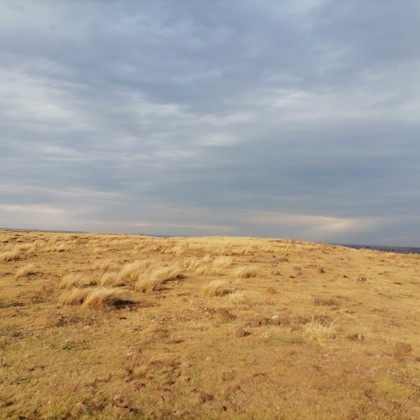
Tall, dense and moist grassland, often at mid to high altitude, as well as old fields, grassland around vleis and hay meadows. It avoids truly wet marsh and bare ground. It eats insects, worms, snails and seeds.
Where the bird is most at home, classified by the vegetation units of southern Africa.


Range and movements
Mainly in the east of the region: the Highveld and midlands of Mpumalanga, KwaZulu-Natal, the Eastern Cape and the Free State, further in Eswatini, Lesotho, Zimbabwe, Zambia, Malawi and western Mozambique; scarce to vagrant in Botswana, Namibia and the south-west. It breeds from Western Europe to central Siberia and winters almost entirely in eastern and southern Africa.
- Summer visitor (c. Oct–Mar)
- dark = core range, pale = thinly spread
How and when to look
The best chances are during the mowing of hay meadows on the Highveld and in the KwaZulu-Natal midlands in January and February, or when walking through tall grassland with a small group. Watch for a rufous, weak-looking bird flying off low with legs dangling and dropping into the grass after some fifty metres.
Conservation status
Not threatened; after steep declines in Western Europe caused by early mowing of hay meadows, the large populations in Eastern Europe and Russia have stabilised. In southern Africa, conversion of tall grassland to crops and plantations, overgrazing and early mowing threaten the wintering areas.
Scientific name
Crex crex | (Linnaeus, 1758)
Linnaeus described the species in 1758 as Rallus Crex; because it was later moved to another genus, the author and year stand in brackets. The genus Crex was introduced in 1803 by Bechstein. Crex comes from Ancient Greek krex and is onomatopoeic, after the grating, repeated call. The specific name repeats the genus name. The specimen the first description was based on came from Sweden.