All species › Cranes, rails and allies › Rails and crakes › Red-Knobbed Coot
Red-Knobbed Coot | Fulica cristata
Knobbelmeerkoet | Focha Moruna
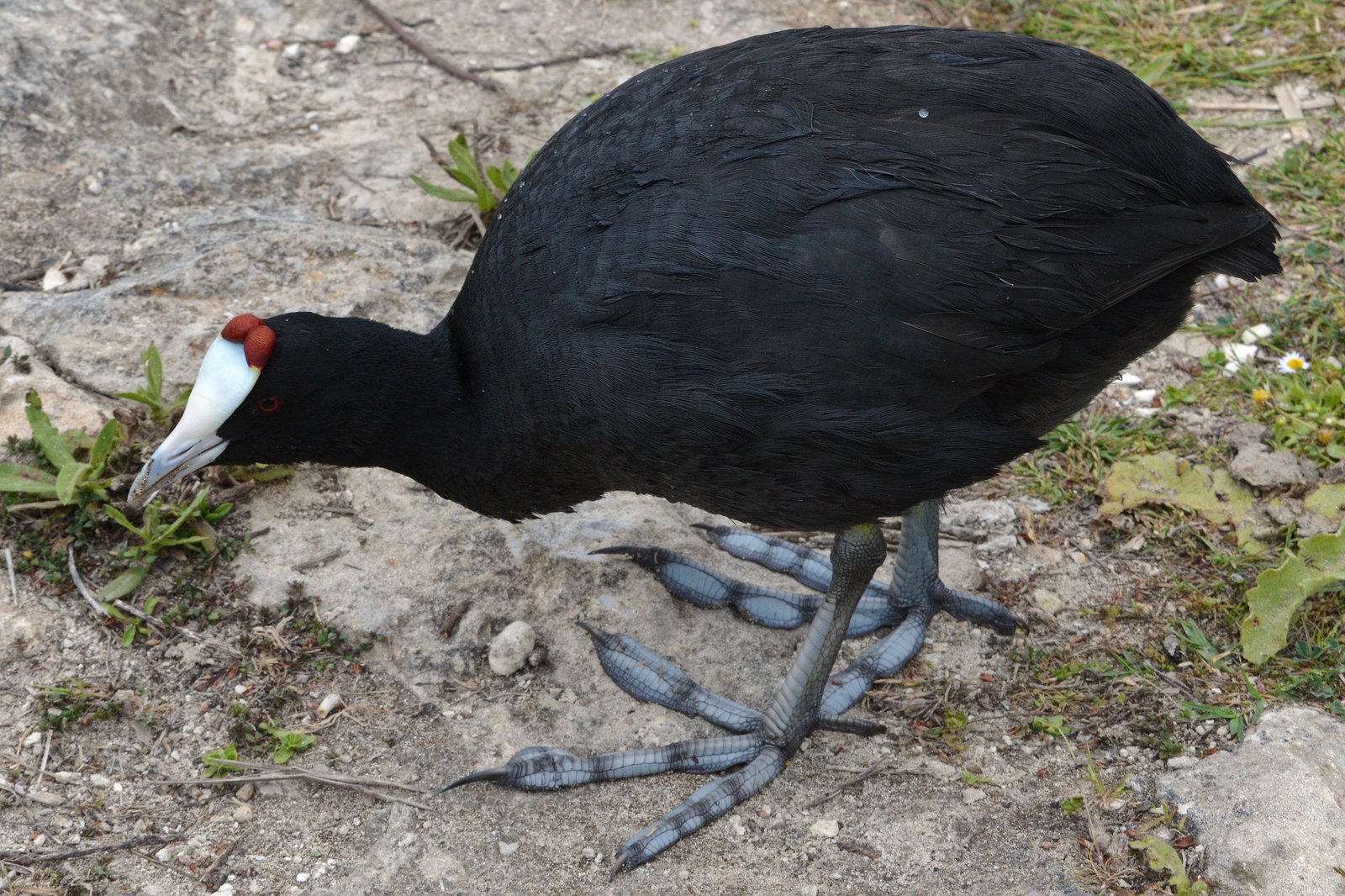
The Red-Knobbed Coot is the only coot of southern Africa: a dumpy, slate-coloured waterbird with a white bill and white frontal shield topped by two dark red knobs. On dams and pans of the Highveld and the Cape it can gather in thousands.
Voice
A sharp, metallic kruk or krik and a penetrating short pook, often a jumble of calls in a busy colony. Territorial disputes bring audible splashing and hissing as birds charge each other with spread wings.
Recording: African Bioacoustics Community — CC BY-NC-SA 4.0 · converted to mono · xeno-canto
Identification
About 43 cm, wholly dull blackish grey with a slightly blacker head and neck. Bill and frontal shield are ivory white; on top of the shield sit two dark red knobs that swell in the breeding season and may be small and inconspicuous outside it. The eye is red. The legs are grey-green with broad lobed toes. No white trailing edge to the wing in flight. The sexes are alike. Juveniles are grey-brown with a pale throat and foreneck and a greyish bill without knobs. It swims with a nodding head and often makes short dives for water plants; it patters over the water before taking off.
Confusion species
No other coot occurs in the region. The Common Moorhen (Gallinula chloropus) is smaller and slimmer, with a red bill tipped yellow, a red frontal shield, a white flank line and white sides to the undertail. The Purple Swamphen (Porphyrio porphyrio) is larger, purple-blue with a red bill and shield and long red legs. At close range the knobs and the lack of a white wing bar rule out vagrant Eurasian Coots from the north.
Habitat
Open fresh water with submerged vegetation: dams, lakes, pans, vleis, sewage works and brackish lagoons. It eats mainly water plants, algae and seeds, supplemented by invertebrates, and also grazes grass at the shore. The nest is a floating or reed-anchored platform of plant material. Outside the breeding season it gathers in large flocks on open water.
Where the bird is most at home, classified by the vegetation units of southern Africa.

Range and movements
Common in South Africa, Lesotho and Eswatini, especially on the Highveld, in the Free State and the Western Cape; also in Namibia, Botswana and Zimbabwe, and scarcer and more local in Mozambique, Zambia, Malawi and southern Angola. Beyond the region in East Africa north to Ethiopia, on Madagascar and, rarely, in Morocco and southern Spain.
- Resident
- Summer visitor (c. Oct–Mar)
- Winter visitor (c. Apr–Sep)
- Passage (Mar–Apr, Oct–Nov)
- dark = core range, pale = thinly spread
How and when to look
All year on almost any larger dam on the Highveld, in the Free State and the Cape; the largest concentrations are on permanent waters in the dry winter. In spring look closely at the swollen red knobs and at the well-known territorial fights, in which birds charge across the water at each other with raised wings.
Conservation status
Not threatened and numerous in southern Africa; the building of farm dams and sewage ponds has benefited the species greatly. Numbers fluctuate with rainfall and water levels. In Europe, however, the small population in Andalusia is seriously threatened.
Scientific name
Fulica cristata | Gmelin, 1789
Gmelin described the species in 1789 and placed it straight away in the genus where it still stands. The genus Fulica was introduced in 1758 by Linnaeus. Fulica is the Latin word for a coot. cristata is Latin for 'crested', from crista 'crest', after the two red knobs above the frontal shield. The specimen the first description was based on came from Madagascar.