All species › Cranes, rails and allies › Rails and crakes › Striped Crake
Striped Crake | Aenigmatolimnas marginalis
Afrikaans porseleinhoen | Polluela Culirroja
The Striped Crake is a small, shy rail of seasonally flooded grassland that arrives from the north with the summer rains and rarely shows itself. It is one of the few rails in which the female is more boldly coloured than the male.
Voice
A fast series of dry ticking notes, tik-tik-tik-tik, like a ticking clock, often at night; also a frog-like croak and a soft rattle. Mostly heard soon after the breeding site floods.
Recording: Niall Perrins — CC BY-NC-SA 4.0 · converted to mono · xeno-canto
Identification
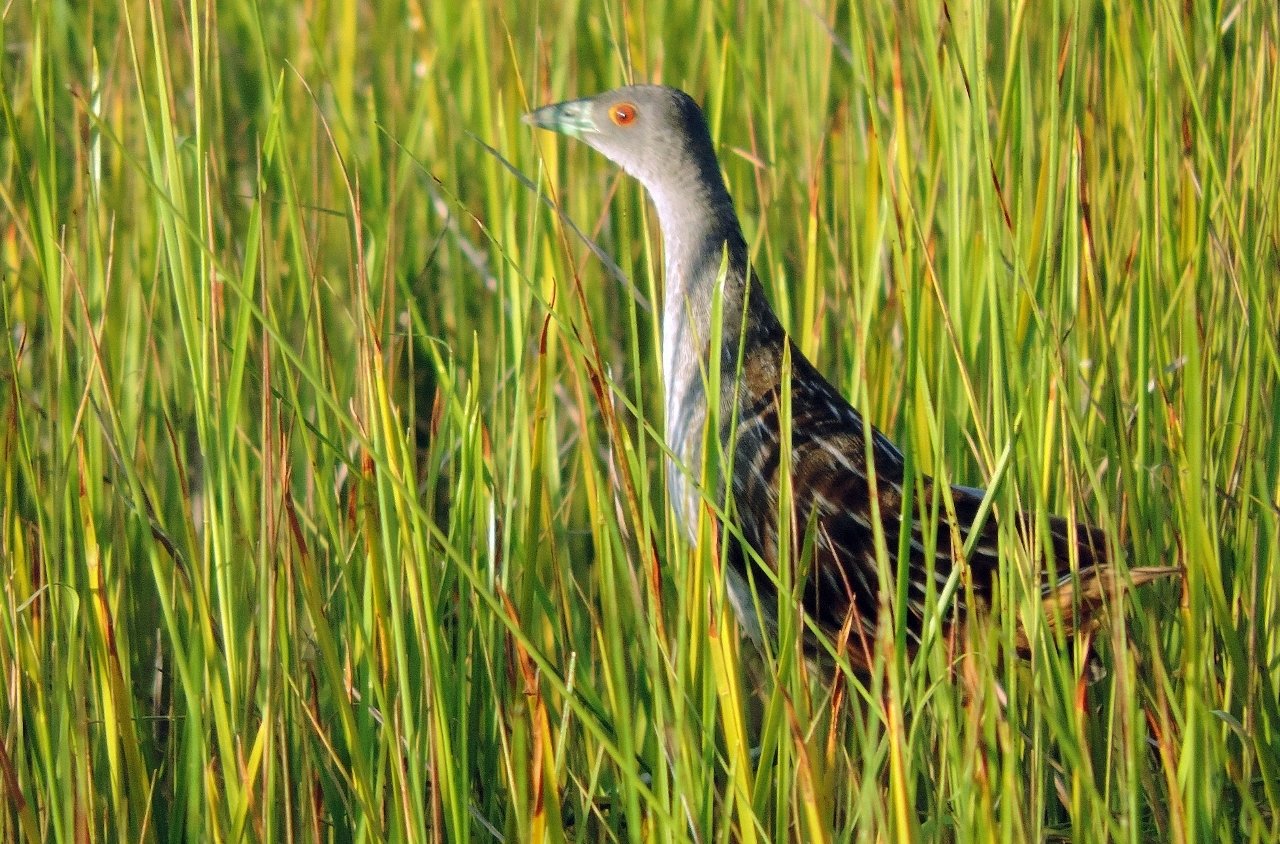
About 20 cm, with a short, thick greenish bill and long green legs. The male is warm brown above with conspicuous white longitudinal streaks on the back and wing coverts, a rufous-brown head, neck and breast sides, a buffy to pale grey belly and a rufous undertail. The female has a slate-grey breast and belly, a browner head and similar white streaking above. Juveniles resemble the male but are duller. It walks with a flicking tail.
Confusion species
The Spotted Crake (Porzana porzana) is larger, densely spotted white on the head and breast, with a yellow, red-based bill and a buff undertail. Baillon's Crake (Zapornia pusilla) has a black-and-white barred undertail and flanks and no longitudinal streaks. The African Crake (Crecopsis egregia) has a blue-grey breast and black-and-white barred flanks. Juvenile Lesser Moorhens (Paragallinula angulata) are larger and lack the white streaks.
Habitat
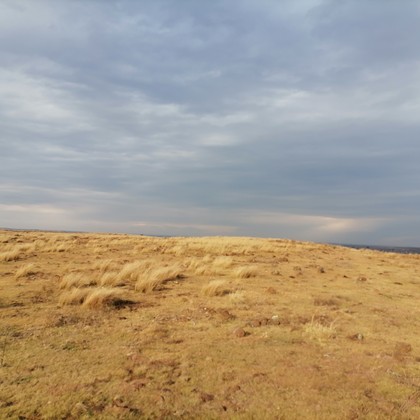
Seasonally flooded grassland, vleis and floodplains with dense, short grass and sedges in shallow water, and the edges of rice fields. It avoids permanent reedbeds. It eats insects, spiders, snails and seeds.
Where the bird is most at home, classified by the vegetation units of southern Africa.

Range and movements
An irregular summer visitor to the north and east of the region: Angola, Zambia, Malawi, Mozambique, Zimbabwe, northern Botswana and the Zambezi Region of Namibia; rare in South Africa, mainly in KwaZulu-Natal, Limpopo and Mpumalanga. Beyond the region across much of sub-Saharan Africa, particularly where seasonal grassland marshes occur.
- Summer visitor (c. Oct–Mar)
- dark = core range, pale = thinly spread
How and when to look
One of the hardest rails in the region. The best chance is in a wet summer, January to March, in newly flooded grassland at dawn or in the evening, listening for the ticking call. A bird briefly crossing an open patch shows the white back streaks.
Conservation status
Not globally threatened, but poorly known and probably under-recorded. It depends on seasonal grassland marshes, which are lost to drainage, overgrazing and conversion to cropland.
Scientific name
Aenigmatolimnas marginalis | (Hartlaub, 1857)
Hartlaub described the species in 1857 as Porzana marginalis; because it was later moved to another genus, the author and year stand in brackets. The genus Aenigmatolimnas was introduced in 1932 by Peters. Aenigmatolimnas comes from the Greek ainigma, 'riddle', and limnas, 'marsh-dweller' — presumably for this crake's long-puzzling relationships. marginalis is Latin for 'bordered' — for the pale feather edges that give the plumage its striped look. The specimen the first description was based on came from Gabon.