All species › Cranes, rails and allies › Cranes › Blue Crane
Blue Crane | Grus paradisea
Paradijskraanvogel | Grulla del Paraíso
The Blue Crane is blue-grey, with a strikingly large, bulbous head and a long train that drags over the ground — not a tail, but greatly elongated inner wing feathers. The species is almost confined to southern Africa and is South Africa's national bird. It is the smallest of the region's cranes.

Voice
A loud, nasal, rattling trumpet, kraaark, higher pitched than the region's other cranes and audible for kilometres over open grassland. Pairs call in duet with the head angled upwards. It also calls in flight and as a flock takes off.
Recording: JJSUN — CC BY-NC-SA 4.0 · converted to mono · xeno-canto
Identification
100–120 cm tall, wingspan 180–200 cm. Uniform blue-grey, with a broad, bulbous head whose crown and forehead are paler grey-white; the neck feathers can be raised into a hood. The bill is short and pinkish grey at the base. The elongated dark grey inner secondaries hang as two trailing plumes to the ground. The sexes are alike; the male is slightly larger. Juveniles are duller tawny-grey, lack the trailing plumes and have a less bulbous head. In flight the neck is held straight out and the feet barely project beyond the tail; the black primaries contrast sharply with the blue-grey wing.
Confusion species
Grey Crowned Crane Balearica regulorum has a straw-coloured crown of stiff feathers, white cheek patches and a red throat wattle. Wattled Crane Grus carunculata is much larger, with a white neck, two feathered wattles and a dark belly. No other bird in the region is uniform blue-grey with trailing plumes.
Habitat
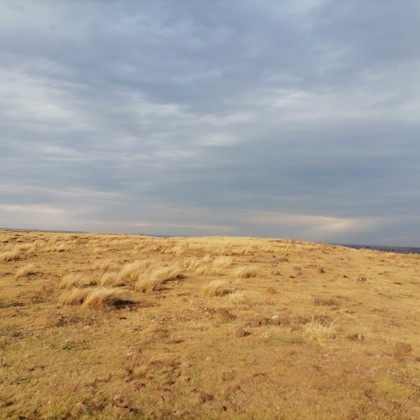
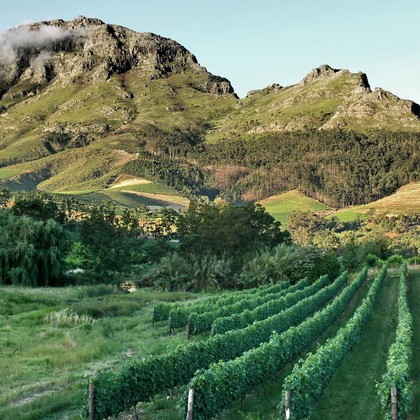
Open short grassland and the edges of the Karoo, and increasingly farmland: wheat stubble, freshly harvested fields, fallow and pasture. It breeds in short grassland and in the flat, wet hollows of the uplands, often within a few hundred metres of water. It roosts standing in the shallow water of vleis and dams.
Where the bird is most at home, classified by the vegetation units of southern Africa.
Range and movements
Almost endemic to southern Africa. The core lies in South Africa: the grain districts of the Overberg and Swartland in the Western Cape, the eastern Karoo, the Eastern Cape highlands, the KwaZulu-Natal midlands and the Free State and Mpumalanga highveld, together with Lesotho and Eswatini. A small isolated population lives around the Etosha Pan in northern Namibia. Occurrence in Botswana, Zimbabwe and Eswatini has dwindled to a few birds; beyond southern Africa the species is absent.
- Resident
- Summer visitor (c. Oct–Mar)
- Winter visitor (c. Apr–Sep)
- Passage (Mar–Apr, Oct–Nov)
- dark = core range, pale = thinly spread
How and when to look
In the grain districts of the Overberg, which hold most of the world population, the birds can be seen year-round; from March to August flocks of tens to hundreds stand on stubble fields and freshly ploughed land. Drive the farm roads early in the morning and listen for the rattling trumpet; families with a chick keep apart from the flock.
Conservation status
Vulnerable on the Red List. From the 1970s to the 1990s numbers fell sharply through poisoning, collisions with power lines and the conversion of grassland to timber plantations. In the Western Cape grain districts the population has since increased, while numbers in the grassland core declined further; in 2025 the species was raised to Vulnerable on the national scale in South Africa. Marking power lines and stewardship agreements with crop farmers are the main measures.
Scientific name
Grus paradisea | (Lichtenstein, 1793) (GBIF: Anthropoides paradiseus)
Lichtenstein described the species in 1793 as Ardea paradisea; because it was later moved to another genus, the author and year stand in brackets. The genus Grus was introduced in 1760 by Brisson. Grus is the Latin word for 'crane'. paradisea is Latin for 'of paradise', for the ornate, plume-like plumage that recalls birds-of-paradise. The specimen the first description was based on came from inner South Africa.