All species › Cranes, rails and allies › Cranes › Wattled Crane
Wattled Crane | Grus carunculata
Lelkraanvogel | Grulla Carunculada
The Wattled Crane is the largest and rarest crane in Africa: a tall grey bird with a white neck and two white feathered wattles hanging below the chin. It is more tightly tied to extensive shallow wetlands than other cranes and usually raises only one chick a year.
Voice
Quieter than the other cranes. A loud, harsh kwarrk audible at long range as an alarm, and a high, drawn-out horrrk in duet, with the male throwing back his head. Young birds give high, thin peeps.
Recording: Dries Van de Loock — CC BY-NC-SA 4.0 · converted to mono · xeno-canto
Identification
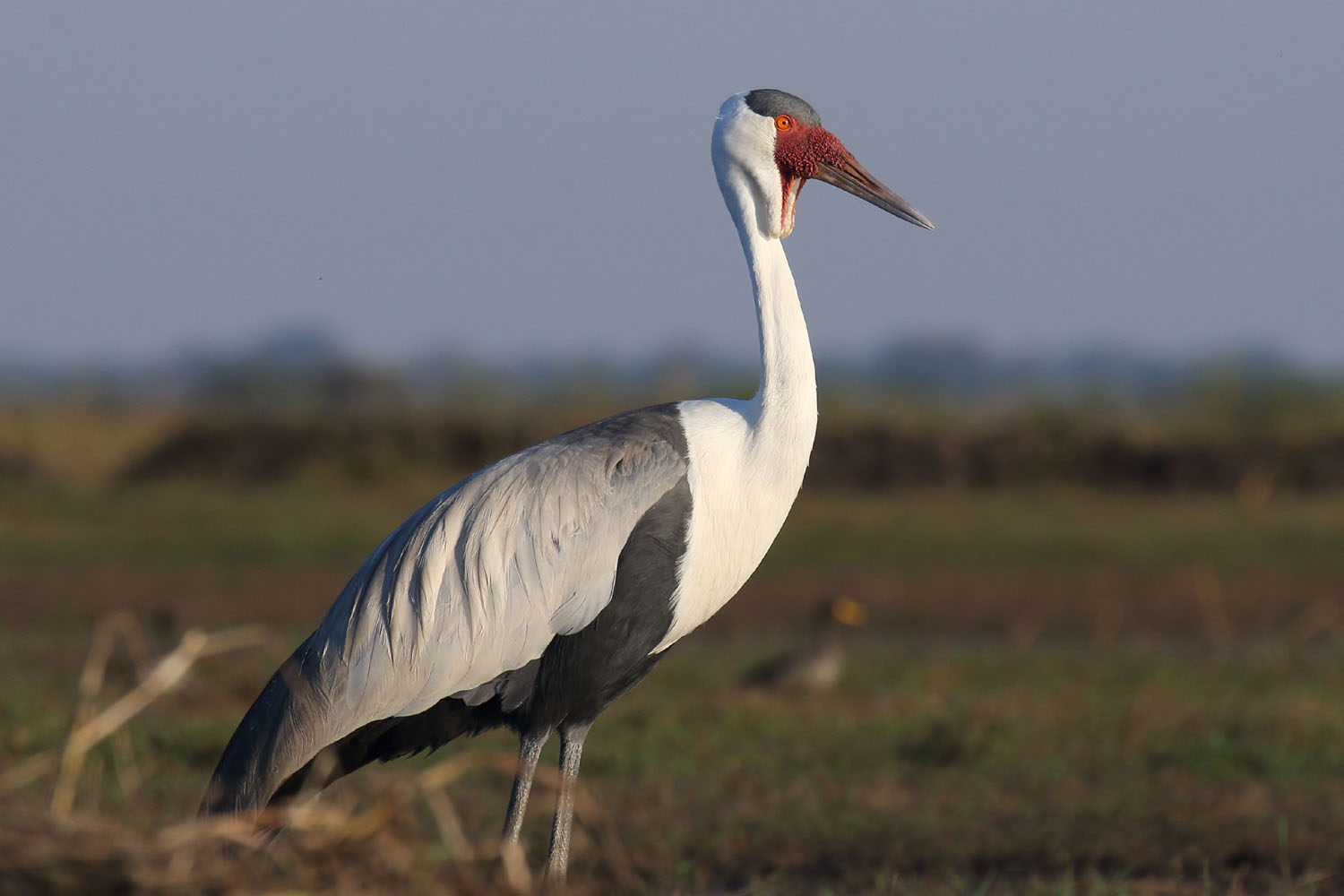
150–175 cm long, wingspan 230–260 cm, one of the longest flying birds in the region. Back and wings are pale grey, and the long, curved inner secondaries hang as a grey train over the tail. Head and neck are white, the crown dark slate-grey, and the bare, red, warty skin in front of the eye extends to the base of the bill. The two wattles are feathered white, often with a red edge at the base. Breast, belly and primaries are black. The bill is long and reddish brown, the legs dark grey. The sexes are alike; the male has longer wattles. Juveniles have a white head without the red face, shorter wattles and a brownish wash on the back.
Confusion species
Grey Crowned Crane Balearica regulorum is smaller, with a golden crown and a red throat wattle. Blue Crane Grus paradisea is smaller and uniform blue-grey, without a white neck. In flight it can recall a large stork such as Saddle-Billed Stork Ephippiorhynchus senegalensis, but the contrast of white neck, grey wings and black underparts is distinctive.
Habitat
Large shallow wetlands, permanent or seasonal, and flooded grassland, and in the uplands wet vleis with sedges and rushes. It digs with its long bill for the tubers of sedges and water lilies, which form the bulk of its food; also seeds, insects, snails and frogs. The nest is a mound of plant material in shallow water, often surrounded by open water.
Where the bird is most at home, classified by the vegetation units of southern Africa.


Range and movements
The core of the world population lies in Zambia: the Kafue Flats, Liuwa Plain, Bangweulu and Busanga. Further in the Okavango Delta and Linyanti area of Botswana, the Zambezi Region of Namibia, eastern Angola along the upper Zambezi, the Zambezi Delta in Mozambique, the Nyika Plateau in Malawi, and sparsely in Zimbabwe. In South Africa a small isolated population remains, mainly in the KwaZulu-Natal midlands, with a few pairs in Mpumalanga and the Eastern Cape. Beyond the region it is isolated in the Ethiopian highlands and scattered in Tanzania and south-eastern DR Congo.
- Resident
- dark = core range, pale = thinly spread
How and when to look
Most reliable on the Kafue Flats and Liuwa Plain in Zambia and in the Okavango Delta, where in the dry season flocks of tens of birds feed on the floodplains. In South Africa the vleis around Underberg and the KwaZulu-Natal midlands are the best places; keep your distance from breeding pairs, which are sensitive to disturbance.
Conservation status
Vulnerable on the Red List; the world population is estimated at some eight thousand birds and is declining. Threats are the loss of wetlands to dams, altered flood regimes on the Kafue Flats and elsewhere, drainage and agriculture, as well as collisions with power lines and disturbance at breeding sites. In South Africa numbers have grown after thirty years of conservation to just over three hundred birds in KwaZulu-Natal, and in 2025 the species was downlisted there from Critically Endangered to Endangered on the national scale.
Scientific name
Grus carunculata | (Gmelin, 1789)
Gmelin described the species in 1789 as Ardea carunculata; because it was later moved to another genus, the author and year stand in brackets. The genus Grus was introduced in 1760 by Brisson. Grus is the Latin word for 'crane'. carunculata is Latin for 'wattled' — for the two feathered wattles below the chin. The specimen the first description was based on came from Cape of Good Hope.